


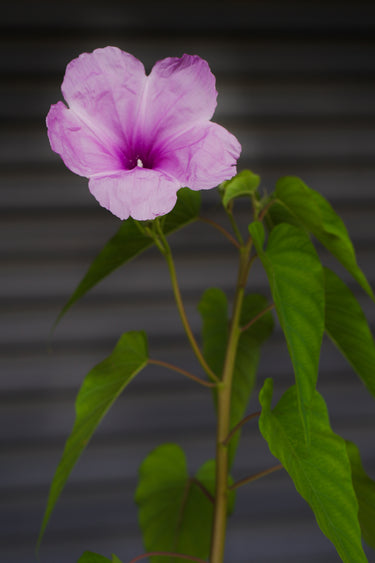


Bush Morning Glory
Ipomoea fistulosa
Pickup currently unavailable at Aiken Nursery
Seen from across a summer garden, Ipomoea fistulosa could pass for one of the great perennial hibiscus, a big soft-wooded bush hung with pink funnels. Look closer and the flowers give the game away: these are true morning glories, five-petaled trumpets in shell to lavender-pink with a deeper throat, carried in loose clusters above broad, bright green leaves. Better known to botanists as Ipomoea carnea subspecies fistulosa, the bush morning glory breaks the family mold by climbing nothing at all, standing instead as an upright shrub six to ten feet tall.
The species hails from the seasonally wet lowlands of tropical South America, Brazil and the neighboring countries, where the plant colonizes ditches, riverbanks, and pond margins with cheerful speed. That vigor has carried the bush morning glory around the warm world as an ornamental and, more practically, as a living fence: set as cuttings in a row, the fast, pithy stems knit into a flowering hedge in a single season. Gardeners in the Deep South have long grown the plant for the same reason, a quick, generous mass of tropical color through the hottest months when many borders flag.
For all the charm, the bush morning glory carries a serious reputation, and honesty serves the gardener better than romance here. Every part of the plant is poisonous, holding the alkaloid swainsonine, produced by a fungal partner living in the tissues, along with related calystegines, and the leaves and seeds can accumulate selenium besides. Livestock that graze the plant in the South American homeland develop a slow, ruinous poisoning that damages the nervous system, and goats prove especially vulnerable. None of this troubles an ornamental planting kept away from grazing animals, but the plant belongs well clear of pastures, and the foliage should never be offered to stock.
In the ornamental garden the bush morning glory wants sun, space, and rich, moist soil, and repays all three with a fast tropical presence at the back of a bed or along a pond edge. In zones 8 and 9 the top growth is killed by frost, and the Woodlanders method for carrying the crown through winter is worth following: after frost blackens the stems, cut the plant back, mound about ten inches of coarse sand over the stubs, and mulch over that with pine straw. As the weather warms, pull the covering away so the new shoots can rise, and given water and feeding the plant will build to a full summer show once more. Photo courtesy of Allan Boatman.
- Hardiness
- USDA Zones 8–11
- Sun
- Full Sun, Part Shade
- Soil
- Well-drained, Moist
- Mature size
- Height 6–9 Feet · Spread 4–5 Feet
- Growth rate
- Fast
- Seasonality
- Dies back, depends on zone
From rooting to shipping, our top priority is ensuring you receive healthy, thriving plants for your garden’s success.
Because most of our plants are grown from rooted cuttings — alongside seed, air layering, and grafting chosen for each variety — you receive a stronger, true-to-type plant that establishes quickly in your garden.
Raised on organic soil blends and eco-friendly pest management — never harsh chemicals — your plant arrives healthy for your garden, your family, and the pollinators they feed.
Every purchase gives back. We donate to the Aiken Arboretum and support local wildlife conservation, so growing your garden helps protect the wider ecosystem too.

All our plant material is carefully propagated, grown, and nurtured at our humble nursery in Aiken, South Carolina.

Your plant arrives carefully packed and ready to settle in. Unpack them promptly, give them a day or two to acclimate, then plant following the notes we include — that’s all it takes. Clear care guidance comes with every order, so success is the easy part.
What to expect upon delivery
All our plants are sold in 1-gallon sizes, though the height of each plant can vary depending on its growth rate and seasonality, typically ranging from 1/2 to 2.5 feet.
Each plant is carefully packaged with its roots enclosed in a secure plastic bag containing moist soil, forming a compact root ball. To ensure safe transport, the box is padded with recycled newspaper, providing both stability and eco-friendly protection from weather during shipping.
What is your return policy?
Review our full return policy information on our SHIPPING AND RETURNS POLICY page.
What payment methods can I use?
We offer 35 different payment methods including major providers like Mastercard, Visa, PayPal, American Express and Diners as well as many different local payment methods including Klarna, iDEAL, AliPay, Sofort, giropay, and many more.
Can I make changes to my order after it’s been placed?
At Woodlanders, we strive to fulfill orders as quickly as possible. Therefore, we can only accommodate changes to your order within the first 24 hours after it has been placed. These changes include adding or removing products and modifying the delivery address. If you need to make any changes or if there has been a mistake with your order information, please reach out to us promptly via our CONTACT page with your order number for the quickest resolution.
Your satisfaction is our priority, and we appreciate your understanding and cooperation.