


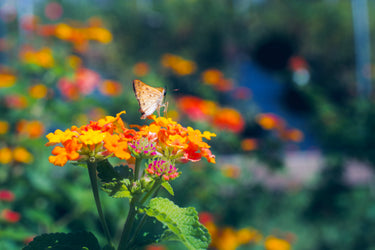


Hardy Lantana
Lantana camara 'Miss Huff'
Pickup currently unavailable at Aiken Nursery
Every so often a plant arrives not from a breeder's bench but from a neighbor's yard, and Lantana camara 'Miss Huff' is one of those happy accidents. The selection was found in cultivation near Athens, Georgia, in the garden of the Miss Huff for whom the plant is named, and introduced to the trade by the former Goodness Grows Nursery. What set this lantana apart was cold tolerance: where most of the tribe sulk and die at the first hard freeze, 'Miss Huff' has proven the hardiest lantana in commerce, with well-established clumps shrugging off brief dips to a few degrees below zero and returning faithfully from the root even in zone 7.
The species behind the cultivar belongs to the verbena family, Verbenaceae, and is almost certainly native to tropical America, though centuries of cultivation have carried Lantana camara into warm gardens and roadsides around the globe until the plant is now genuinely pantropic. The genus name is an old borrowing, taken by early botanists from a Latin name for the unrelated wayfaring tree, Viburnum lantana, whose rounded flower clusters the lantana echoes. Wherever the plant traveled, the aromatic leaves found a place in local folk medicine as poultices and infusions, though the same foliage and the green, unripe berries carry compounds called lantadenes that are toxic to grazing livestock, a reminder that this generous shrub is for looking and pollinating rather than eating.
From late spring the clumps push up on strong stems and cover themselves in domed flowerheads that open orange and age through gold to soft pink, so a single truss can carry three colors at once and the whole shrub reads like a struck match. Bloom never really pauses until frost. Butterflies find 'Miss Huff' irresistible, and swallowtails, monarchs, and skippers crowd the flowers alongside the occasional hummingbird; a near-sterility means the plant sets little seed, pouring that energy into yet more bloom instead of berries. Deer and rabbits leave the pungent foliage alone, and salt spray does the shrub no harm, which makes 'Miss Huff' as useful on a coastal lot as an inland one.
Give 'Miss Huff' room, because a happy, established clump can swell to head height and half again as wide, a summer-long fountain of color for the back of a sunny border or the center of an island bed. Full sun and soil that drains freely yet holds a little moisture suit the plant best. In the colder end of the range, plant in spring so the roots settle before winter, mound sand over the crown, and mulch well in fall to see the clump safely through; come the following May, cut the dead top to the ground and wait for the base to break. Pair the hot flowers with blue salvia, Russian sage, or ornamental grasses for a planting that hums with wings from June until the first freeze.
- Hardiness
- USDA Zones 7–10
- Sun
- Full Sun
- Soil
- Well-drained, Moist
- Mature size
- Height 4–6 Feet · Spread 4–8 Feet
- Growth rate
- Fast
- Seasonality
- Dies back, depends on zone
Orange aging to gold and pink, late spring to frost
From rooting to shipping, our top priority is ensuring you receive healthy, thriving plants for your garden’s success.
Because most of our plants are grown from rooted cuttings — alongside seed, air layering, and grafting chosen for each variety — you receive a stronger, true-to-type plant that establishes quickly in your garden.
Raised on organic soil blends and eco-friendly pest management — never harsh chemicals — your plant arrives healthy for your garden, your family, and the pollinators they feed.
Every purchase gives back. We donate to the Aiken Arboretum and support local wildlife conservation, so growing your garden helps protect the wider ecosystem too.

All our plant material is carefully propagated, grown, and nurtured at our humble nursery in Aiken, South Carolina.

Your plant arrives carefully packed and ready to settle in. Unpack them promptly, give them a day or two to acclimate, then plant following the notes we include — that’s all it takes. Clear care guidance comes with every order, so success is the easy part.
What to expect upon delivery
All our plants are sold in 1-gallon sizes, though the height of each plant can vary depending on its growth rate and seasonality, typically ranging from 1/2 to 2.5 feet.
Each plant is carefully packaged with its roots enclosed in a secure plastic bag containing moist soil, forming a compact root ball. To ensure safe transport, the box is padded with recycled newspaper, providing both stability and eco-friendly protection from weather during shipping.
What is your return policy?
Review our full return policy information on our SHIPPING AND RETURNS POLICY page.
What payment methods can I use?
We offer 35 different payment methods including major providers like Mastercard, Visa, PayPal, American Express and Diners as well as many different local payment methods including Klarna, iDEAL, AliPay, Sofort, giropay, and many more.
Can I make changes to my order after it’s been placed?
At Woodlanders, we strive to fulfill orders as quickly as possible. Therefore, we can only accommodate changes to your order within the first 24 hours after it has been placed. These changes include adding or removing products and modifying the delivery address. If you need to make any changes or if there has been a mistake with your order information, please reach out to us promptly via our CONTACT page with your order number for the quickest resolution.
Your satisfaction is our priority, and we appreciate your understanding and cooperation.