


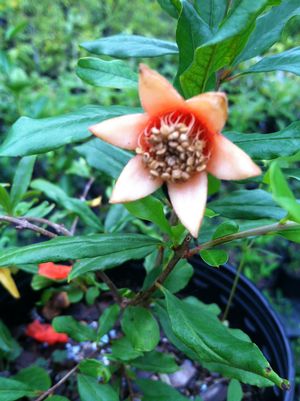

Pomegranate
Punica granatum (fruiting, from SC)
In propagation
Currently growing out 1 Gallon pots. Expected Fall 2026.
Add your name with the notify button below, and we will email you the moment this plant is ready to bring home.
Learn how we grow on The Prop House.
Pickup currently unavailable at Aiken Nursery
This is the pomegranate grown the old way, for the fruit. Punica granatum is a deciduous Middle Eastern shrub of narrow, glossy leaves and vivid orange-red flowers, followed by the large, leathery-skinned, garnet-seeded fruits for which the plant has been cultivated since antiquity. Woodlanders raised this particular selection from seed of a good fruiting specimen in upstate South Carolina, and the plant may well represent 'Wonderful', the widely grown commercial variety, proven here as a dependable cropper in the southern garden.
Few plants carry a longer human record. The pomegranate was among the first fruits brought into cultivation, spreading from Persia and the Levant across the ancient world, moving with caravans, armies, and traders until the shrub grew from Spain to India. Spanish missionaries carried the fruit to the Americas, and in the gardens of the old South the pomegranate became a dooryard fixture, tucked near back steps where the tart juice went into jelly and syrup. This South Carolina seedling continues that long southern thread.
The pomegranate has always meant more than the sum of the seeds. The many-chambered fruit is an ancient emblem of fertility and abundance, woven through Greek myth in the story of Persephone, through Jewish, Christian, and Islamic tradition, and through the astringent rind and bark that old apothecaries kept for the gut and for expelling parasites. Even the name is a history lesson: granatum, grainy or full of seeds, gave English the word grenade, while Punica points back to Carthage and the Punic peoples through whom Rome first knew the fruit.
In the garden, give the pomegranate a hot, sunny, well-drained spot and room for a multi-stemmed shrub of ten to twelve feet, or limb the plant up into a small tree. Full sun and a long, warm season bring the heaviest crop, and steady water during fruit set keeps the ripening globes from splitting. Site the shrub in an edible landscape, a Mediterranean-style planting, or a sunny border where the orange-red flowers feed pollinators and the fall fruit can be gathered, and pair with figs, rosemary, and other sun-loving companions. Drought-tolerant once established, and long-lived where winters stay mild.
- Hardiness
- USDA Zones 8–10
- Sun
- Full Sun
- Soil
- Well-drained
- Mature size
- Height 10–12 Feet · Spread 6–8 Feet
- Growth rate
- Moderate
- Seasonality
- Deciduous
Single, orange-red, tubular, late spring to summer
These statements have not been evaluated by the Food and Drug Administration. This information is shared for traditional and educational interest only and is not intended to diagnose, treat, cure, or prevent any disease. Please consult a qualified healthcare professional before any medicinal use.
- Root and stem bark contain alkaloids that are toxic in excess and should not be self-administered
- Concentrated rind and bark preparations may interact with medications
- Avoid medicinal use during pregnancy without professional guidance
From rooting to shipping, our top priority is ensuring you receive healthy, thriving plants for your garden’s success.
Because most of our plants are grown from rooted cuttings — alongside seed, air layering, and grafting chosen for each variety — you receive a stronger, true-to-type plant that establishes quickly in your garden.
Raised on organic soil blends and eco-friendly pest management — never harsh chemicals — your plant arrives healthy for your garden, your family, and the pollinators they feed.
Every purchase gives back. We donate to the Aiken Arboretum and support local wildlife conservation, so growing your garden helps protect the wider ecosystem too.

All our plant material is carefully propagated, grown, and nurtured at our humble nursery in Aiken, South Carolina.

Your plant arrives carefully packed and ready to settle in. Unpack them promptly, give them a day or two to acclimate, then plant following the notes we include — that’s all it takes. Clear care guidance comes with every order, so success is the easy part.
What to expect upon delivery
All our plants are sold in 1-gallon sizes, though the height of each plant can vary depending on its growth rate and seasonality, typically ranging from 1/2 to 2.5 feet.
Each plant is carefully packaged with its roots enclosed in a secure plastic bag containing moist soil, forming a compact root ball. To ensure safe transport, the box is padded with recycled newspaper, providing both stability and eco-friendly protection from weather during shipping.
What is your return policy?
Review our full return policy information on our SHIPPING AND RETURNS POLICY page.
What payment methods can I use?
We offer 35 different payment methods including major providers like Mastercard, Visa, PayPal, American Express and Diners as well as many different local payment methods including Klarna, iDEAL, AliPay, Sofort, giropay, and many more.
Can I make changes to my order after it’s been placed?
At Woodlanders, we strive to fulfill orders as quickly as possible. Therefore, we can only accommodate changes to your order within the first 24 hours after it has been placed. These changes include adding or removing products and modifying the delivery address. If you need to make any changes or if there has been a mistake with your order information, please reach out to us promptly via our CONTACT page with your order number for the quickest resolution.
Your satisfaction is our priority, and we appreciate your understanding and cooperation.