




Chinese Quinine
Dichroa febrifuga
Pickup currently unavailable at Aiken Nursery
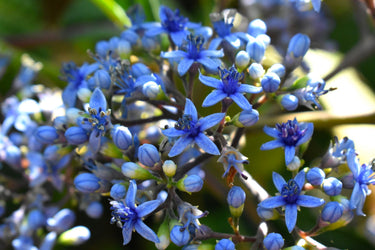
Few garden shrubs carry a resume like Dichroa febrifuga. In the ground this is a handsome, medium evergreen with lacecap heads of small blue flowers in late spring and, better still, clusters of berries in fall that ripen to an almost unreal iridescent, metallic blue, the kind of structural color usually reserved for beetles and tropical birds. A relatively recent introduction from China, the plant sits close enough to Hydrangea, in the family Hydrangeaceae, that the same trick applies: acidic soil deepens the flowers and fruit to true blue, while alkaline ground pushes them toward pink.
Both halves of the botanical name reward a moment of attention. Dichroa comes from the Greek for two-colored, a nod to those shifting blues and pinks, while the epithet febrifuga is plain Latin for fever-dispelling, and that second word opens onto two thousand years of history. In China the plant is chang shan, named for Mount Chang, and ranks among the fifty fundamental herbs of traditional medicine. The roots appear in the Shennong Bencao Jing, the oldest surviving Chinese materia medica, and again in Zhang Zhongjing's Han-dynasty Treatise on Cold Damage, prescribed above all against the recurring fevers of malaria.
The modern chapter is just as remarkable. In the twentieth century, chemists chasing the herb's power isolated the alkaloids febrifugine and isofebrifugine, and those molecules in turn inspired a synthetic derivative, halofuginone, that has since traveled far from the fever clinic, serving as an anticoccidial in poultry feed and as a research compound studied for fibrosis, cancer, and autoimmune disease. The tradition came with a hard catch that modern study confirmed, since chang shan is strongly emetic and toxic to the liver in more than small amounts, which is exactly why the plant belongs in the garden as an ornamental while the pharmacology belongs in the laboratory. Nothing here is medical advice.
Set against that heritage, the garden role is refreshingly simple. Grow Dichroa febrifuga as a lush, shade-loving shrub for a woodland border, a shaded courtyard, or a mixed planting where the metallic fall berries can be admired at close range, and keep the soil acidic for the deepest blue. The plant is handsome with hydrangeas, ferns, hostas, and aucuba, takes happily to a large container that can shelter under cover at the cold edge of the range, and asks only for moist, well-drained soil in morning sun or dappled shade.
Photo courtesy of Cambridge Botanic Garden.
- Hardiness
- USDA Zones 8–11
- Sun
- Full Sun, Part Shade
- Soil
- Well-drained, Fertile
- Mature size
- Height 3–6 Feet · Spread 3–4 Feet
- Growth rate
- Moderate
- Seasonality
- Evergreen
Small, blue, flat topped clusters, spring
These statements have not been evaluated by the Food and Drug Administration. This information is shared for traditional and educational interest only and is not intended to diagnose, treat, cure, or prevent any disease. Please consult a qualified healthcare professional before any medicinal use.
- Strongly emetic and nauseating
- Toxic in overdose, with liver and gastrointestinal effects
- Traditional antimalarial use is not a substitute for modern treatment
- Not safe for self-administration
From rooting to shipping, our top priority is ensuring you receive healthy, thriving plants for your garden’s success.
Because most of our plants are grown from rooted cuttings — alongside seed, air layering, and grafting chosen for each variety — you receive a stronger, true-to-type plant that establishes quickly in your garden.
Raised on organic soil blends and eco-friendly pest management — never harsh chemicals — your plant arrives healthy for your garden, your family, and the pollinators they feed.
Every purchase gives back. We donate to the Aiken Arboretum and support local wildlife conservation, so growing your garden helps protect the wider ecosystem too.

All our plant material is carefully propagated, grown, and nurtured at our humble nursery in Aiken, South Carolina.

Your plant arrives carefully packed and ready to settle in. Unpack them promptly, give them a day or two to acclimate, then plant following the notes we include — that’s all it takes. Clear care guidance comes with every order, so success is the easy part.
What to expect upon delivery
All our plants are sold in 1-gallon sizes, though the height of each plant can vary depending on its growth rate and seasonality, typically ranging from 1/2 to 2.5 feet.
Each plant is carefully packaged with its roots enclosed in a secure plastic bag containing moist soil, forming a compact root ball. To ensure safe transport, the box is padded with recycled newspaper, providing both stability and eco-friendly protection from weather during shipping.
What is your return policy?
Review our full return policy information on our SHIPPING AND RETURNS POLICY page.
What payment methods can I use?
We offer 35 different payment methods including major providers like Mastercard, Visa, PayPal, American Express and Diners as well as many different local payment methods including Klarna, iDEAL, AliPay, Sofort, giropay, and many more.
Can I make changes to my order after it’s been placed?
At Woodlanders, we strive to fulfill orders as quickly as possible. Therefore, we can only accommodate changes to your order within the first 24 hours after it has been placed. These changes include adding or removing products and modifying the delivery address. If you need to make any changes or if there has been a mistake with your order information, please reach out to us promptly via our CONTACT page with your order number for the quickest resolution.
Your satisfaction is our priority, and we appreciate your understanding and cooperation.