


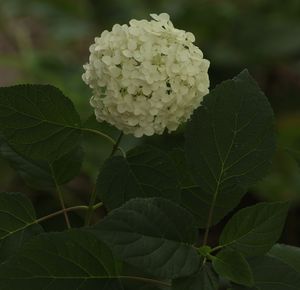

Smooth Hydrangea 'Annabelle'
Hydrangea arborescens ‘Annabelle’
Pickup currently unavailable at Aiken Nursery
'Annabelle' is a wild American shrub with a hometown. Around 1910 two sisters, Harriet and Amy Kirkpatrick, spotted an unusually full-flowered smooth hydrangea in the woods of Union County, Illinois, dug the plant, and grew it in their garden in the town of Anna. For half a century the shrub passed hand to hand around southern Illinois as a nameless local treasure, until the University of Illinois plantsman Dr. Joseph C. McDaniel traced the trail back to Anna in the 1960s, selected the plant, and released it for sale in 1962. The name 'Annabelle' honors both the town and the Kirkpatrick belles who found the shrub: Anna plus belle.
Behind the cultivar stands Hydrangea arborescens, the smooth hydrangea native to woodland slopes and streambanks across the eastern United States. 'Annabelle' is simply the most famous garden selection of that native, a deciduous shrub of three to five feet, wider than tall, that opens enormous rounded heads of creamy white sterile florets, snowballs the size of a dinner plate, in early summer. The heads age softly to green and can be cut for drying. Michael Dirr, the dean of American woody-plant horticulture, remembered McDaniel as a true plantsman and gentleman, and 'Annabelle' remains the shrub's quiet monument.
The species carries a deep ethnobotanical history under an older name, Seven-bark, so called for the way the stems peel in successive layers of color. Cherokee, Creek, and other southeastern peoples used the root and root bark as a diuretic and a remedy for kidney and bladder stones, a tradition later taken up by the Eclectic physicians of the nineteenth century, and the plant earned the folk name kidney-bush along the way. The leaves and buds, by contrast, contain cyanide-releasing compounds and are not for eating, a reminder that this is a plant with a serious past rather than a garnish.
In the garden, 'Annabelle' is generous and forgiving. Because the shrub flowers on new wood, a hard late-winter cut to a foot or so returns bigger blooms without any risk to the show, making this one of the most reliable hydrangeas for cold gardens where old-wood types freeze out. Give the plant good soil that stays moist, a little afternoon shade in hot regions, and room to spread into a low colony. The white heads light up a shady border, a foundation planting, or the edge of a woodland, and the strongest stems hold the flowers up after summer rain.
- Hardiness
- USDA Zones 4–8
- Sun
- Full Sun, Part Shade
- Soil
- Well-drained, Moist
- Mature size
- Height 3–5 Feet · Spread 6–7 Feet
- Growth rate
- Fast
- Seasonality
- Deciduous
Creamy white, snowball, June - August
These statements have not been evaluated by the Food and Drug Administration. This information is shared for traditional and educational interest only and is not intended to diagnose, treat, cure, or prevent any disease. Please consult a qualified healthcare professional before any medicinal use.
- Leaves and buds contain cyanogenic compounds and can be toxic if ingested.
- Traditional use only; not a substitute for professional medical care.
- Consult a qualified practitioner before any medicinal use.
From rooting to shipping, our top priority is ensuring you receive healthy, thriving plants for your garden’s success.
Because most of our plants are grown from rooted cuttings — alongside seed, air layering, and grafting chosen for each variety — you receive a stronger, true-to-type plant that establishes quickly in your garden.
Raised on organic soil blends and eco-friendly pest management — never harsh chemicals — your plant arrives healthy for your garden, your family, and the pollinators they feed.
Every purchase gives back. We donate to the Aiken Arboretum and support local wildlife conservation, so growing your garden helps protect the wider ecosystem too.

All our plant material is carefully propagated, grown, and nurtured at our humble nursery in Aiken, South Carolina.

Your plant arrives carefully packed and ready to settle in. Unpack them promptly, give them a day or two to acclimate, then plant following the notes we include — that’s all it takes. Clear care guidance comes with every order, so success is the easy part.
What to expect upon delivery
All our plants are sold in 1-gallon sizes, though the height of each plant can vary depending on its growth rate and seasonality, typically ranging from 1/2 to 2.5 feet.
Each plant is carefully packaged with its roots enclosed in a secure plastic bag containing moist soil, forming a compact root ball. To ensure safe transport, the box is padded with recycled newspaper, providing both stability and eco-friendly protection from weather during shipping.
What is your return policy?
Review our full return policy information on our SHIPPING AND RETURNS POLICY page.
What payment methods can I use?
We offer 35 different payment methods including major providers like Mastercard, Visa, PayPal, American Express and Diners as well as many different local payment methods including Klarna, iDEAL, AliPay, Sofort, giropay, and many more.
Can I make changes to my order after it’s been placed?
At Woodlanders, we strive to fulfill orders as quickly as possible. Therefore, we can only accommodate changes to your order within the first 24 hours after it has been placed. These changes include adding or removing products and modifying the delivery address. If you need to make any changes or if there has been a mistake with your order information, please reach out to us promptly via our CONTACT page with your order number for the quickest resolution.
Your satisfaction is our priority, and we appreciate your understanding and cooperation.