


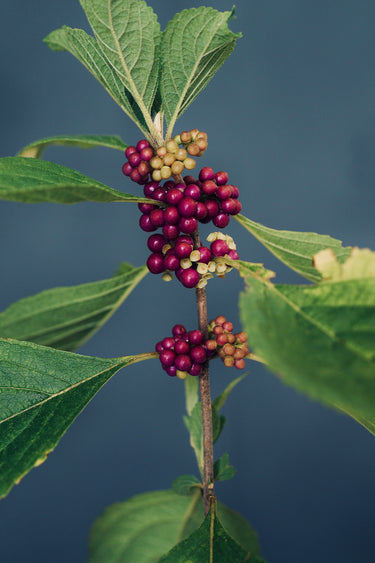


American Beautyberry
Callicarpa americana
Pickup currently unavailable at Aiken Nursery
The genus name says it: Callicarpa, from the Greek kallos, beauty, and karpos, fruit, beautiful fruit, a genus named for exactly what it does. Callicarpa americana, the American beautyberry, is the southeastern native that gives the genus a calling card. From late August into November, the plant sets dense clusters of small drupes in a luminous magenta-purple, a color that registers as almost unreal in the late-summer landscape, somewhere between fuchsia and amethyst, with no real precedent among native fruits. The berries gather in tight whorls around the stem at every leaf node, all the way down the arching branches, so that a mature shrub in October looks less like a shrub bearing fruit than a ribbon of purple glass beads strung along the branches.
The species ranges across the southeastern coastal plain and Piedmont, west into Texas and northern Mexico, with outlier populations in Bermuda, the Bahamas, and Cuba, growing along forest edges, in pine flatwoods, on old-field margins, and in the dappled understory of mixed hardwood-pine canopies. So much a part of the southern landscape that to many southerners the beautyberry feels native to memory itself, the shrub has only really been embraced as a garden plant in recent decades. William Bartram, the eighteenth-century Quaker naturalist whose Travels (1791) remains the foundational botanical document of the American South, described Callicarpa in the Carolina and Georgia woods he walked, and the southern poet Kathryn Stripling Byer used the beautyberry in her poem Beautyberry as a figure for endurance, beauty in the face of adversity, a fair description of how the plant actually lives.
The other story is more recent. In the rural Mississippi of his grandfather's generation, the USDA botanist Charles Bryson had been told that crushed beautyberry leaves, rubbed on the skin or stuffed under a farm animal's harness, kept biting insects away. Bryson passed the tip to Charles Cantrell, a chemist at the USDA Agricultural Research Service in Oxford, Mississippi, and Cantrell and colleagues isolated three terpenoid compounds from the leaves: callicarpenal, intermedeol, and spathulenol. In peer-reviewed testing against the mosquitoes that carry yellow fever and malaria, callicarpenal worked at roughly 79 percent the strength of DEET; against the blacklegged ticks that carry Lyme disease, and lone star ticks, callicarpenal was statistically equal to DEET; against fire ants, also effective. The USDA patented the compounds. The grandfather was right.
In the garden, the American beautyberry is a forgiving, durable, slightly unruly deciduous shrub, four to six feet tall and as wide, with an open, arching frame that takes a light pruning in late winter to stay compact and fruit heavily. The shrub blooms and fruits on new wood, so cutting back to twelve or eighteen inches each spring sharply increases the show. The early-summer flowers are small and pale lavender-pink, pretty up close, easy to miss from a distance, and busy with native bees and small butterflies. But the fruit is the event: more than forty species of southeastern birds work the clusters in fall and winter, from bobwhite and cardinals to mockingbirds and thrashers, along with deer, raccoons, foxes, and opossums. The berries are mildly edible, long used for jelly, though the wildlife usually clears them faster than any cook could.
For the native gardener, the wildlife gardener, the ethnobotanist, or anyone who wants to plant a real piece of the flora of the American South: the plant Bartram saw, the plant Bryson's grandfather knew, the plant the USDA validated.
- Hardiness
- USDA Zones 7–11
- Sun
- Full Sun, Part Shade
- Soil
- Moist, Well-drained
- Mature size
- Height 6–8 Feet · Spread 6–8 Feet
- Growth rate
- Fast
- Seasonality
- Deciduous
Small lavender-pink flowers in cymes at every node, late spring to summer
These statements have not been evaluated by the Food and Drug Administration. This information is shared for traditional and educational interest only and is not intended to diagnose, treat, cure, or prevent any disease. Please consult a qualified healthcare professional before any medicinal use.
- Caution for those allergic to mint-family (Lamiaceae) plants
- Not recommended in pregnancy or nursing due to limited safety data
- Consult a healthcare professional before any medicinal use
From rooting to shipping, our top priority is ensuring you receive healthy, thriving plants for your garden’s success.
Because most of our plants are grown from rooted cuttings — alongside seed, air layering, and grafting chosen for each variety — you receive a stronger, true-to-type plant that establishes quickly in your garden.
Raised on organic soil blends and eco-friendly pest management — never harsh chemicals — your plant arrives healthy for your garden, your family, and the pollinators they feed.
Every purchase gives back. We donate to the Aiken Arboretum and support local wildlife conservation, so growing your garden helps protect the wider ecosystem too.

All our plant material is carefully propagated, grown, and nurtured at our humble nursery in Aiken, South Carolina.

Your plant arrives carefully packed and ready to settle in. Unpack them promptly, give them a day or two to acclimate, then plant following the notes we include — that’s all it takes. Clear care guidance comes with every order, so success is the easy part.
What to expect upon delivery
All our plants are sold in 1-gallon sizes, though the height of each plant can vary depending on its growth rate and seasonality, typically ranging from 1/2 to 2.5 feet.
Each plant is carefully packaged with its roots enclosed in a secure plastic bag containing moist soil, forming a compact root ball. To ensure safe transport, the box is padded with recycled newspaper, providing both stability and eco-friendly protection from weather during shipping.
What is your return policy?
Review our full return policy information on our SHIPPING AND RETURNS POLICY page.
What payment methods can I use?
We offer 35 different payment methods including major providers like Mastercard, Visa, PayPal, American Express and Diners as well as many different local payment methods including Klarna, iDEAL, AliPay, Sofort, giropay, and many more.
Can I make changes to my order after it’s been placed?
At Woodlanders, we strive to fulfill orders as quickly as possible. Therefore, we can only accommodate changes to your order within the first 24 hours after it has been placed. These changes include adding or removing products and modifying the delivery address. If you need to make any changes or if there has been a mistake with your order information, please reach out to us promptly via our CONTACT page with your order number for the quickest resolution.
Your satisfaction is our priority, and we appreciate your understanding and cooperation.