


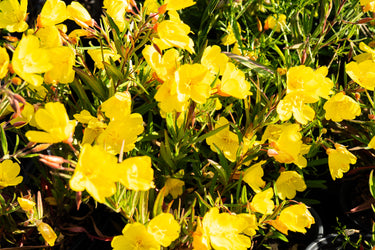


Sundrops
Oenothera fruticosa ssp. glauca (tetragona)
In propagation
Currently growing out 1 Quart pots. Expected Winter 2027.
Add your name with the notify button below, and we will email you the moment this plant is ready to bring home.
Learn how we grow on The Prop House.
Pickup currently unavailable at Aiken Nursery
Sundrops make a gentle joke of their family. Oenothera fruticosa ssp. glauca belongs to the evening primroses, a tribe famous for opening at dusk and closing by mid-morning, yet the sundrops break ranks and bloom by day, holding cups of clear, satiny yellow wide open through the sunlit hours of late spring and early summer. The genus name comes from the Greek oinos, wine, and thera, to hunt or seek, an old and disputed reference to a European relative whose roots were once thought to give a taste for wine; the epithet fruticosa means shrubby, for the firm, upright stems, and glauca notes the blue-green bloom on the foliage.
Native across eastern North America, from Nova Scotia and Quebec south to Florida and west toward Manitoba and Louisiana, this narrowleaf sundrops forms a tidy, mounding clump that spreads gently into a colony where the ground is kept free of competition. The reddish buds and glaucous leaves are handsome in their own right, and a real bonus arrives in the cold months, when the plant holds a flat evergreen rosette that flushes purple and bronze and quietly smothers winter weeds while the border sleeps.
The evening primroses carry a long ethnobotanical record, and the famous evening primrose oil is pressed from the seeds of the biennial Oenothera biennis rather than from these day-blooming sundrops, a distinction worth keeping straight; grow this one for the flowers and the pollinators, not the pharmacy. Bees, butterflies, and moths work the open cups through the flush, and the four broad petals catch light like little dishes of butter set out along the stems.
Give the sundrops full sun for the heaviest bloom, a little afternoon shade where summers are fierce, and lean, sandy to loamy, well-drained ground; established plants shrug off drought and ask almost nothing. Use the clump at the front of a sunny border, in a rock garden, or as a low, colonizing groundcover through a meadow planting, and pair with coreopsis, salvia, and coneflower for a long, easy season. Deer tend to pass the foliage by, and a light shearing after bloom keeps the planting neat.
- Hardiness
- USDA Zones 4–8
- Sun
- Full Sun, Part Shade
- Soil
- Well-drained, Dry
- Mature size
- Height 12–24 Inches · Spread 12–18 Inches
- Growth rate
- Moderate to Fast
- Seasonality
- Semi-Evergreen
Clear yellow, cup-shaped, day-blooming flowers in late spring and early summer
From rooting to shipping, our top priority is ensuring you receive healthy, thriving plants for your garden’s success.
Because most of our plants are grown from rooted cuttings — alongside seed, air layering, and grafting chosen for each variety — you receive a stronger, true-to-type plant that establishes quickly in your garden.
Raised on organic soil blends and eco-friendly pest management — never harsh chemicals — your plant arrives healthy for your garden, your family, and the pollinators they feed.
Every purchase gives back. We donate to the Aiken Arboretum and support local wildlife conservation, so growing your garden helps protect the wider ecosystem too.

All our plant material is carefully propagated, grown, and nurtured at our humble nursery in Aiken, South Carolina.

Your plant arrives carefully packed and ready to settle in. Unpack them promptly, give them a day or two to acclimate, then plant following the notes we include — that’s all it takes. Clear care guidance comes with every order, so success is the easy part.
What to expect upon delivery
All our plants are sold in 1-gallon sizes, though the height of each plant can vary depending on its growth rate and seasonality, typically ranging from 1/2 to 2.5 feet.
Each plant is carefully packaged with its roots enclosed in a secure plastic bag containing moist soil, forming a compact root ball. To ensure safe transport, the box is padded with recycled newspaper, providing both stability and eco-friendly protection from weather during shipping.
What is your return policy?
Review our full return policy information on our SHIPPING AND RETURNS POLICY page.
What payment methods can I use?
We offer 35 different payment methods including major providers like Mastercard, Visa, PayPal, American Express and Diners as well as many different local payment methods including Klarna, iDEAL, AliPay, Sofort, giropay, and many more.
Can I make changes to my order after it’s been placed?
At Woodlanders, we strive to fulfill orders as quickly as possible. Therefore, we can only accommodate changes to your order within the first 24 hours after it has been placed. These changes include adding or removing products and modifying the delivery address. If you need to make any changes or if there has been a mistake with your order information, please reach out to us promptly via our CONTACT page with your order number for the quickest resolution.
Your satisfaction is our priority, and we appreciate your understanding and cooperation.