


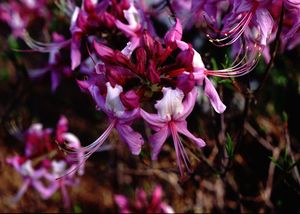

Pinxterbloom Azalea
Rhododendron periclymenoides 'Purple'
See all 49 Azaleas & Rhododendrons
In propagation
Currently growing out 1 Gallon pots. Expected Fall 2026.
Add your name with the notify button below, and we will email you the moment this plant is ready to bring home.
Learn how we grow on The Prop House.
Pickup currently unavailable at Aiken Nursery
Among the most beloved of the eastern wild azaleas, Rhododendron periclymenoides drifts through the open woods and swamp margins of the eastern United States from New Hampshire and Massachusetts south to South Carolina, Tennessee, and Alabama, opening clouds of pink bloom just as the woodland wakes in spring. This selection breaks from the ordinary pink of the species: a soft lavender-purple color form discovered in Lancaster County, South Carolina, and introduced by Woodlanders, uncommon in the wild and rarer still in cultivation. Botanists once filed the species under the name Rhododendron nudiflorum, and the plant still answers to that older label in many an old garden book.
The names carry their own small history. The species epithet periclymenoides means resembling Periclymenum, the European honeysuckle, a nod to the slender, long-tubed flowers and their sweet, petunia-like scent, and the old common names wild honeysuckle and purple honeysuckle follow the same thought. Pinxterbloom, the name most often heard, comes from the Dutch Pinksteren, or Pentecost, the late-spring feast that arrives just as the flowers do; Dutch settlers of the Hudson Valley named the shrub for the season that announced them. The flowers open before or with the unfurling leaves, each blossom trailing stamens nearly twice the length of the corolla, so a shrub in full bloom reads as a haze of pale lavender rather than a mass of solid color.
For all the delicacy, pinxterbloom azalea does hard ecological work. The early nectar feeds returning hummingbirds and the first swallowtails, and the foliage is a documented larval host for dozens of butterflies and moths, so a single shrub anchors a great deal of spring life. Gardeners should know the plant is much loved by deer as well, and browsing pressure can run heavy where herds are large. As with all azaleas, every part carries grayanotoxins and is poisonous if eaten, so the shrub is one to enjoy for scent and color rather than for any use in the kitchen.
Site this azalea where the fragrance can be met in passing, at a woodland edge, along a shaded path, or in a naturalistic native border, and give the cool, moist, acidic, humus-rich soil that dogwoods, mountain laurel, and blueberries share. The stoloniferous roots knit slowly into a loose, well-mannered colony over the years, lovely drifted among ferns, native phlox, and other spring woodlanders, or set against darker evergreens that throw the lavender bloom forward. Morning sun with afternoon shade suits the plant best in the South, and a pine-straw mulch keeps the shallow roots cool. For the collector of native azaleas, the unusual color and the Woodlanders provenance make this a quietly special thing to grow.
- Hardiness
- USDA Zones 4–8
- Sun
- Part Shade
- Soil
- Well-drained, Moist, Acid
- Mature size
- Height 6–8 Feet · Spread 3–4 Feet
- Growth rate
- Moderate
- Seasonality
- Deciduous
Lavender-purple, fragrant, April to May
From rooting to shipping, our top priority is ensuring you receive healthy, thriving plants for your garden’s success.
Because most of our plants are grown from rooted cuttings — alongside seed, air layering, and grafting chosen for each variety — you receive a stronger, true-to-type plant that establishes quickly in your garden.
Raised on organic soil blends and eco-friendly pest management — never harsh chemicals — your plant arrives healthy for your garden, your family, and the pollinators they feed.
Every purchase gives back. We donate to the Aiken Arboretum and support local wildlife conservation, so growing your garden helps protect the wider ecosystem too.

All our plant material is carefully propagated, grown, and nurtured at our humble nursery in Aiken, South Carolina.

Your plant arrives carefully packed and ready to settle in. Unpack them promptly, give them a day or two to acclimate, then plant following the notes we include — that’s all it takes. Clear care guidance comes with every order, so success is the easy part.
What to expect upon delivery
All our plants are sold in 1-gallon sizes, though the height of each plant can vary depending on its growth rate and seasonality, typically ranging from 1/2 to 2.5 feet.
Each plant is carefully packaged with its roots enclosed in a secure plastic bag containing moist soil, forming a compact root ball. To ensure safe transport, the box is padded with recycled newspaper, providing both stability and eco-friendly protection from weather during shipping.
What is your return policy?
Review our full return policy information on our SHIPPING AND RETURNS POLICY page.
What payment methods can I use?
We offer 35 different payment methods including major providers like Mastercard, Visa, PayPal, American Express and Diners as well as many different local payment methods including Klarna, iDEAL, AliPay, Sofort, giropay, and many more.
Can I make changes to my order after it’s been placed?
At Woodlanders, we strive to fulfill orders as quickly as possible. Therefore, we can only accommodate changes to your order within the first 24 hours after it has been placed. These changes include adding or removing products and modifying the delivery address. If you need to make any changes or if there has been a mistake with your order information, please reach out to us promptly via our CONTACT page with your order number for the quickest resolution.
Your satisfaction is our priority, and we appreciate your understanding and cooperation.