


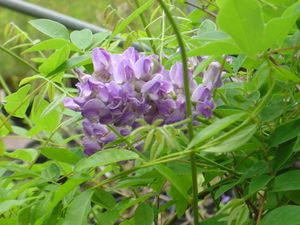

American Wisteria
Wisteria frutescens
In propagation
Currently growing out 1 Gallon pots. Expected season to be announced.
Add your name with the notify button below, and we will email you the moment this plant is ready to bring home.
Learn how we grow on The Prop House.
Pickup currently unavailable at Aiken Nursery
For the first sixty-five years in the books, this vine was filed as a kind of soybean. Linnaeus named the plant Glycine frutescens in 1753, frutescens meaning turning shrubby, and there the classification sat until 1818, when Thomas Nuttall looked again, decided a woody climber of the southern riverbanks deserved a genus apart, and named the vine for his friend Caspar Wistar, the Philadelphia anatomist. Somewhere between the man and the plant a vowel slipped, Wistar becoming Wisteria, and the misspelling has outlived everyone involved.
This is the wisteria of the Southeast, native from Virginia down through the Carolinas and Georgia to Florida and west to Texas, threading the margins of swamps, bottomland woods, and slow water. They do everything the Asian wisterias do, but with manners. The flower clusters are shorter and denser, lilac-blue with a fleck of yellow at the throat, and they arrive in early summer on the current season's growth, after the leaves are out rather than before, so the bloom comes cradled in green instead of strung on bare wood. They twine counterclockwise, flower within a couple of years instead of making you wait a decade, and, the part that matters most, they do not bolt for the canopy and strangle the trees the way their Asian cousins have quietly learned to do across the South.
A native that gives you the whole romance of wisteria, the drooping racemes, the soft drift of scent, without the fifty-year campaign to take back your porch. There is very little reason to plant the other one.
- Hardiness
- USDA Zones 7–9
- Sun
- Full Sun
- Soil
- Moist
- Mature size
- Height 10–40 Feet · Spread 10–20 Feet
- Growth rate
- Fast
- Seasonality
- Deciduous
Lilac-blue, fragrant, late spring to summer
From rooting to shipping, our top priority is ensuring you receive healthy, thriving plants for your garden’s success.
Because most of our plants are grown from rooted cuttings — alongside seed, air layering, and grafting chosen for each variety — you receive a stronger, true-to-type plant that establishes quickly in your garden.
Raised on organic soil blends and eco-friendly pest management — never harsh chemicals — your plant arrives healthy for your garden, your family, and the pollinators they feed.
Every purchase gives back. We donate to the Aiken Arboretum and support local wildlife conservation, so growing your garden helps protect the wider ecosystem too.

All our plant material is carefully propagated, grown, and nurtured at our humble nursery in Aiken, South Carolina.

Your plant arrives carefully packed and ready to settle in. Unpack them promptly, give them a day or two to acclimate, then plant following the notes we include — that’s all it takes. Clear care guidance comes with every order, so success is the easy part.
What to expect upon delivery
All our plants are sold in 1-gallon sizes, though the height of each plant can vary depending on its growth rate and seasonality, typically ranging from 1/2 to 2.5 feet.
Each plant is carefully packaged with its roots enclosed in a secure plastic bag containing moist soil, forming a compact root ball. To ensure safe transport, the box is padded with recycled newspaper, providing both stability and eco-friendly protection from weather during shipping.
What is your return policy?
Review our full return policy information on our SHIPPING AND RETURNS POLICY page.
What payment methods can I use?
We offer 35 different payment methods including major providers like Mastercard, Visa, PayPal, American Express and Diners as well as many different local payment methods including Klarna, iDEAL, AliPay, Sofort, giropay, and many more.
Can I make changes to my order after it’s been placed?
At Woodlanders, we strive to fulfill orders as quickly as possible. Therefore, we can only accommodate changes to your order within the first 24 hours after it has been placed. These changes include adding or removing products and modifying the delivery address. If you need to make any changes or if there has been a mistake with your order information, please reach out to us promptly via our CONTACT page with your order number for the quickest resolution.
Your satisfaction is our priority, and we appreciate your understanding and cooperation.