

Fragrant Native

Sweet Shrub

Calycanthus floridus

$23.00
USDA Zones 5–9 Part Shade Matures 4–6 Feet

Sited by the nose, not the eye: Calycanthus floridus hides strange maroon flowers inside the foliage and gives back a warm fruit-bowl perfume of strawberry, pineapple, and banana. A three-century Southern heirloom.

Size Options: 1 Gallon

Pickup available at Aiken Nursery

Usually ready in 2-4 days

Healthy-arrival guarantee Free shipping over $150
Roots wrapped in moist soil and padded for safe transit
Grown and shipped from our nursery in Aiken, SC
Shipping later in the season? Schedule your delivery date in your cart.

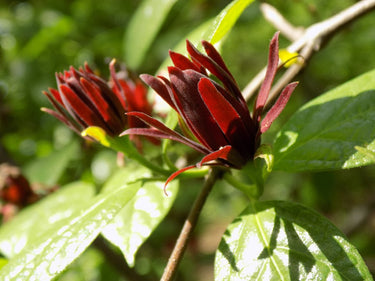
Some plants are loved for how they look. Calycanthus floridus is loved for how they smell, which is a different and older kind of attachment. The flowers are strange and handsome in their own right, an inch or two across, dark maroon going toward burgundy, built from many narrow strap-like segments with no clear line between petal and sepal, somewhere between a small magnolia and something from the bottom of the sea. But the reason this shrub has been passed down through Southern gardens for three centuries is what happens when the flowers open on a warm day: a deep fruit-bowl perfume, strawberry and pineapple and ripe banana, that drifts well beyond the plant.

Here is the honest catch, and it is the whole reason provenance matters with this one. The fragrance is gloriously inconsistent. Grown from seed, the scent varies wildly plant to plant, some intoxicating, some barely there, which is why old garden wisdom says to smell before you buy and why the good forms have always been passed hand to hand rather than left to chance. The leaves and bark carry their own spice when bruised, so even between bloom and a fragrance you can rely on, there is something to crush between your fingers on the walk past.

The history runs deep. Calycanthus came into cultivation in 1726 and never left; Jefferson planted nineteen of them at Monticello in 1778, recording them under the country name "bubby flower," and the shrub has carried a small constellation of names ever since, Carolina allspice, sweet Betsy, sweet bubby, strawberry-bush. The flowers were once tucked into the top drawer of a dresser to scent the linens, which tells you most of what you need to know about how people have felt about them. This is an heirloom in the truest sense, a plant kept alive by being wanted.

They make a dense, rounded shrub of six to nine feet, suckering gently into a colony over time, and they are as easygoing as they are old-fashioned: untroubled by pests, indifferent to soil, happy from full sun into real shade. There is a tradeoff worth knowing. In full sun they flower and scent most heavily but spread more freely; in shade they grow slower and stay more contained. Either way the foliage turns clean gold in fall and the curious urn-shaped pods hang on into winter. Native to the woodlands of the Southeast, Calycanthus floridus asks for almost nothing and gives back a fragrance you will cross the yard for.

Will this plant thrive in your zone?

Size Options: 1 Gallon
Plant Profile
At a glance
Hardiness
USDA Zones 5–9
Sun
Part Shade
Soil
Well-drained, Moist
Mature size
Height 4–6 Feet · Spread 4–6 Feet
Growth rate
Moderate
Seasonality
Deciduous
Design Notes

Plant Calycanthus floridus where you'll walk past them, not where you'll look at them. This is the rare shrub sited by the nose rather than the eye: beside a door, along a path, under a window left open in late spring, anywhere the warm-day perfume will catch you mid-stride. The flowers themselves tuck back into the foliage and don't demand a sightline, so the usual rules about specimen placement don't really apply. Proximity is the whole design principle.

Two things shape where they go. The first is the sun-versus-suckering tradeoff: in full sun they bloom and scent most generously but spread more freely into a colony, while in shade they stay slower and more contained but flower less. Decide which you're after before you dig. Where you have room and want the fragrance at full strength, give them sun and let them naturalize into a loose thicket; where space is tight or you want a tidier shape, site them in part shade and keep an eye on the suckers. The second is fragrance itself: because seed-grown plants vary so much, this is a plant to buy in bloom or from a known form, and then to place as if it were the only scented thing in the garden, because it may well be the best.

In the landscape they earn their keep as an informal shrub, a loose hedge, or the fragrant backbone of a native border, and they bridge a cultivated bed into a wilder woodland edge as gracefully as anything you can plant. Underplant or pair with other shade-tolerant natives and you have an understory that works in every season. They take to a large container too, which is the old trick for keeping the suckering in check and the fragrance close: a roomy pot by a seating area gives you the scent at nose height and a colony that can't wander. However they're grown, this is a plant chosen for an experience rather than a look, the kind you site once, near where you live, and are quietly glad of every spring for decades.

Flower, Fruit & Foliage

Maroon, mid-spring into summer; brown urn-shaped pods, fall into winter

Flowers:
The flower is unlike anything else in a Southern garden. An inch or two across, dark maroon deepening toward burgundy, built from many narrow, strap-like segments that spiral out with no clear boundary between petal and sepal, closer to a small sea creature or a half-open magnolia than to an ordinary bloom. They appear from mid-spring into early summer and last a good long while, borne at the ends of short branchlets and often half-hidden inside the foliage, so you tend to smell them before you find them. The scent is the point: on a warm day the best forms throw a deep fruit-bowl perfume of strawberry, pineapple, and ripe banana that carries well past the plant. The honest caveat is that seed-grown plants vary, some are intoxicating and some are nearly scentless, which is exactly why the good ones have always been passed hand to hand.

Fruit:
By late summer the flowers give way to fruit as odd as the bloom that made it: a leathery, urn-shaped capsule, sometimes likened to a small fig or a wrinkled pear, ripening from green to brown. They hang on through fall and deep into winter, persisting on the bare stems as a quiet structural curiosity long after the leaves have gone. Not a showy berry display, more a thing the close looker notices and the casual passer-by misses entirely.

Foliage:
The leaves are simple, opposite, and a clean dark green, oval with a gracefully pointed tip and a paler grey-green underside, giving the shrub a dense, well-furnished body all season. They carry a second fragrance of their own: bruise or crush a leaf and the same spiced, aromatic note rises from the tissue, which is part of how the plant earned the name Carolina allspice. Come autumn the whole shrub turns a soft, even gold, an unhurried fall color that lingers. Between the crushable leaves, the strange flowers, and the persistent pods, there's something to notice on this plant in every season but the dead of winter, and even then the pods are still holding on.

Care

Read our full care guide

Light: Full sun into real shade. Sun brings the heaviest bloom and scent but freer suckering; shade brings slower, more contained growth.

Soil: Easygoing and adaptable to most soils; best in moist, well-drained ground.

Water: Keep the roots moist while establishing, then water deeply in drought. A 3-inch mulch helps hold moisture.

Pruning: Prune after flowering to shape and encourage bushier growth; remove suckers to limit spread, or leave them to form a colony.

Hardiness: USDA zones 5 to 9. Generally untroubled by pests and disease.

Here’s a closer look at how we produce our plants

From rooting to shipping, our top priority is ensuring you receive healthy, thriving plants for your garden’s success.

Woodlanders Growing Process

Because most of our plants are grown from rooted cuttings — alongside seed, air layering, and grafting chosen for each variety — you receive a stronger, true-to-type plant that establishes quickly in your garden.

Sustainable Growing Practices

Raised on organic soil blends and eco-friendly pest management — never harsh chemicals — your plant arrives healthy for your garden, your family, and the pollinators they feed.

Supporting Local Biodiversity

Every purchase gives back. We donate to the Aiken Arboretum and support local wildlife conservation, so growing your garden helps protect the wider ecosystem too.

At Woodlanders, we are committed to quality.
Grown in Aiken, South Carolina
At Woodlanders, we are committed to quality.

All our plant material is carefully propagated, grown, and nurtured at our humble nursery in Aiken, South Carolina.

Learn more about Woodlanders
Healthy plants, ready to thrive
Success, made simple
Healthy plants, ready to thrive

Your plant arrives carefully packed and ready to settle in. Unpack them promptly, give them a day or two to acclimate, then plant following the notes we include — that’s all it takes. Clear care guidance comes with every order, so success is the easy part.

Read the care guide
Frequently Asked Questions
What to expect upon delivery

All our plants are sold in 1-gallon sizes, though the height of each plant can vary depending on its growth rate and seasonality, typically ranging from 1/2 to 2.5 feet.

Each plant is carefully packaged with its roots enclosed in a secure plastic bag containing moist soil, forming a compact root ball. To ensure safe transport, the box is padded with recycled newspaper, providing both stability and eco-friendly protection from weather during shipping.

What is your return policy?

Review our full return policy information on our SHIPPING AND RETURNS POLICY page.

What payment methods can I use?

We offer 35 different payment methods including major providers like Mastercard, Visa, PayPal, American Express and Diners as well as many different local payment methods including Klarna, iDEAL, AliPay, Sofort, giropay, and many more.

Can I make changes to my order after it’s been placed?

At Woodlanders, we strive to fulfill orders as quickly as possible. Therefore, we can only accommodate changes to your order within the first 24 hours after it has been placed. These changes include adding or removing products and modifying the delivery address. If you need to make any changes or if there has been a mistake with your order information, please reach out to us promptly via our CONTACT page with your order number for the quickest resolution.

Your satisfaction is our priority, and we appreciate your understanding and cooperation.