

Pollinator Deer-Resistant Fragrant Native

Sea Foam Fothergilla

Fothergilla × intermedia 'Sea Spray'

$32.00 Sold out
1 Gallon USDA Zones 5–8 Full Sun and Part Shade Matures 4–8 Feet

Fothergilla × intermedia 'Sea Spray' is a scarce hybrid witch-alder with cool, glaucous blue-green summer foliage and honey-scented white bottlebrush flowers in spring.

Pickup currently unavailable at Aiken Nursery

Healthy-arrival guarantee Free shipping over $150
Roots wrapped in moist soil and padded for safe transit
Grown and shipped from our nursery in Aiken, SC
Shipping later in the season? Schedule your delivery date in your cart.

'Sea Spray' has long traveled under the name Fothergilla major, a tidy assumption the botanists have since complicated. Run through a flow cytometer, the plant turns out to be a hybrid, F. × intermedia, the meeting of mountain witch-alder (F. major) and the dwarf coastal F. gardenii, the little shrub Charleston's Alexander Garden sent across to England in the 1760s, in a genus already named for John Fothergill, the London physician who tried to grow half of America in a single garden. All of which makes the name, for once, honest. Most Sea Spray christenings are wishful; this one actually carries the coast in the blood.

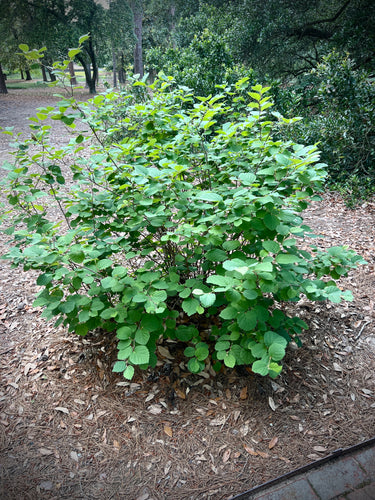
What you notice first is the foliage: cool, glaucous, blue-green straight through summer, as though someone had breathed sea-fog across the leaves and it never quite lifted. In spring, before that color settles, the plant sends up white bottlebrush spikes, petal-less, all stamen, honey-scented, opening as the new leaves unfurl rather than ahead of them. Early pollinators find the flowers well before much else is awake. The habit stays modest and oval-rounded, more contained than a straight major, which is part of why collectors keep asking after a plant still genuinely scarce in the trade.

Fall is the honest part. On a good site 'Sea Spray' colors up; on others, as Michael Dirr noted from the lone specimen he had seen, at Bernheim in 1997, the plant settles for a quieter dark red-brown rather than the orange-and-scarlet riot the genus is known for. More sun, better color. We will not promise fireworks every November.

Our stock traces to a young plant at Hopelands Gardens, the Iselins' fourteen-acre estate here in Aiken, set there by Bob McCartney himself, beneath live oaks and the deodar cedars Hope Iselin planted a century before him. Cuttings off Bob's specimen, grown on at the nursery. Provenance you could drive to.

They ask for little in return: acidic soil that stays moist but drains, a spot in sun to part shade, a mulch over those shallow roots. Deer pass them by. This is the kind of shrub you set in among oakleaf hydrangea and native azaleas and then find yourself watching anyway, the blue of the leaves, the honey on the spring air, the slow pleasure of a thing that manages to be two places at once.

Will this plant thrive in your zone?

Plant Profile
At a glance
Hardiness
USDA Zones 5–8
Sun
Full Sun, Part Shade
Soil
Well-drained, Moist, Acid
Mature size
Height 4–8 Feet · Spread 3–5 Feet
Growth rate
Slow
Seasonality
Deciduous
Design Notes

'Sea Spray' is a foliage plant first, so site the shrub where the cool blue-green summer leaves can do their quiet work: the front of a woodland edge, a mixed shrub border, or among oakleaf hydrangea, native azaleas, and other acid-loving companions. Give sun to part shade, with morning sun and afternoon shade in the lower South, acid soil that stays moist but drains, and a mulch over the shallow roots. Deer leave the plant alone. Set it where the honey-scented spring flowers can be caught on the air near a path or a seat, and treat the gentle fall color as a bonus rather than the main event.

Flower, Fruit & Foliage

1 to 2 inch bottlebrush inflorescences, white stamens, yellow anthers, honey-scented, April to May

Foliage. The reason to grow them. Leaves emerge in spring and deepen, as the season settles, into the cool glaucous blue-green the cultivar is named for, a waxy, sea-glass cast that runs strongest on the undersides, where a fine down silvers the surface paler still. Each leaf is broad and scalloped, two to four inches long, toothed across the upper two-thirds, the veins pressed in deep enough to give the whole shrub a quilted, hand-worked look up close. The stems zig-zag between the buds, a small structural habit of the genus that reads as character once you know to watch for it. Come autumn the color is honest rather than guaranteed: a well-lit plant warms toward bronze and dull red, while a shadier one may simply hold the dark red-brown Dirr recorded at Bernheim.

Flower. As the new leaves unfurl, in April into early May, the plant breaks into white bottlebrush spikes an inch or two long, though white is the eye's shorthand, because these flowers carry no petals at all. What you are looking at is stamens, dozens to a spike, white filaments tipped in soft yellow anthers, massed into a haze that catches light like the foam the plant is named for. The scent is the real surprise: warm and clean and distinctly of honey, traveling further on a still morning than a flower that size has any business doing. Bees and the season's first pollinators find them early, while little else is open.

Fruit. Almost an afterthought. By late summer the spent spikes give way to small two-seeded capsules, beaked and barely half an inch, ripening brown and splitting to fling their hard seed a startling distance, the genus's one piece of theater. On 'Sea Spray' even that is muted: as a hybrid of uneven chromosome count, they set little viable seed, which is exactly why every plant we grow comes from a cutting rather than a sown row.

Care

Read our full care guide

Light & siting

Give them sun to part shade. More sun means more flower and a stronger blue in the leaf, but in the lower South our light has teeth, and a plant set to catch morning sun with shade through the afternoon will thank you for it. The woodland edge is exactly what they're built for. Deep shade dulls both the bloom and the color, so resist the urge to tuck them too far under the canopy.

Soil

Acidic is the one non-negotiable. They want a moist, humus-rich, freely draining soil somewhere in the pH 5 to 6.5 range; offer them lime or a sweet builder's fill instead and they'll sulk, yellow between the veins, and generally let you know about it. Work leaf mold or fine pine bark into the planting hole, especially if your ground runs to heavy clay or hungry sand. Drainage matters as much as moisture. Wet feet in stagnant soil is one of the few things that will undo an otherwise easy shrub.

Water & mulch

Through the first season or two, keep the soil evenly moist while the roots find their footing, and don't let a young plant dry out hard. Once settled they carry a fair tolerance for drought, though they're never really happier than under steady moisture, and a plant in fast sand will want watching come July. Lay two to three inches of pine straw or leaf litter over the root zone and renew it each spring. The roots run shallow, and that blanket keeps them cool, damp, and buffered against the season's swings. Pull the mulch back a hand's width from the stems.

Feeding & pruning

They're not greedy. A spring topdress of compost, or a light feed formulated for acid-lovers if your soil is poor, is plenty; heavy fertilizer only buys you soft growth and little to show for it. Pruning is mostly a matter of restraint. The loose, informal branching is the whole charm, so the less you take, the better they look. If you must, shape just after bloom and lift out any dead or crossing wood. Over the years you can renew an aging plant by cutting the oldest stems to the ground a few at a time.

Hardiness & health

Hardy through USDA Zones 5 to 8, and refreshingly free of trouble once they're sited well: no serious pests, no disease worth naming, and a dependable indifference from the deer. Plant them right, in acid soil with a little room to breathe, and the rest of the work is mostly admiration.

Here’s a closer look at how we produce our plants

From rooting to shipping, our top priority is ensuring you receive healthy, thriving plants for your garden’s success.

Woodlanders Growing Process

Because most of our plants are grown from rooted cuttings — alongside seed, air layering, and grafting chosen for each variety — you receive a stronger, true-to-type plant that establishes quickly in your garden.

Sustainable Growing Practices

Raised on organic soil blends and eco-friendly pest management — never harsh chemicals — your plant arrives healthy for your garden, your family, and the pollinators they feed.

Supporting Local Biodiversity

Every purchase gives back. We donate to the Aiken Arboretum and support local wildlife conservation, so growing your garden helps protect the wider ecosystem too.

At Woodlanders, we are committed to quality.
Grown in Aiken, South Carolina
At Woodlanders, we are committed to quality.

All our plant material is carefully propagated, grown, and nurtured at our humble nursery in Aiken, South Carolina.

Learn more about Woodlanders
Healthy plants, ready to thrive
Success, made simple
Healthy plants, ready to thrive

Your plant arrives carefully packed and ready to settle in. Unpack them promptly, give them a day or two to acclimate, then plant following the notes we include — that’s all it takes. Clear care guidance comes with every order, so success is the easy part.

Read the care guide
Frequently Asked Questions
What to expect upon delivery

All our plants are sold in 1-gallon sizes, though the height of each plant can vary depending on its growth rate and seasonality, typically ranging from 1/2 to 2.5 feet.

Each plant is carefully packaged with its roots enclosed in a secure plastic bag containing moist soil, forming a compact root ball. To ensure safe transport, the box is padded with recycled newspaper, providing both stability and eco-friendly protection from weather during shipping.

What is your return policy?

Review our full return policy information on our SHIPPING AND RETURNS POLICY page.

What payment methods can I use?

We offer 35 different payment methods including major providers like Mastercard, Visa, PayPal, American Express and Diners as well as many different local payment methods including Klarna, iDEAL, AliPay, Sofort, giropay, and many more.

Can I make changes to my order after it’s been placed?

At Woodlanders, we strive to fulfill orders as quickly as possible. Therefore, we can only accommodate changes to your order within the first 24 hours after it has been placed. These changes include adding or removing products and modifying the delivery address. If you need to make any changes or if there has been a mistake with your order information, please reach out to us promptly via our CONTACT page with your order number for the quickest resolution.

Your satisfaction is our priority, and we appreciate your understanding and cooperation.