




Spider Azalea, Seigai Tsutsuji
Rhododendron stenopetalum 'Linearifolium'
Pickup currently unavailable at Aiken Nursery
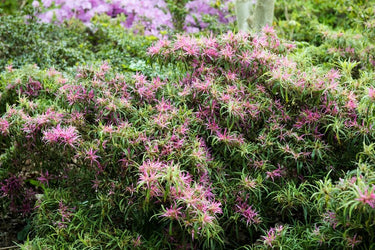
A three-hundred-year-old Japanese garden azalea that does not look quite like a rhododendron, does not look quite like an azalea, and does not really look like anything else. The leaves are narrow green ribbons, three to five millimeters wide and a couple of inches long, closer to willow or fine grass than to the broad rounded foliage of an ordinary tsutsuji. The flowers, opening in late April and May, follow the same grammar: deeply divided into long strap-like petals in lilac-pink to lavender-rose, tangled and knotted at first, then unfurling slowly into a shape that reads, depending on the eye, as a crane fly, a spider, or a piece of decorative garnish. Wabi-sabi made evergreen.
This is one of the great oddities of Japanese horticulture. Azaleas have been bred and refined in Japan since at least the Kamakura period of the twelfth and thirteenth centuries, and selected in earnest through the Edo era; Japan's first book devoted to azaleas, Kinshu Makura, or A Brocade Pillow, appeared in 1692 and codified hundreds of named kinds. 'Linearifolium' is a survivor of that old tradition, a sport chosen and propagated entirely by gardeners, never found in the wild, and alive today only because someone, centuries ago, judged this strange version worth keeping. The Japanese name Seigai Tsutsuji, blue-sea azalea, catches the rippling effect the fine foliage makes in a mass.
The plant has been shuffled through three Latin names over the years, first Rhododendron linearifolium, then R. macrosepalum 'Linearifolium', and now, correctly, R. stenopetalum 'Linearifolium', though the shrub still circulates in the trade under all three. Growth is slow, eventually reaching three or four feet, with a soft, slightly tousled shape that takes kindly to pruning into something more architectural or can be left loose for a quieter effect. The leaves hold through mild winters, often taking on wine-red tones in the cold months before returning to mid-green in spring.
This is not a plant for filling space. This is a plant for the spot where a visitor should slow down and look closely: the corner of a courtyard, a Japanese-style bed, the foot of a stone lantern, beside a bench or a teahouse, anywhere proximity rewards attention. The fine, almost pine-needle texture reads beautifully against the broad leaves of camellias, hostas, or a Japanese maple, and a single specimen carries more interest than a whole bed of ordinary shrubs. Give part shade, acidic, humus-rich, well-drained soil, and shelter from hot afternoon sun that can scorch the narrow leaves.
A fine next step for the gardener who already grows a couple of the broad-leaved azaleas and is ready to move beyond them, and a plant seldom offered, since cuttings root slowly and grudgingly even for skilled propagators. Photos courtesy of Joanna Kossak.
- Hardiness
- USDA Zones 6–8
- Sun
- Part Shade
- Soil
- Well-drained, Acid
- Mature size
- Height 3–5 Feet · Spread 3–5 Feet
- Growth rate
- Slow
- Seasonality
- Semi-Evergreen
Lilac-pink to lavender-rose, spidery, faintly fragrant, late April to May
From rooting to shipping, our top priority is ensuring you receive healthy, thriving plants for your garden’s success.
Because most of our plants are grown from rooted cuttings — alongside seed, air layering, and grafting chosen for each variety — you receive a stronger, true-to-type plant that establishes quickly in your garden.
Raised on organic soil blends and eco-friendly pest management — never harsh chemicals — your plant arrives healthy for your garden, your family, and the pollinators they feed.
Every purchase gives back. We donate to the Aiken Arboretum and support local wildlife conservation, so growing your garden helps protect the wider ecosystem too.

All our plant material is carefully propagated, grown, and nurtured at our humble nursery in Aiken, South Carolina.

Your plant arrives carefully packed and ready to settle in. Unpack them promptly, give them a day or two to acclimate, then plant following the notes we include — that’s all it takes. Clear care guidance comes with every order, so success is the easy part.
What to expect upon delivery
All our plants are sold in 1-gallon sizes, though the height of each plant can vary depending on its growth rate and seasonality, typically ranging from 1/2 to 2.5 feet.
Each plant is carefully packaged with its roots enclosed in a secure plastic bag containing moist soil, forming a compact root ball. To ensure safe transport, the box is padded with recycled newspaper, providing both stability and eco-friendly protection from weather during shipping.
What is your return policy?
Review our full return policy information on our SHIPPING AND RETURNS POLICY page.
What payment methods can I use?
We offer 35 different payment methods including major providers like Mastercard, Visa, PayPal, American Express and Diners as well as many different local payment methods including Klarna, iDEAL, AliPay, Sofort, giropay, and many more.
Can I make changes to my order after it’s been placed?
At Woodlanders, we strive to fulfill orders as quickly as possible. Therefore, we can only accommodate changes to your order within the first 24 hours after it has been placed. These changes include adding or removing products and modifying the delivery address. If you need to make any changes or if there has been a mistake with your order information, please reach out to us promptly via our CONTACT page with your order number for the quickest resolution.
Your satisfaction is our priority, and we appreciate your understanding and cooperation.