


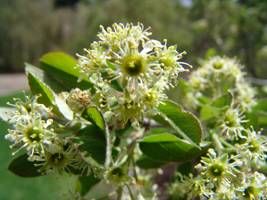

Nantucket Serviceberry
Amelanchier nantucketensis
In propagation
Currently growing out 1 Gallon pots. Expected Winter 2027.
Add your name with the notify button below, and we will email you the moment this plant is ready to bring home.
Learn how we grow on The Prop House.
Pickup currently unavailable at Aiken Nursery
Among the rarest of the serviceberries, Amelanchier nantucketensis is a low, thicket-forming shrub that Eugene Bicknell first described in 1911 from the sandplains of Nantucket, the Massachusetts island whose name the plant carries. Nantucket serviceberry belongs to a small, taxonomically slippery group within the rose family, so closely tangled with neighboring shadbushes that botanists have argued for more than a century over whether this is a true species or a stabilized hybrid. What sets the plant apart is disarmingly small: petals shorter than those of any other serviceberry in the Northeast, often dusted with pollen along their own margins, a quirk called andropetaly that appears nowhere else in the group.
In the wild, colonies cling to open, sandy, sun-baked ground, the pine barrens, sandplain grasslands, and maritime heaths scattered thinly from Nova Scotia and Maine down the coast to Long Island, with the stronghold on Nantucket itself. This is a shrub built for lean living, spreading quietly by underground stolons into low drifts rather than rising into a single crown. White flowers open in mid-spring on short, erect racemes, feeding early bees and butterflies, and give way by early summer to small pomes that birds strip almost as fast as they ripen. Because Nantucket serviceberry is globally uncommon and state-protected across much of that range, growing nursery-propagated stock is a small act of conservation as much as gardening.
The genus name travels from amelanchièr, the old Provençal word for the European serviceberry, while the English names carry their own folklore. Shadbush marks the moment the flowers open, timed to the spring run of shad up the rivers; serviceberry most likely descends from Sorbus, the rowans whose small red pomes the fruit resembles, though a fond old story ties the word to the funeral services held once spring thawed the ground. Serviceberry fruit across the genus is sweet and blueberry-like with a faint almond note from the seeds, long gathered for pies, jams, and preserves, and this species offers the same edible reward on a smaller, wilder scale.
Woodlanders is indebted to Richard Lynch of the Sweetbay Magnolia Bioreserve on Staten Island, New York, for the original stock behind these plants, a lineage worth preserving. In the garden, Nantucket serviceberry asks for full sun and sharp, sandy, acidic soil, the leaner the better, and repays neglect once established. Set the shrub where a low, suckering colony is welcome, along a sunny bank, at a meadow or woodland edge, or woven into a coastal or native planting beside little bluestem, bearberry, lowbush blueberry, and bayberry. Deer tend to pass the plant by, and the autumn foliage warms to orange and red before the bare, twiggy winter frame takes over.
- Hardiness
- USDA Zones 4–8
- Sun
- Full Sun, Part Shade
- Soil
- Well-drained
- Mature size
- Height 4–6 Feet · Spread 4–6 Feet
- Growth rate
- Medium
- Seasonality
- Deciduous
- Provenance
- Original stock from Richard Lynch of the Sweetbay Magnolia Bioreserve, Staten Island, New York.
From rooting to shipping, our top priority is ensuring you receive healthy, thriving plants for your garden’s success.
Because most of our plants are grown from rooted cuttings — alongside seed, air layering, and grafting chosen for each variety — you receive a stronger, true-to-type plant that establishes quickly in your garden.
Raised on organic soil blends and eco-friendly pest management — never harsh chemicals — your plant arrives healthy for your garden, your family, and the pollinators they feed.
Every purchase gives back. We donate to the Aiken Arboretum and support local wildlife conservation, so growing your garden helps protect the wider ecosystem too.

All our plant material is carefully propagated, grown, and nurtured at our humble nursery in Aiken, South Carolina.

Your plant arrives carefully packed and ready to settle in. Unpack them promptly, give them a day or two to acclimate, then plant following the notes we include — that’s all it takes. Clear care guidance comes with every order, so success is the easy part.
What to expect upon delivery
All our plants are sold in 1-gallon sizes, though the height of each plant can vary depending on its growth rate and seasonality, typically ranging from 1/2 to 2.5 feet.
Each plant is carefully packaged with its roots enclosed in a secure plastic bag containing moist soil, forming a compact root ball. To ensure safe transport, the box is padded with recycled newspaper, providing both stability and eco-friendly protection from weather during shipping.
What is your return policy?
Review our full return policy information on our SHIPPING AND RETURNS POLICY page.
What payment methods can I use?
We offer 35 different payment methods including major providers like Mastercard, Visa, PayPal, American Express and Diners as well as many different local payment methods including Klarna, iDEAL, AliPay, Sofort, giropay, and many more.
Can I make changes to my order after it’s been placed?
At Woodlanders, we strive to fulfill orders as quickly as possible. Therefore, we can only accommodate changes to your order within the first 24 hours after it has been placed. These changes include adding or removing products and modifying the delivery address. If you need to make any changes or if there has been a mistake with your order information, please reach out to us promptly via our CONTACT page with your order number for the quickest resolution.
Your satisfaction is our priority, and we appreciate your understanding and cooperation.