


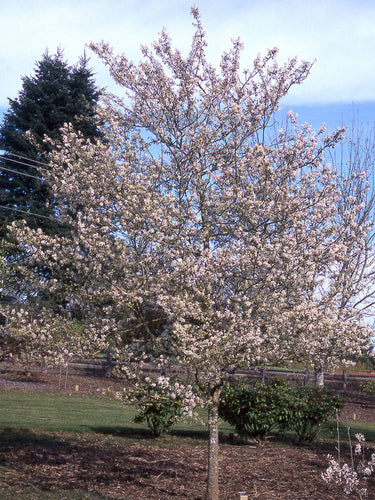


Apple Serviceberry
Amelanchier x grandiflora 'Princess Diana'
In propagation
Currently growing out 1 Gallon pots. Expected Summer 2027.
Add your name with the notify button below, and we will email you the moment this plant is ready to bring home.
Learn how we grow on The Prop House.
Pickup currently unavailable at Aiken Nursery
Apple serviceberry, Amelanchier x grandiflora, is the graceful natural hybrid of two eastern native serviceberries, the downy and the smooth Allegheny, and 'Princess Diana' is among the loveliest selections of the group. The plant appeared in a cultivated garden in Elm Grove, Wisconsin, was propagated and introduced by Tom Watson of Christom Farms Nursery in Cambridge, Wisconsin in 1983, and was granted U.S. Plant Patent 6,041 in 1987, chosen for a wide, gracefully spreading canopy, generous white bloom, and fall color that arrives early and holds late. Where many serviceberries grow stiffly upright, 'Princess Diana' reaches outward, a small tree with the airy, layered poise the name suggests.
In April, before or with the first leaves, the branches fill with showy white flowers rising from yellow buds, an early feast for bees. The new foliage unfolds with a bronze cast, deepens to green through summer, then turns brilliant scarlet and red in autumn, the trait that anchors the plant's reputation. Between bloom and fall color come the berries, small pomes ripening from red to deep bluish-purple by June, sweet and blueberry-flavored, and stripped almost overnight by waxwings, robins, and thrushes.
The old names tell the plant's story. Shadbush marks a bloom timed to the spring shad runs, Juneberry names the month the fruit ripens, and serviceberry most likely descends from Sorbus, the rowans whose small pomes the fruit recalls. Serviceberry fruit has long been food across North America, eaten fresh, dried into cakes, and pounded with fat and meat into pemmican by many Indigenous peoples, and later gathered by settlers for the Juneberry pies and jams still made today. 'Princess Diana' brings that heritage into a compact, ornamental tree.
Gardeners reach for 'Princess Diana' where a graceful small tree is wanted, as a lawn specimen, at a woodland edge, or among naturalized native plantings, and growers report good resistance to the leaf spot that can mar serviceberry foliage. Give full sun to part shade and average, well-drained soil, with even moisture through establishment. The reward is a true four-season tree: white flowers, June fruit for the birds, early and lasting red fall color, and a smooth gray winter silhouette spreading wide against the sky.
- Hardiness
- USDA Zones 3–8
- Sun
- Full Sun, Part Shade
- Soil
- Well-drained, Moist
- Mature size
- Height 15–20 Feet · Spread 12–15 Feet
- Growth rate
- Medium
- Seasonality
- Deciduous
- Provenance
- Found in a cultivated garden in Elm Grove, Wisconsin; propagated and introduced by Tom Watson of Christom Farms Nursery, Cambridge, Wisconsin in 1983, and patented in 1987 under U.S. Plant Patent 6,041.
Showy white flowers opening from yellow buds in April, before or with the first leaves
From rooting to shipping, our top priority is ensuring you receive healthy, thriving plants for your garden’s success.
Because most of our plants are grown from rooted cuttings — alongside seed, air layering, and grafting chosen for each variety — you receive a stronger, true-to-type plant that establishes quickly in your garden.
Raised on organic soil blends and eco-friendly pest management — never harsh chemicals — your plant arrives healthy for your garden, your family, and the pollinators they feed.
Every purchase gives back. We donate to the Aiken Arboretum and support local wildlife conservation, so growing your garden helps protect the wider ecosystem too.

All our plant material is carefully propagated, grown, and nurtured at our humble nursery in Aiken, South Carolina.

Your plant arrives carefully packed and ready to settle in. Unpack them promptly, give them a day or two to acclimate, then plant following the notes we include — that’s all it takes. Clear care guidance comes with every order, so success is the easy part.
What to expect upon delivery
All our plants are sold in 1-gallon sizes, though the height of each plant can vary depending on its growth rate and seasonality, typically ranging from 1/2 to 2.5 feet.
Each plant is carefully packaged with its roots enclosed in a secure plastic bag containing moist soil, forming a compact root ball. To ensure safe transport, the box is padded with recycled newspaper, providing both stability and eco-friendly protection from weather during shipping.
What is your return policy?
Review our full return policy information on our SHIPPING AND RETURNS POLICY page.
What payment methods can I use?
We offer 35 different payment methods including major providers like Mastercard, Visa, PayPal, American Express and Diners as well as many different local payment methods including Klarna, iDEAL, AliPay, Sofort, giropay, and many more.
Can I make changes to my order after it’s been placed?
At Woodlanders, we strive to fulfill orders as quickly as possible. Therefore, we can only accommodate changes to your order within the first 24 hours after it has been placed. These changes include adding or removing products and modifying the delivery address. If you need to make any changes or if there has been a mistake with your order information, please reach out to us promptly via our CONTACT page with your order number for the quickest resolution.
Your satisfaction is our priority, and we appreciate your understanding and cooperation.