


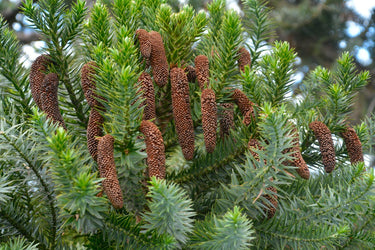

Paraná Pine
Araucaria angustifolia
In propagation
Currently rooting cuttings. Expected Summer 2027.
Add your name with the notify button below, and we will email you the moment this plant is ready to bring home.
Learn how we grow on The Prop House.
Pickup currently unavailable at Aiken Nursery
Araucaria angustifolia is a living relic, one of the last of an ancient conifer family that shaded the dinosaurs across the supercontinent of Gondwana. The Paraná pine belongs to the Araucariaceae, kin to the Chilean monkey puzzle, the Norfolk Island pine, the Australian bunya, and the famously rediscovered Wollemi pine, a lineage once spread worldwide and now scattered mostly across the Southern Hemisphere. Despite the common name, the tree is no true pine at all, but something far older and stranger, holding stiff, sharp, dark green leaves on the branch for a decade or more.
In the wild, Araucaria angustifolia crowns the highland forests of southern Brazil, reaching into northern Argentina and Paraguay, the defining emergent of the Araucaria moist forests within the greater Atlantic Forest. A century of logging for that pale, valuable timber, together with clearing for farms and plantations, has taken an estimated ninety-seven percent of the original range, and the species is now listed by the IUCN as Critically Endangered. To grow one is to keep a piece of a vanishing forest alive, and to plant a tree that may outlast the gardener by generations.
The genus name honors the Arauco region of southern Chile and the Araucano, or Mapuche, people in whose homeland the first-known species grows, while angustifolia simply means narrow-leaved. In southern Brazil the tree means winter food. Female trees, quite separate from the males, ripen enormous cones packed with a hundred or more large seeds called pinhão, gathered by the ton and boiled or roasted through the cold months, ground into flour, and celebrated at seasonal festivals. The harvest is shared with the forest, for the azure jay caches the seeds and, forgetting some, plants the next generation, a partnership on which the tree's survival partly depends.
Given room, Araucaria angustifolia grows tall and columnar, self-pruning to a clean trunk topped by whorls of upturned branches that flatten with age into the candelabra or umbrella crown that names the tree, well over a hundred feet in habitat and more slowly in cultivation. For Southern gardeners the appeal is practical as well as romantic, since this species tolerates the region's heat and humid summers far better than the Chilean monkey puzzle, asking mainly for full sun and well-drained soil. Site the tree in the open as a rare specimen and living fossil, where the bold, prehistoric silhouette can stand alone against the sky.
- Hardiness
- USDA Zones 8–10
- Sun
- Full Sun
- Soil
- Well-drained
- Mature size
- Height 40–80 Feet · Spread 20–30 Feet
- Growth rate
- Medium
- Seasonality
- Evergreen
- Provenance
- Cuttings sourced from a mature specimen we planted in the Aiken Citywide Arboretum.
From rooting to shipping, our top priority is ensuring you receive healthy, thriving plants for your garden’s success.
Because most of our plants are grown from rooted cuttings — alongside seed, air layering, and grafting chosen for each variety — you receive a stronger, true-to-type plant that establishes quickly in your garden.
Raised on organic soil blends and eco-friendly pest management — never harsh chemicals — your plant arrives healthy for your garden, your family, and the pollinators they feed.
Every purchase gives back. We donate to the Aiken Arboretum and support local wildlife conservation, so growing your garden helps protect the wider ecosystem too.

All our plant material is carefully propagated, grown, and nurtured at our humble nursery in Aiken, South Carolina.

Your plant arrives carefully packed and ready to settle in. Unpack them promptly, give them a day or two to acclimate, then plant following the notes we include — that’s all it takes. Clear care guidance comes with every order, so success is the easy part.
What to expect upon delivery
All our plants are sold in 1-gallon sizes, though the height of each plant can vary depending on its growth rate and seasonality, typically ranging from 1/2 to 2.5 feet.
Each plant is carefully packaged with its roots enclosed in a secure plastic bag containing moist soil, forming a compact root ball. To ensure safe transport, the box is padded with recycled newspaper, providing both stability and eco-friendly protection from weather during shipping.
What is your return policy?
Review our full return policy information on our SHIPPING AND RETURNS POLICY page.
What payment methods can I use?
We offer 35 different payment methods including major providers like Mastercard, Visa, PayPal, American Express and Diners as well as many different local payment methods including Klarna, iDEAL, AliPay, Sofort, giropay, and many more.
Can I make changes to my order after it’s been placed?
At Woodlanders, we strive to fulfill orders as quickly as possible. Therefore, we can only accommodate changes to your order within the first 24 hours after it has been placed. These changes include adding or removing products and modifying the delivery address. If you need to make any changes or if there has been a mistake with your order information, please reach out to us promptly via our CONTACT page with your order number for the quickest resolution.
Your satisfaction is our priority, and we appreciate your understanding and cooperation.