




Shining Coneflower
Rudbeckia nitida
Pickup currently unavailable at Aiken Nursery
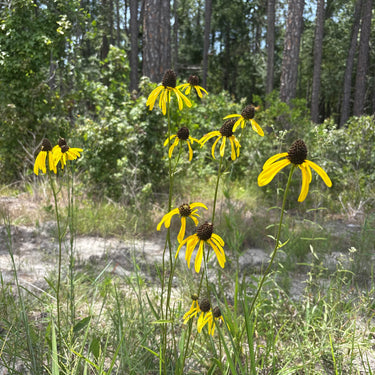
Rudbeckia nitida is a tall, luminous coneflower that trades the coarse hairiness of the common black-eyed Susans for smooth, glossy, dark green leaves and hairless stems, the shining foliage that gives the species a name. From a leafy base rise slender stems three to five feet tall, each carrying a large yellow daisy whose soft rays droop back from a raised, greenish-brown central cone, blooming through the heat of mid to late summer.
A native of the central and eastern United States, the shining coneflower haunts moist woodland edges, low ground, and damp meadows, where the tall stems can lean toward the light. The Woodlanders selection was propagated from a wild source in coastal Georgia, where the plant has grown uncommon or rare, so growing the plant carries a small thread of local conservation. The genus honors Olof Rudbeck, the Swedish botanist and teacher of Linnaeus, while nitida, shining, marks the polished, un-hairy leaves that set the species apart from the rougher coneflowers.
In the garden, Rudbeckia nitida makes a fine tall accent for the back of a moist, sunny to lightly shaded border, a rain garden, a pond edge, or the damp margin of a naturalistic planting, the airy yellow daisies rising above lower companions. The summer bloom feeds bees and butterflies, and the seed heads carry small birds into fall. Pair with Joe-Pye weed, swamp sunflower, ironweed, and native grasses that share the taste for moist ground and open sun.
Give the plant sun to light shade and a moist but well-drained, acid soil, and the tall stems will hold without staking in an open, breezy spot, though rich, damp ground and a little support suit the heaviest growth. Leave the seed heads standing for the birds and the winter silhouette, then cut the old stems in late winter as the glossy new rosette returns. A graceful, less-common native coneflower for the gardener with the damp ground to suit them.
- Hardiness
- USDA Zones 5–9
- Sun
- Full Sun, Part Shade
- Soil
- Moist, Well-drained
- Mature size
- Height 3–5 Feet · Spread 2–3 Feet
- Growth rate
- Moderate
- Seasonality
- Dies back, depends on zone
Yellow drooping rays, greenish-brown central cone, mid to late summer
From rooting to shipping, our top priority is ensuring you receive healthy, thriving plants for your garden’s success.
Because most of our plants are grown from rooted cuttings — alongside seed, air layering, and grafting chosen for each variety — you receive a stronger, true-to-type plant that establishes quickly in your garden.
Raised on organic soil blends and eco-friendly pest management — never harsh chemicals — your plant arrives healthy for your garden, your family, and the pollinators they feed.
Every purchase gives back. We donate to the Aiken Arboretum and support local wildlife conservation, so growing your garden helps protect the wider ecosystem too.

All our plant material is carefully propagated, grown, and nurtured at our humble nursery in Aiken, South Carolina.

Your plant arrives carefully packed and ready to settle in. Unpack them promptly, give them a day or two to acclimate, then plant following the notes we include — that’s all it takes. Clear care guidance comes with every order, so success is the easy part.
What to expect upon delivery
All our plants are sold in 1-gallon sizes, though the height of each plant can vary depending on its growth rate and seasonality, typically ranging from 1/2 to 2.5 feet.
Each plant is carefully packaged with its roots enclosed in a secure plastic bag containing moist soil, forming a compact root ball. To ensure safe transport, the box is padded with recycled newspaper, providing both stability and eco-friendly protection from weather during shipping.
What is your return policy?
Review our full return policy information on our SHIPPING AND RETURNS POLICY page.
What payment methods can I use?
We offer 35 different payment methods including major providers like Mastercard, Visa, PayPal, American Express and Diners as well as many different local payment methods including Klarna, iDEAL, AliPay, Sofort, giropay, and many more.
Can I make changes to my order after it’s been placed?
At Woodlanders, we strive to fulfill orders as quickly as possible. Therefore, we can only accommodate changes to your order within the first 24 hours after it has been placed. These changes include adding or removing products and modifying the delivery address. If you need to make any changes or if there has been a mistake with your order information, please reach out to us promptly via our CONTACT page with your order number for the quickest resolution.
Your satisfaction is our priority, and we appreciate your understanding and cooperation.