


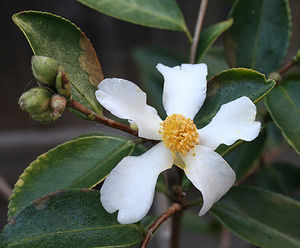

Camellia, Tea-oil
Camellia oleifera
In propagation
Currently growing out 1 Gallon pots. Expected Summer 2027.
Add your name with the notify button below, and we will email you the moment this plant is ready to bring home.
Learn how we grow on The Prop House.
Pickup currently unavailable at Aiken Nursery
Three things to know about this camellia. First, the tea-oil camellia is the most economically important non-tea member of the genus. China has cultivated Camellia oleifera for over two thousand three hundred years for the oil pressed from the seeds, a light, sweetish, monounsaturated cooking oil chemically close to olive oil (around eighty percent oleic acid in both), used for cooking, traditional cosmetics, hair tonics, and the historic rust-proofing of Japanese woodworking tools and chef's knives. Tea oil sits with olive, palm, and coconut among the four major woody oil crops on Earth. This is a working tree.
Second, the tea-oil camellia is also the quiet foundation of cold-hardy camellia growing in North America, and almost no one knows it. In the late 1970s a run of brutal winters at the US National Arboretum in Washington, D.C. destroyed 941 of the 956 camellias in the collection. Among the handful that came through unharmed were specimens of Camellia oleifera. Dr. William Ackerman, then a research geneticist at the Arboretum, took notice, and beginning in 1979 crossed the cold-hardy species, especially the cultivar 'Lu Shan Snow', with C. sasanqua, C. hiemalis, and C. vernalis. The resulting Winter Series hybrids, released in 1991 ('Polar Ice', 'Snow Flurry', 'Winter's Hope', 'Winter's Joy', 'Pink Icicle', 'Winter's Star', and others), are the reason camellias can now be grown reliably into USDA zone 6. Every fall-blooming Ackerman hybrid on the East Coast traces back to this one species.
Third, and this is the part most people miss on hearing the words tea-oil camellia, the plant is beautiful. Smooth, peeling, cinnamon-to-tan bark clothes mature trunks; the glossy, finely toothed, willow-textured leaves are evergreen; and single white flowers two to three inches across, sometimes flushed pink at the edge, open around a generous boss of golden stamens from October into January, carrying a soft sweet fragrance unusual among fall-blooming camellias. Spent petals drop individually, the trait growers call self-grooming, so the plant never slumps into the brown decay that troubles many older japonicas. Slow-growing and eventually ten to twenty feet over decades, the tea-oil camellia builds into a multi-trunked large shrub or a small tree, depending on the pruning.
A plant for the gardener building a tea garden beside a Camellia sinensis, for the collector after the species behind every modern cold-hardy hybrid, or for anyone in zone 6 or 7 wanting a fragrant, fall-flowering evergreen with documented winter survival to fifteen below zero. A genuinely useful plant masquerading as a beautiful one, or the reverse, depending on which side you come at it from.
- Hardiness
- USDA Zones 6–9
- Sun
- Full Sun, Part Shade
- Soil
- Moist, Well-drained
- Mature size
- Height 12–15 Feet · Spread 8–10 Feet
- Growth rate
- Slow
- Seasonality
- Evergreen
From rooting to shipping, our top priority is ensuring you receive healthy, thriving plants for your garden’s success.
Because most of our plants are grown from rooted cuttings — alongside seed, air layering, and grafting chosen for each variety — you receive a stronger, true-to-type plant that establishes quickly in your garden.
Raised on organic soil blends and eco-friendly pest management — never harsh chemicals — your plant arrives healthy for your garden, your family, and the pollinators they feed.
Every purchase gives back. We donate to the Aiken Arboretum and support local wildlife conservation, so growing your garden helps protect the wider ecosystem too.

All our plant material is carefully propagated, grown, and nurtured at our humble nursery in Aiken, South Carolina.

Your plant arrives carefully packed and ready to settle in. Unpack them promptly, give them a day or two to acclimate, then plant following the notes we include — that’s all it takes. Clear care guidance comes with every order, so success is the easy part.
What to expect upon delivery
All our plants are sold in 1-gallon sizes, though the height of each plant can vary depending on its growth rate and seasonality, typically ranging from 1/2 to 2.5 feet.
Each plant is carefully packaged with its roots enclosed in a secure plastic bag containing moist soil, forming a compact root ball. To ensure safe transport, the box is padded with recycled newspaper, providing both stability and eco-friendly protection from weather during shipping.
What is your return policy?
Review our full return policy information on our SHIPPING AND RETURNS POLICY page.
What payment methods can I use?
We offer 35 different payment methods including major providers like Mastercard, Visa, PayPal, American Express and Diners as well as many different local payment methods including Klarna, iDEAL, AliPay, Sofort, giropay, and many more.
Can I make changes to my order after it’s been placed?
At Woodlanders, we strive to fulfill orders as quickly as possible. Therefore, we can only accommodate changes to your order within the first 24 hours after it has been placed. These changes include adding or removing products and modifying the delivery address. If you need to make any changes or if there has been a mistake with your order information, please reach out to us promptly via our CONTACT page with your order number for the quickest resolution.
Your satisfaction is our priority, and we appreciate your understanding and cooperation.