


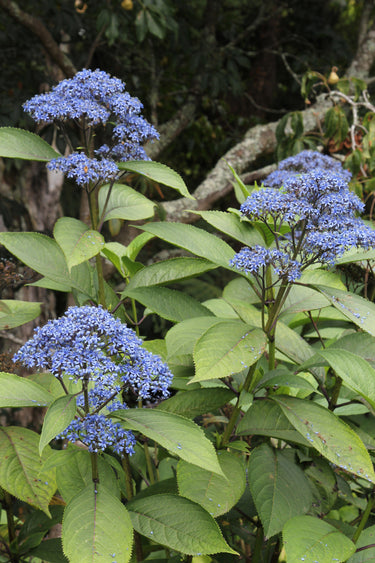


Evergreen Hydrangea
Dichroa versicolor
Pickup currently unavailable at Aiken Nursery
The genus name comes from the Greek dichroos, meaning "two-colored," and Dichroa versicolor presses the idea further: bloom color shifts with soil chemistry much the way a hydrangea does, swinging from deep cobalt to soft mauve depending on how much aluminum a plant can draw up. The species epithet versicolor only doubles down on the point, promising a shrub that refuses to settle on a single shade.
Botanically this is the close cousin of the more familiar Dichroa febrifuga, but built on a grander scale, with leaves three to four times larger and lacecap-like corymbs that can stretch nearly a foot across. Think of the plant as an evergreen hydrangea analog for the gardener who has run out of shade-garden ideas: glossy, deep green leaves the size of a hand, held on dark stems that read almost lacquered in winter light. The species climbs the high, cool mountains of Taiwan, which is part of why these shrubs hold up better in southeastern gardens than a tropical reputation might suggest. Woodlanders' stock traces to a seed exchange between Scott McMahan at the Atlanta Botanical Garden and a high-elevation Taiwanese collection, a provenance that shows in the surprising cold tolerance.
The genus carries a heavier cultural weight through that famous cousin: Dichroa febrifuga is the Chinese quinine of traditional medicine, one of the classic fever herbs of the old pharmacopoeia. Dichroa versicolor is grown instead for pure ornament, and in Hong Kong and parts of southern China the shrub has long done double duty as a garden plant and an informal hedge. We have found the same to be true here, whether the shrub is looped along a shaded path or settled in beside taller camellias where the arching stems can borrow a little structure.
In the garden, give Dichroa versicolor a spot in morning sun or dappled shade where the outsized blooms and, in a good year, the iridescent metallic berries can be read at close range. Acidic, aluminum-rich soil deepens the blue of both flower and fruit, while sweeter ground pushes the same plant toward lavender and pink. Pair the shrub with hydrangeas, ferns, hostas, and aucuba for a lush, shade-loving grouping, and plant a second clone nearby to coax the fullest set of those turquoise-to-near-black berries. A plant for the collector who already owns the hydrangeas and is ready for something quieter and stranger.
- Hardiness
- USDA Zones 8–11
- Sun
- Full Sun, Part Shade
- Soil
- Well-drained, Moist
- Mature size
- Height 3–4 Feet · Spread 3–4 Feet
- Growth rate
- Moderate
- Seasonality
- Evergreen
Corymbs to 12 inches, blue to mauve, late spring into summer
From rooting to shipping, our top priority is ensuring you receive healthy, thriving plants for your garden’s success.
Because most of our plants are grown from rooted cuttings — alongside seed, air layering, and grafting chosen for each variety — you receive a stronger, true-to-type plant that establishes quickly in your garden.
Raised on organic soil blends and eco-friendly pest management — never harsh chemicals — your plant arrives healthy for your garden, your family, and the pollinators they feed.
Every purchase gives back. We donate to the Aiken Arboretum and support local wildlife conservation, so growing your garden helps protect the wider ecosystem too.

All our plant material is carefully propagated, grown, and nurtured at our humble nursery in Aiken, South Carolina.

Your plant arrives carefully packed and ready to settle in. Unpack them promptly, give them a day or two to acclimate, then plant following the notes we include — that’s all it takes. Clear care guidance comes with every order, so success is the easy part.
What to expect upon delivery
All our plants are sold in 1-gallon sizes, though the height of each plant can vary depending on its growth rate and seasonality, typically ranging from 1/2 to 2.5 feet.
Each plant is carefully packaged with its roots enclosed in a secure plastic bag containing moist soil, forming a compact root ball. To ensure safe transport, the box is padded with recycled newspaper, providing both stability and eco-friendly protection from weather during shipping.
What is your return policy?
Review our full return policy information on our SHIPPING AND RETURNS POLICY page.
What payment methods can I use?
We offer 35 different payment methods including major providers like Mastercard, Visa, PayPal, American Express and Diners as well as many different local payment methods including Klarna, iDEAL, AliPay, Sofort, giropay, and many more.
Can I make changes to my order after it’s been placed?
At Woodlanders, we strive to fulfill orders as quickly as possible. Therefore, we can only accommodate changes to your order within the first 24 hours after it has been placed. These changes include adding or removing products and modifying the delivery address. If you need to make any changes or if there has been a mistake with your order information, please reach out to us promptly via our CONTACT page with your order number for the quickest resolution.
Your satisfaction is our priority, and we appreciate your understanding and cooperation.