



Bodinier Beautyberry 'Profusion'
Callicarpa bodinieri var. giraldii 'Profusion'
Pickup currently unavailable at Aiken Nursery
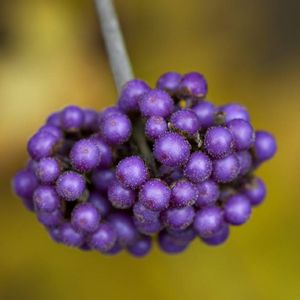
'Profusion' is the beautyberry that finally made the genus behave. A Dutch selection out of Callicarpa bodinieri var. giraldii, a deciduous shrub from west and central China, this clone was chosen for one quality above all: fruit, in quantity, on a young plant, without needing a second shrub nearby to make it happen. Upright arching canes reach eight to ten feet, carrying bronze-purple new growth that shifts to pinkish purple in autumn. Small lilac-pink flowers open at the end of summer, unremarkable and much loved by bees. Then in October the point of the whole thing arrives: tight clusters of berries in a violet so saturated and so metallic that first-time visitors routinely assume the shrub has been sprayed. The berries hold on long after the leaves have gone, which is exactly when a garden needs them.
The names are a small roll call of nineteenth-century plant hunting. Callicarpa is Greek, kallos and karpos, beautiful fruit, and no genus has ever been more literally named. The species honors Émile-Marie Bodinier, a French missionary who botanized across China until his death in 1901 and sent home a great many things nobody in Europe had seen. The varietal epithet honors Giuseppe Giraldi, an Italian missionary collecting in Shaanxi in the same era. Modern floras increasingly fold var. giraldii back into the species, but the trade has kept the longer name on this cultivar for decades, and the Royal Horticultural Society still lists 'Profusion' under it, complete with an Award of Garden Merit.
In China the genus is zi zhu, purple pearl, and the leaves have a long place in the traditional pharmacopoeia as a hemostatic, used to stop bleeding both internal and external. Callicarpa bodinieri itself is among the species drawn on. Phytochemical surveys of the genus have turned up well over two hundred compounds, diterpenes and triterpenoids and flavonoids chief among them, and laboratory work has reported anti-inflammatory and analgesic activity alongside the traditional hemostatic use. Woodlanders customers may know the American cousin, Callicarpa americana, which carries a parallel tradition among Indigenous peoples of the Southeast, where crushed leaves were worked into a mosquito repellent.
Plant in full sun. Shade costs you fruit, and fruit is the entire proposition. Beautyberries flower and fruit on new wood, so cut the whole shrub back hard in late winter, to a foot or two from the ground if you like; the response is vigorous and the berry display improves for it. Ordinary soil suits, moisture is welcome, and nothing much bothers the plants. Site where the October color will be seen from a window or a path, ideally against something dark or evergreen, since violet berries disappear entirely against a background of brown twigs. Good partners are Ilex verticillata for the red-against-violet argument, ornamental grasses for the movement, and any evergreen backdrop that will hold the color still.
- Hardiness
- USDA Zones 5–8
- Sun
- Full Sun, Part Shade
- Soil
- Well-drained, Moist
- Mature size
- Height 8–10 Feet · Spread 6–8 Feet
- Growth rate
- Fast
- Seasonality
- Deciduous
small lilac-pink flowers in axillary cymes at the end of summer, followed by dense violet berry clusters
These statements have not been evaluated by the Food and Drug Administration. This information is shared for traditional and educational interest only and is not intended to diagnose, treat, cure, or prevent any disease. Please consult a qualified healthcare professional before any medicinal use.
- Berries are ornamental and are not a food
- Not evaluated for safety in pregnancy or while breastfeeding
- May interact with anticoagulant medication
- Consult a qualified practitioner before use
From rooting to shipping, our top priority is ensuring you receive healthy, thriving plants for your garden’s success.
Because most of our plants are grown from rooted cuttings — alongside seed, air layering, and grafting chosen for each variety — you receive a stronger, true-to-type plant that establishes quickly in your garden.
Raised on organic soil blends and eco-friendly pest management — never harsh chemicals — your plant arrives healthy for your garden, your family, and the pollinators they feed.
Every purchase gives back. We donate to the Aiken Arboretum and support local wildlife conservation, so growing your garden helps protect the wider ecosystem too.

All our plant material is carefully propagated, grown, and nurtured at our humble nursery in Aiken, South Carolina.

Your plant arrives carefully packed and ready to settle in. Unpack them promptly, give them a day or two to acclimate, then plant following the notes we include — that’s all it takes. Clear care guidance comes with every order, so success is the easy part.
What to expect upon delivery
All our plants are sold in 1-gallon sizes, though the height of each plant can vary depending on its growth rate and seasonality, typically ranging from 1/2 to 2.5 feet.
Each plant is carefully packaged with its roots enclosed in a secure plastic bag containing moist soil, forming a compact root ball. To ensure safe transport, the box is padded with recycled newspaper, providing both stability and eco-friendly protection from weather during shipping.
What is your return policy?
Review our full return policy information on our SHIPPING AND RETURNS POLICY page.
What payment methods can I use?
We offer 35 different payment methods including major providers like Mastercard, Visa, PayPal, American Express and Diners as well as many different local payment methods including Klarna, iDEAL, AliPay, Sofort, giropay, and many more.
Can I make changes to my order after it’s been placed?
At Woodlanders, we strive to fulfill orders as quickly as possible. Therefore, we can only accommodate changes to your order within the first 24 hours after it has been placed. These changes include adding or removing products and modifying the delivery address. If you need to make any changes or if there has been a mistake with your order information, please reach out to us promptly via our CONTACT page with your order number for the quickest resolution.
Your satisfaction is our priority, and we appreciate your understanding and cooperation.