


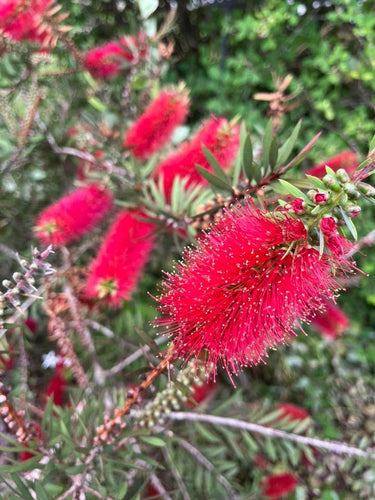


Hardy Red Bottlebrush
Callistemon 'Woodlander's Hardy'
Pickup currently unavailable at Aiken Nursery
This is a Woodlanders plant in the most literal sense: selected, named, and introduced to the American nursery trade by this nursery, in this town, decades ago. The cultivar now carries our name across the country. One Green World in Oregon, Cistus on Sauvie Island, Greenleaf as a national wholesaler, Wilson Bros in three-gallon, Cloud Mountain Farm in Washington, Dancing Oaks in the Willamette Valley, and dozens of regional nurseries from Louisiana to Idaho all carry the plant. Few cultivars in American horticulture are so permanently tied to a single small nursery in Aiken, South Carolina. To buy here is to buy at the source.
The story is one of those small, persistent acts of selection that quietly change what a region can grow. Callistemon, the bottlebrush, is an Australian genus of around fifty species, traditionally grown in the United States only in zone 9 and warmer: a pretty plant with brilliant red stamen-flowers, but tender. Woodlanders identified a clone with the cold tolerance to push the genus a full hardiness zone north, reliably evergreen at 5°F, the parent plant having survived a North Carolina winter that bottomed out at minus nine. The result is the cold-hardiest red bottlebrush in the American trade, a plant that was supposed to belong to Florida and southern California and now belongs, just as comfortably, to the upper South, the Mid-Atlantic, and the Pacific Northwest.
A note on the name. The plant was first distributed as Callistemon sieberi, but true C. sieberi has yellow flowers and ours is unmistakably red, so that attribution was wrong. Decades of detective work have not pinned down the exact parent species (some point to C. rigidus or C. subulatus), and the plant is most accurately written today as Callistemon sp. 'Woodlander's Hardy', or, under the recent taxonomic merger, Melaleuca viminalis 'Woodlander's Hardy'. We carry the original name forward because the cultivar selection, the actual plant, is the point, not the species lineage.
In the garden, 'Woodlander's Hardy' forms a graceful, somewhat weeping shrub, eventually four to six feet tall and as wide, the arching branches lined with narrow, soft, lance-shaped evergreen leaves that take on coppery and russet tones through the cold months. The genus name, from the Greek kalli, beautiful, and stemon, stamen, beautiful stamens, makes immediate sense in bloom: the flowers are essentially all stamens, each four-inch cylindrical brush composed of hundreds of long red filaments tipped with golden anthers, the true petals tiny and lost behind the show. Peak bloom comes in late spring, with sporadic rebloom through summer and into fall on new wood, so a light pruning after the main flush meaningfully extends the season. Hummingbirds find the flowers within hours of the first opening; bees, butterflies, and beneficial wasps work them heavily.
Drought tolerant once established, and heat tolerant, and humidity tolerant, and forgiving of poor lean soil, salt spray, and urban grit, the bottlebrush shrugs off most of what defeats fussier shrubs. Deer largely pass the foliage by, which carries the soft lemony scent of the myrtle family when crushed.
For the zone 7 gardener who always wanted a bottlebrush and was told it could not be done, the hummingbird gardener after a long-blooming evergreen anchor, the Lowcountry gardener building a heat-and-humidity-proof border, or the collector who wants the plant that put Woodlanders into the American nursery trade.
- Hardiness
- USDA Zones 7–10
- Sun
- Full Sun, Part Shade
- Soil
- Well-drained
- Mature size
- Height 4–6 Feet · Spread 4–6 Feet
- Growth rate
- Moderate
- Seasonality
- Evergreen
Brilliant red bottlebrush spikes of red stamens with golden anthers, late spring with rebloom
From rooting to shipping, our top priority is ensuring you receive healthy, thriving plants for your garden’s success.
Because most of our plants are grown from rooted cuttings — alongside seed, air layering, and grafting chosen for each variety — you receive a stronger, true-to-type plant that establishes quickly in your garden.
Raised on organic soil blends and eco-friendly pest management — never harsh chemicals — your plant arrives healthy for your garden, your family, and the pollinators they feed.
Every purchase gives back. We donate to the Aiken Arboretum and support local wildlife conservation, so growing your garden helps protect the wider ecosystem too.

All our plant material is carefully propagated, grown, and nurtured at our humble nursery in Aiken, South Carolina.

Your plant arrives carefully packed and ready to settle in. Unpack them promptly, give them a day or two to acclimate, then plant following the notes we include — that’s all it takes. Clear care guidance comes with every order, so success is the easy part.
What to expect upon delivery
All our plants are sold in 1-gallon sizes, though the height of each plant can vary depending on its growth rate and seasonality, typically ranging from 1/2 to 2.5 feet.
Each plant is carefully packaged with its roots enclosed in a secure plastic bag containing moist soil, forming a compact root ball. To ensure safe transport, the box is padded with recycled newspaper, providing both stability and eco-friendly protection from weather during shipping.
What is your return policy?
Review our full return policy information on our SHIPPING AND RETURNS POLICY page.
What payment methods can I use?
We offer 35 different payment methods including major providers like Mastercard, Visa, PayPal, American Express and Diners as well as many different local payment methods including Klarna, iDEAL, AliPay, Sofort, giropay, and many more.
Can I make changes to my order after it’s been placed?
At Woodlanders, we strive to fulfill orders as quickly as possible. Therefore, we can only accommodate changes to your order within the first 24 hours after it has been placed. These changes include adding or removing products and modifying the delivery address. If you need to make any changes or if there has been a mistake with your order information, please reach out to us promptly via our CONTACT page with your order number for the quickest resolution.
Your satisfaction is our priority, and we appreciate your understanding and cooperation.