Field Guide · Xeriscape & Drought · Aiken, South Carolina
Gardening for the Dry Years: A Xeriscape Field Guide for the Changing South
Our summers are lengthening and our rain is growing less dependable. The wise border is learning to ask less of the hose, and these are the drought-proof plants now filling our propagation benches to meet it.
I The Case for the Dry Garden
For a long time, xeriscape was a word that belonged to somewhere else. It conjured Arizona: gravel, saguaro, the heat-shimmer of a place that had made its peace with going without. Here in the Southeast we had rain, generous and reliable, and we planted as though it always would be. That assumption is quietly expiring. Our summers arrive earlier and stay later, the dry spells between storms stretch longer, and the gardener who plans for the weather of thirty years ago is planning for a climate that no longer shows up on schedule.
None of this is cause for despair, and all of it is cause for a different plant list. A garden built around drought-adapted plants is not a lesser garden or a sacrifice; done well, it is more beautiful, more alive with pollinators, and far less work than the thirsty borders it replaces. The good news, the news we are most excited to share, is that the palette for a Southern dry garden is enormous, and much of it is already growing by the hundred on our benches, headed for the catalog. This is a field guide to that palette.
A drought-adapted garden is not a lesser garden or a sacrifice. Done well, it is more beautiful, more alive, and far less work.

II What Xeriscape Actually Means
Let us clear away the cliche first, because it does real harm. Xeriscape does not mean gravel and cactus, and it certainly does not mean a barren yard of rock and yucca. The word simply names a way of gardening that works with the water a place actually receives rather than against it. The principles are unglamorous and they are the whole game: choose plants adapted to your rainfall, group them by their thirst, give them the sharp drainage most of them evolved on, and water deeply but rarely so roots go looking for moisture instead of loitering at the surface.
What makes the approach so generous, especially in our climate, is how wide the qualifying plant list turns out to be. Mediterranean subshrubs, Southwestern sages, Australian bottlebrush, native prairie grasses, aromatic herbs, all of these thrive on lean soil and long dry spells. Many are evergreen, most are pollinator magnets, and a surprising number bloom for months rather than weeks. The plants that follow are the heroes we lean on most, chosen because they earn their place through a whole Southern summer and because we are propagating them now in numbers.
III The Backbone: The Salvia Bench
If a Southern xeriscape has a backbone, it is the sages. No other group we grow gives so much bloom for so little water over so long a season, and no other group fills our propagation house the way the salvias do right now, tray after tray of autumn sage, Mexican bush sage, and their many named kin rooting through the summer heat. They are the plants we reach for first when someone asks where to start.
The autumn sages, Salvia greggii and the closely allied Salvia x jamensis, are the daily bread of the group: compact, semi-woody little shrubs native to the limestone hills of Texas and northern Mexico, where they learned to bloom through drought and heat that would flatten a lesser plant. Their deep roots reach water the surface has long since lost, and in exchange they flower from spring to frost in cherry, coral, white, and every shade between, feeding hummingbirds the entire time. Give them full sun and free-draining soil, keep them out of wet clay, and they ask for almost nothing else.
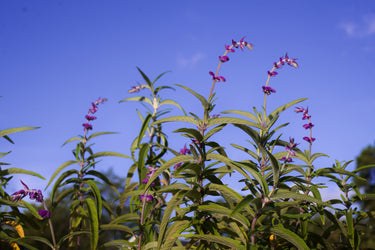
Where the autumn sages are the workhorses, Salvia leucantha, the Mexican bush sage, is the showpiece: a taller, fountaining plant whose arching wands of velvety purple flower spikes carry the late-summer and autumn garden when much else has faded. It is one of the most drought-tolerant and reliable sages for the Deep South, and our benches are full of it in selections like the all-purple 'Midnight'.
Salvia greggii 'Cherry Queen'
- Drought Tolerant
- Hummingbirds
- Full Sun
- Blooms to Frost
A cherry-red autumn sage from one of America's finest salvia hybridizers, blooming spring to frost on a compact, semi-woody frame. Deep-rooted, heat-proof, and adored by hummingbirds. The kind of plant that does the quiet heavy lifting in a dry border, currently rooting on our benches by the tray.
View at Woodlanders ›
Salvia leucantha 'Midnight'
- Drought Tolerant
- Pollinator
- Fall Bloom
- Architectural
Mexican bush sage in its all-purple selection, throwing arching wands of velvety flower spikes from late summer into autumn. A fountaining, shrub-sized sage that carries the dry border when summer's flush has gone, and one of the most dependable salvias we grow for the Deep South.
View at Woodlanders ›Field Note
The salvias fail in the Southeast for one reason far more than any other: wet feet. These are plants of lean, fast-draining hillsides, and rich soil kept moist through our humid summers or soggy through our winters will rot the crown every time. If your ground is heavy clay, plant high on a mound, cut the soil with coarse grit, and resist the urge to be generous. With sages, a little neglect is a kind of love.
IV Evergreen Structure: The Bottlebrush
A garden of sages and grasses can drift toward the ephemeral, all bloom and movement and nothing to hold the eye in winter. This is where the bottlebrushes earn their keep. The Callistemon are Australian evergreens built for exactly the conditions a changing South is delivering: heat, drought, poor soil, and the occasional hard freeze. They hold a dense, fine-leaved presence all year, and in late spring they light up with the brilliant brush-like flowers that give them their name, each one a landing strip for bees and hummingbirds.
Two selections anchor our benches. Callistemon rigidus 'Clemson' is an exceptional cold-hardy form, a compact-to-medium evergreen hung with vivid red brushes and tough enough to shrug at both drought and a Piedmont winter. And then there is a plant we are especially proud of: Callistemon 'Woodlander's Hardy', selected, named, and introduced to the American nursery trade by this nursery, in this town. It is bottlebrush proven in our own ground, which is the highest recommendation we know how to give.

Callistemon rigidus 'Clemson'
- Drought Tolerant
- Evergreen
- Cold-Hardy
- Pollinator
An exceptional cold-hardy bottlebrush: a compact-to-medium evergreen shrub hung with brilliant red, brush-like flowers in late spring, tough through both drought and a Piedmont winter. Year-round structure and a pollinator banquet in one plant. A perennial best seller for good reason.
View at Woodlanders ›
Callistemon 'Woodlander's Hardy'
- Woodlanders Introduction
- Drought Tolerant
- Deer-Resistant
- Fragrant
A Woodlanders plant in the most literal sense: selected, named, and introduced to the trade by this nursery, in this town. An aromatic, deer-resistant, drought-tough evergreen bottlebrush proven in our own Aiken ground, and one of our most quietly beloved introductions.
View at Woodlanders ›V The Kitchen-Garden Anchor: Rosemary
No dry-garden palette is complete without the plant that has anchored Mediterranean hillsides, and Mediterranean cooking, for millennia. Rosemary, botanically shuffled of late from Rosmarinus officinalis into the genus Salvia but forever rosemary to the rest of us, is the ideal xeriscape shrub: evergreen, aromatic, blue-flowered in the cool months, indifferent to drought and poor soil, and useful in the kitchen the year around. It gives structure like a small hedge, scent every time you brush past, and nectar for bees in the lean season when little else is open. That it thrives on neglect is simply the Mediterranean way.

Rosmarinus officinalis
- Drought Tolerant
- Evergreen
- Edible
- Fragrant
The timeless Mediterranean classic, in the garden and the kitchen alike: an aromatic evergreen shrub with needle-like leaves and blue cool-season flowers, thriving on full sun, poor soil, and long dry spells. Structure, scent, nectar, and seasoning from a single tough plant.
View at Woodlanders ›VI The Mediterranean Note: Rockrose
For sheer flowering generosity on the driest, hottest ground you can offer, few shrubs rival the rockroses. Cistus are evergreen Mediterranean shrubs that stand up to heat, wind, salt, and drought without complaint, and once established they want no water and no fertilizer at all. Their charm is a particular kind of extravagance: each papery flower lasts only from morning to evening, but the plant produces them by the hundred through late spring and early summer, so a rockrose in season looks perpetually strewn with silk. Cistus x purpureus, the orchid rockrose, opens rich rose-purple blooms with a dark basal blotch, a small daily miracle on a plant that asks for nothing.
Each papery flower lasts only a day, but the plant makes them by the hundred, so a rockrose in season looks perpetually strewn with silk.

Cistus x purpureus
- Drought Tolerant
- Evergreen
- Fragrant
- Pollinator
The orchid rockrose: an evergreen Mediterranean shrub that opens rose-purple, dark-blotched flowers by the hundred through late spring, each lasting a single day. Unbothered by heat, wind, salt, or drought, and happiest where you would water nothing else. Extravagant bloom for zero maintenance.
View at Woodlanders ›VII Movement: The Grasses
Structure and bloom will carry a dry garden a long way, but it is the grasses that give it life, the low sound and constant motion that make a planting feel like weather rather than furniture. For the Southern xeriscape there is no finer choice than our native Muhlenbergia capillaris, pink muhly grass, a fine-textured bunchgrass that spends the year as an unassuming green fountain and then, in autumn, erupts into a cloud of rose-pink flower so diffuse it looks like colored smoke caught in the light. It is drought-tolerant to a fault, native to our own sandy soils, and never more beautiful than when backlit by a low October sun.

Muhlenbergia capillaris
- Native
- Drought Tolerant
- Ornamental Grass
- Fall Color
Pink muhly grass: a native, fine-textured bunchgrass that holds as a quiet green fountain all summer, then in autumn throws a diffuse cloud of rose-pink bloom like colored smoke. Deeply drought-tolerant, at home in lean sandy soil, and unforgettable backlit by a low fall sun.
View at Woodlanders ›VIII A Xeriscape Spec Table
A quick reference to the heroes on this list, with the numbers that decide where each one belongs.
| Plant | Type | Cold Hardiness | Role in the Dry Garden |
|---|---|---|---|
| Salvia greggii (autumn sage) | Semi-woody subshrub | Zone 7–8 | Long-blooming backbone; hummingbirds |
| Salvia leucantha (Mexican bush sage) | Fountaining subshrub | Zone 8 | Late-season showpiece; height |
| Callistemon rigidus 'Clemson' | Evergreen shrub | Zone 7 (cold-hardy) | Year-round structure; spring bloom |
| Callistemon 'Woodlander's Hardy' | Evergreen shrub | Zone 7–8 | Structure; nursery introduction |
| Rosmarinus officinalis | Evergreen herb-shrub | Zone 7–8 | Low hedge; scent; edible; winter bloom |
| Cistus x purpureus (rockrose) | Evergreen shrub | Zone 8 | Extravagant early-summer bloom |
| Muhlenbergia capillaris (muhly) | Native bunchgrass | Zone 6–7 | Movement, texture, fall color |
IX Building the Palette
A xeriscape is a community before it is a collection, and it composes best when you plant in the layers the plants themselves suggest. Let the evergreen shrubs, the bottlebrushes and rosemary, set the year-round frame and the winter bones. Weave the sages through the sunny gaps for months of bloom and a steady hum of hummingbirds. Drop the rockrose where the ground is hottest and poorest, the spot you had given up on. And run the muhly grass in loose drifts along the front and edges, where the light can find it in fall. Group everything by its thirst, mulch with gravel rather than bark to keep crowns dry, and you will have built a planting that looks generous while asking almost nothing of the tap.
X Field Notes From the Nursery
How much water does a new xeriscape really need?
More than you might think, but only at the start. Even the most drought-proof plant needs regular deep watering through its first growing season to push roots down into the soil. Water deeply and infrequently, soaking the root zone and then letting it dry, which trains roots to go deep. After that first year most of these heroes need supplemental water only in true extended drought, and many need none at all.
Should I improve my soil for these plants?
Improve its drainage, not its richness. Almost every plant here evolved on lean, fast-draining ground and resents fertility and moisture in equal measure. In heavy Southeastern clay, plant on a raised mound or berm and work in coarse grit or expanded shale. Skip the compost and skip the fertilizer; a fed, watered xeriscape plant grows soft, floppy, and short-lived.
Will a dry garden still feed pollinators?
Emphatically yes, and often better than a conventional border. The salvias are among the finest hummingbird plants in cultivation, the bottlebrushes and rockrose draw bees in clouds, and the long, staggered bloom of a mixed xeriscape offers nectar across more of the year than a bed that peaks and fades. Drought-adapted rarely means wildlife-poor; usually it means the opposite.
References
North Carolina Extension Gardener Plant Toolbox: Salvia greggii (Autumn Sage).
Lady Bird Johnson Wildflower Center: Salvia greggii, Native Plant Database.
Oregon State University Horticulture: Rockrose (Cistus spp.) Evaluation.
Gardening Know How: Growing Rockrose Plants.
From the Nursery
Planning a dry garden for the years ahead?
Nearly every plant in this field guide is on our benches right now, propagated and grown on here in Aiken for the seasons to come. As our climate shifts, these drought-proof heroes are becoming the heart of what we grow, and we would love to help you build a border around them. Browse the Woodlanders catalog, keep an eye on the salvia and bottlebrush restocks, and write us with a photo of your hottest, driest corner; matching a plant to a hard place is our favorite kind of problem.