


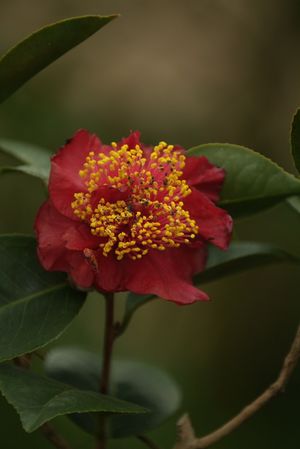


Red Camellia (named cultivar ?)
Camellia japonica (single red)
1 Gallon | Hardiness Zones 7-9
A camellia with a story we can only tell halfway. Years ago, a plant was dropped off at the nursery in Aiken — left for a friend to pick up and carry home to Korea. The pickup never happened. The plant stayed. The label, somewhere in the years that followed, was lost. We propagated her anyway, because she was too good to let slip, and because she has the particular bone structure of a real cultivar — someone, somewhere, named her.
What she is, plainly: a single-form Camellia japonica with short, heavily textured petals in deep oxblood red, arranged in a clean flat ring around a generous bright-yellow stamen boss. The single red japonica is one of the oldest forms in cultivation — it's the camellia that appears in Chinese paintings and porcelain from the 11th century onward, the camellia before camellias became the elaborate, ruffled, formal-double affairs of the Victorian show bench. Holding one of her flowers in your hand, you understand why early painters bothered. The contrast of the matte red against the gold center is graphic and arresting in a way the more ornate cultivars never quite manage.
She has glossy, dark green foliage and the upright, well-mannered habit of a good japonica. We've grown her long enough to know she performs reliably in part shade, blooms heavily, and reads beautifully against winter foliage and bare wood. As an unnamed selection she's a chance to own something not in any catalog, not in any breeder's registry — a camellia with provenance that ends, charmingly, at a doorstep.
For the gardener who would rather have one good plant with a story than three named ones without.
Pickup available at Aiken Nursery
Usually ready in 2-4 days
Schedule Delayed Shipping in your Cart
| Hardiness Zones | USDA Zones 7-9 |
| Sun | Part Shade |
| Soil | Well-drained, Acid, Mulched, and Sandy |
| Mature size | Height: 4-6 Feet / Spread: 2-4 Feet |
| Growth Rate | Slow |
| Seasonality | Evergreen |
Flower, Fruit and Foliage
Here’s a closer look at how we produce our plants:
From rooting to shipping, our top priority is ensuring you receive healthy, thriving plants for your garden’s success.

The majority of our plants are carefully cultivated from rooted cuttings, while we also utilize propagation methods such as seed, air layering, and grafting, thoughtfully chosen to suit each plant’s unique needs.

Our plants are cultivated using sustainable practices, including organic soil blends and eco-friendly pest management, ensuring they thrive while minimizing environmental impact.

We are proud to contribute to local biodiversity through ongoing donations to the Aiken Arboretum and support for local wildlife conservation efforts, helping to preserve and enhance our community’s natural ecosystems.
Frequently Asked Questions
What to expect upon delivery
All our plants are sold in 1-gallon sizes, though the height of each plant can vary depending on its growth rate and seasonality, typically ranging from 1/2 to 2.5 feet.
Each plant is carefully packaged with its roots enclosed in a secure plastic bag containing moist soil, forming a compact root ball. To ensure safe transport, the box is padded with recycled newspaper, providing both stability and eco-friendly protection from weather during shipping.
What is your return policy?
Review our full return policy information on our SHIPPING AND RETURNS POLICY page.
What payment methods can I use?
We offer 35 different payment methods including major providers like Mastercard, Visa, PayPal, American Express and Diners as well as many different local payment methods including Klarna, iDEAL, AliPay, Sofort, giropay, and many more.
Can I make changes to my order after it’s been placed?
At Woodlanders, we strive to fulfill orders as quickly as possible. Therefore, we can only accommodate changes to your order within the first 24 hours after it has been placed. These changes include adding or removing products and modifying the delivery address. If you need to make any changes or if there has been a mistake with your order information, please reach out to us promptly via our CONTACT page with your order number for the quickest resolution.
Your satisfaction is our priority, and we appreciate your understanding and cooperation.