


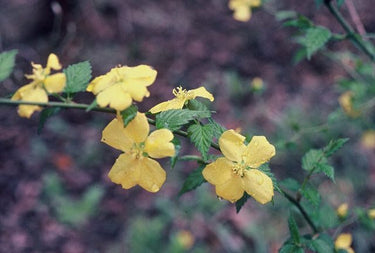

Japanese Kerria, 'Shannon'
Kerria japonica 'Shannon'
In propagation
Currently growing out 1 Gallon pots. Expected Fall 2026.
Add your name with the notify button below, and we will email you the moment this plant is ready to bring home.
Learn how we grow on The Prop House.
Pickup currently unavailable at Aiken Nursery
William Kerr arrived in Guangzhou in 1803 as the first professional plant hunter posted permanently in China, dispatched by Sir Joseph Banks and the Royal Botanic Gardens at Kew to send back whatever the southern port cities could offer. Among his returns was a double-flowered shrub with bright yellow, pompon-like blooms, gathered from cultivation and shipped to Kew in 1805. The genus was eventually named Kerria in his honor. His later years were less distinguished, marked by an opium habit and a thinning correspondence, and he died in Ceylon in 1814. The double-flowered form he introduced, 'Pleniflora', went on to become one of the most common shrubs in Victorian gardens, present in nearly every collection of the era and still widely planted today.
The single-flowered species did not reach Western gardens until 1834, nearly thirty years later, and yet in botanical terms the single is the original: the form that grows wild on mountain slopes in China and Japan, and the one that appears in the Man'yoshu, the oldest surviving collection of Japanese poetry, where yamabuki, the Japanese name for kerria, carries associations of spring, impermanence, and the particular yellow of mountain streams in early morning light. The double-flowered form is the cultivated elaboration; 'Shannon' stands closer to the source.
What 'Shannon' offers over the standard single species is scale. The flowers are large, considerably bigger than the typical single form, clear golden yellow, each with the full five-petaled simplicity of a wild rose relative, which is exactly what kerria is. The blooms appear in spring in generous numbers along the arching green canes, then continue sporadically through summer in a way the double forms never manage. The bright green stems persist through winter, staying vivid and photosynthetically active long after the leaves have dropped, a feature that keeps the shrub genuinely interesting from December through March, more than most spring-flowering shrubs can claim.
Kerria carries a modest place in traditional Chinese medicine as well, where a decoction of the flowering shoots, sometimes taken with honey, was used as a folk remedy for coughs and women's complaints. That note belongs to the plant's history and is offered for interest only, not as medical advice. In the garden the practical case is simpler still: kerria thrives in shade that defeats most flowering shrubs, and among the single-flowered forms, 'Shannon' is the best version widely available.
- Hardiness
- USDA Zones 4–9
- Sun
- Part Shade, Full Shade
- Soil
- Well-drained, Loam
- Mature size
- Height 3–5 Feet · Spread 3–5 Feet
- Growth rate
- Moderate
- Seasonality
- Deciduous
Clear golden yellow, single, large, spring
These statements have not been evaluated by the Food and Drug Administration. This information is shared for traditional and educational interest only and is not intended to diagnose, treat, cure, or prevent any disease. Please consult a qualified healthcare professional before any medicinal use.
- Traditional folk use only, not a substitute for professional medical care
- Safety in modern use is not well studied
From rooting to shipping, our top priority is ensuring you receive healthy, thriving plants for your garden’s success.
Because most of our plants are grown from rooted cuttings — alongside seed, air layering, and grafting chosen for each variety — you receive a stronger, true-to-type plant that establishes quickly in your garden.
Raised on organic soil blends and eco-friendly pest management — never harsh chemicals — your plant arrives healthy for your garden, your family, and the pollinators they feed.
Every purchase gives back. We donate to the Aiken Arboretum and support local wildlife conservation, so growing your garden helps protect the wider ecosystem too.

All our plant material is carefully propagated, grown, and nurtured at our humble nursery in Aiken, South Carolina.

Your plant arrives carefully packed and ready to settle in. Unpack them promptly, give them a day or two to acclimate, then plant following the notes we include — that’s all it takes. Clear care guidance comes with every order, so success is the easy part.
What to expect upon delivery
All our plants are sold in 1-gallon sizes, though the height of each plant can vary depending on its growth rate and seasonality, typically ranging from 1/2 to 2.5 feet.
Each plant is carefully packaged with its roots enclosed in a secure plastic bag containing moist soil, forming a compact root ball. To ensure safe transport, the box is padded with recycled newspaper, providing both stability and eco-friendly protection from weather during shipping.
What is your return policy?
Review our full return policy information on our SHIPPING AND RETURNS POLICY page.
What payment methods can I use?
We offer 35 different payment methods including major providers like Mastercard, Visa, PayPal, American Express and Diners as well as many different local payment methods including Klarna, iDEAL, AliPay, Sofort, giropay, and many more.
Can I make changes to my order after it’s been placed?
At Woodlanders, we strive to fulfill orders as quickly as possible. Therefore, we can only accommodate changes to your order within the first 24 hours after it has been placed. These changes include adding or removing products and modifying the delivery address. If you need to make any changes or if there has been a mistake with your order information, please reach out to us promptly via our CONTACT page with your order number for the quickest resolution.
Your satisfaction is our priority, and we appreciate your understanding and cooperation.