


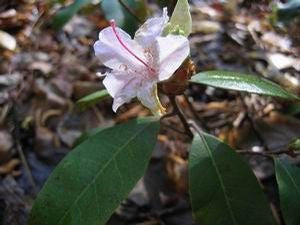

Chapman's Rhododendron
Rhododendron chapmanii
See all 49 Azaleas & Rhododendrons
In propagation
Currently growing out 1 Gallon pots. Expected season to be announced.
Add your name with the notify button below, and we will email you the moment this plant is ready to bring home.
Learn how we grow on The Prop House.
Pickup currently unavailable at Aiken Nursery
Chapman's rhododendron is a compact evergreen shrub of six to eight feet, carrying small, thick, distinctly rounded leaves in a light green, with margins that roll under slightly at the edge. In late spring the plant opens clusters of rose-pink flowers, funnel-shaped and freely borne, and the effect on a well-grown specimen is generous rather than sparse. Set beside the closely related Rhododendron minus, this plant reads lighter and rounder in the leaf, and most authorities now treat the two as one species, filing this one as Rhododendron minus var. chapmanii. We keep the name under which gardeners and native-plant people know the plant.
What sets Chapman's rhododendron apart horticulturally is heat. This is a north Florida plant, native to a handful of sites in the panhandle, growing in the filtered light of sandhill and flatwoods margins, and generally reckoned more heat tolerant than any other evergreen rhododendron. For Southern gardeners who have watched catawba hybrids sulk and die through a Carolina August, that is not a small claim. The species is named for Alvan Wentworth Chapman, the nineteenth-century physician and botanist of Apalachicola whose flora of the southern states was the standard work for generations.
The endangered listing is a habitat story rather than a horticultural one. The wild populations are few, small, and squeezed by land conversion and by fire suppression, since this is a plant of a fire-maintained landscape that stops regenerating when the fire stops. Research published by the American Rhododendron Society established decades ago that cuttings root readily without hormone treatment, which means there has never been any good reason to lift plants from the wild for either the nursery trade or restoration work. Every plant we offer is nursery-propagated, and growing one is a real if modest contribution to keeping a scarce species in cultivation.
Plant Chapman's rhododendron in well-drained, sandy, acid soil in partial shade, mulch with pine straw, and water through dry spells; that is the whole of it, and the plant is less demanding than most of the genus provided the drainage is right. Never plant into heavy or wet ground. Hardy through USDA zones 6 to 9. Pair with longleaf pine, wiregrass, native azaleas and other sandhill plants, or use as a slow evergreen anchor in a shaded native border.
- Hardiness
- USDA Zones 6–9
- Sun
- Part Shade
- Soil
- Well-drained, Sandy, Acid
- Mature size
- Height 6–8 Feet · Spread 4–6 Feet
- Growth rate
- Moderate
- Seasonality
- Evergreen
- Provenance
- Nursery-propagated. A federally listed endangered species native to a few sites in the north Florida panhandle. HELD ARCHIVED pending Fiona's decision: our own copy states the plant is prohibited in interstate commerce and saleable in South Carolina only, which sits awkwardly with a nationwide mail-order storefront.
Clusters of funnel-shaped rose-pink flowers in late spring
From rooting to shipping, our top priority is ensuring you receive healthy, thriving plants for your garden’s success.
Because most of our plants are grown from rooted cuttings — alongside seed, air layering, and grafting chosen for each variety — you receive a stronger, true-to-type plant that establishes quickly in your garden.
Raised on organic soil blends and eco-friendly pest management — never harsh chemicals — your plant arrives healthy for your garden, your family, and the pollinators they feed.
Every purchase gives back. We donate to the Aiken Arboretum and support local wildlife conservation, so growing your garden helps protect the wider ecosystem too.

All our plant material is carefully propagated, grown, and nurtured at our humble nursery in Aiken, South Carolina.

Your plant arrives carefully packed and ready to settle in. Unpack them promptly, give them a day or two to acclimate, then plant following the notes we include — that’s all it takes. Clear care guidance comes with every order, so success is the easy part.
What to expect upon delivery
All our plants are sold in 1-gallon sizes, though the height of each plant can vary depending on its growth rate and seasonality, typically ranging from 1/2 to 2.5 feet.
Each plant is carefully packaged with its roots enclosed in a secure plastic bag containing moist soil, forming a compact root ball. To ensure safe transport, the box is padded with recycled newspaper, providing both stability and eco-friendly protection from weather during shipping.
What is your return policy?
Review our full return policy information on our SHIPPING AND RETURNS POLICY page.
What payment methods can I use?
We offer 35 different payment methods including major providers like Mastercard, Visa, PayPal, American Express and Diners as well as many different local payment methods including Klarna, iDEAL, AliPay, Sofort, giropay, and many more.
Can I make changes to my order after it’s been placed?
At Woodlanders, we strive to fulfill orders as quickly as possible. Therefore, we can only accommodate changes to your order within the first 24 hours after it has been placed. These changes include adding or removing products and modifying the delivery address. If you need to make any changes or if there has been a mistake with your order information, please reach out to us promptly via our CONTACT page with your order number for the quickest resolution.
Your satisfaction is our priority, and we appreciate your understanding and cooperation.