


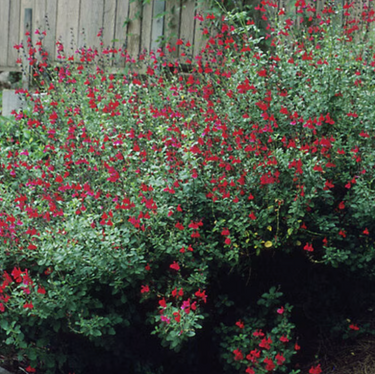

Cherry Queen Autumn Sage
Salvia greggii 'Cherry Queen'
In propagation
Currently growing out 1 Gallon pots. Expected Spring 2027.
Add your name with the notify button below, and we will email you the moment this plant is ready to bring home.
Learn how we grow on The Prop House.
Pickup currently unavailable at Aiken Nursery
'Cherry Queen' is a North Carolina-bred salvia from one of the most important salvia hybridizers America has produced. The cross is a deliberate one, between Salvia greggii, the autumn sage of the Texas and Mexican borderlands, prized for drought tolerance and a six-month bloom, and Salvia blepharophylla, a Mexican species whose name, eyelash-leaved sage, comes from the tiny fringe of hairs at the edge of each leaf (Greek blepharon, eyelash, and phylla, leaves). Blepharophylla carries the most saturated, signal-bright red flower in the whole genus, but the plant spreads by stolons in ways most gardeners do not want and resents cold winters, while greggii brings the bones and the durability. The breeder who put the two together was Dr. Richard "Rich" Dufresne of Candor, North Carolina, an organic chemist who became, more or less by accident, the leading American breeder of woody salvias for the eastern climate. Dufresne died in December 2018, leaving a body of work that includes 'Cherry Chief', 'Maraschino', and this selection, which Plant Delights Nursery called the most brilliant red they had ever seen on any hardy salvia.
The flower is the show: tubular, two-lipped, about an inch long, in a clean saturated cherry-red, not the deeper crimson of a bottlebrush nor the brick of Salvia greggii 'Furman's Red', but a sharp, luminous red that reads from across a garden. Bloom begins early, sometimes on the first warm days of April in zone 8, and continues in waves through summer and into fall, with a heavy push from September into November once the autumn sage genetics take over from the blepharophylla spring and summer pattern. In humid Southeastern conditions the plants often bloom without pause from April through hard frost. Hummingbirds find the flowers within hours of the first opening, and bees, butterflies, and beneficial wasps work them heavily all season.
The plant is compact and well-mannered, two to three feet tall and about as wide, with a slightly more spreading, semi-prostrate habit than the usual upright autumn sage. The leaves are narrower than most greggii selections, dark green and glossy, a blepharophylla trait, and carry the small pointed tip that Dufresne named as a diagnostic feature for telling true 'Cherry Queen' from other red-flowered forms in the trade. The foliage is aromatic when crushed, with the soft minty, resinous scent of the woody salvias, lighter than culinary sage. Drought tolerant once established, heat tolerant, and, unusually for a Texas-Mexico salvia, genuinely humidity tolerant, a real advantage in the Southeast where many western sages struggle. Deer and rabbits leave the plant alone.
One note on care: like all the woody salvias of the greggii, microphylla, and jamensis group, 'Cherry Queen' is not self-cleaning, and spent flower stalks stay on the plant until removed. The standard approach is a hard cut, by half to two-thirds, in late winter, less precision pruning than a clean reset, which clears the dead tops and triggers the spring flush. Left untouched, the plant still blooms and grows, but the frame turns ragged.
This is a plant for the hummingbird gardener who wants the brightest red salvia available, the Southeastern gardener trying to grow xeric Texas-Mexico sages in real Carolina humidity, the collector building a serious Salvia collection, and anyone who would like to grow a piece of Rich Dufresne's quiet legacy at home.
- Hardiness
- USDA Zones 7–10
- Sun
- Full Sun
- Soil
- Well-drained
- Mature size
- Height 2–3 Feet · Spread 2–3 Feet
- Growth rate
- Fast
- Seasonality
- Semi-Evergreen
Tubular, two-lipped, luminous cherry-red flowers about an inch long, from April to frost; a hummingbird magnet.
From rooting to shipping, our top priority is ensuring you receive healthy, thriving plants for your garden’s success.
Because most of our plants are grown from rooted cuttings — alongside seed, air layering, and grafting chosen for each variety — you receive a stronger, true-to-type plant that establishes quickly in your garden.
Raised on organic soil blends and eco-friendly pest management — never harsh chemicals — your plant arrives healthy for your garden, your family, and the pollinators they feed.
Every purchase gives back. We donate to the Aiken Arboretum and support local wildlife conservation, so growing your garden helps protect the wider ecosystem too.

All our plant material is carefully propagated, grown, and nurtured at our humble nursery in Aiken, South Carolina.

Your plant arrives carefully packed and ready to settle in. Unpack them promptly, give them a day or two to acclimate, then plant following the notes we include — that’s all it takes. Clear care guidance comes with every order, so success is the easy part.
What to expect upon delivery
All our plants are sold in 1-gallon sizes, though the height of each plant can vary depending on its growth rate and seasonality, typically ranging from 1/2 to 2.5 feet.
Each plant is carefully packaged with its roots enclosed in a secure plastic bag containing moist soil, forming a compact root ball. To ensure safe transport, the box is padded with recycled newspaper, providing both stability and eco-friendly protection from weather during shipping.
What is your return policy?
Review our full return policy information on our SHIPPING AND RETURNS POLICY page.
What payment methods can I use?
We offer 35 different payment methods including major providers like Mastercard, Visa, PayPal, American Express and Diners as well as many different local payment methods including Klarna, iDEAL, AliPay, Sofort, giropay, and many more.
Can I make changes to my order after it’s been placed?
At Woodlanders, we strive to fulfill orders as quickly as possible. Therefore, we can only accommodate changes to your order within the first 24 hours after it has been placed. These changes include adding or removing products and modifying the delivery address. If you need to make any changes or if there has been a mistake with your order information, please reach out to us promptly via our CONTACT page with your order number for the quickest resolution.
Your satisfaction is our priority, and we appreciate your understanding and cooperation.