


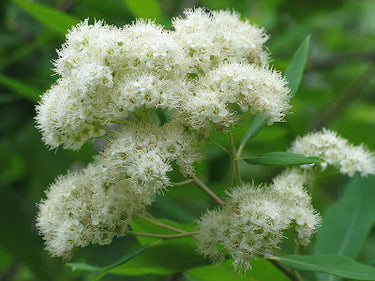


Virginia Spirea
Spiraea virginiana
Pickup available at Aiken Nursery
Usually ready in 2-4 days
Important: This plant is sold within South Carolina only.
In the high-gradient streams of the southern Appalachians, the Gauley, the Bluestone, the Greenbrier, scattered tributaries of the New River, and a handful of similar second- and third-order rivers, grows a shrub that holds on to rocky bars and scoured banks where almost nothing else can. This is Spiraea virginiana, the Appalachian spiraea, a plant that evolved alongside the violent flood regime of these mountain rivers and depends on that disturbance. The floods scour competing vegetation off the banks, expose mineral soil for germination, and break off rhizome fragments that float downstream to colonize new sites. Where the rivers were dammed, the floods stopped, and the spiraea began to disappear.
Spiraea virginiana has been federally listed as Threatened under the U.S. Endangered Species Act since 1990. Fewer than thirty genetically distinct individuals are known across the entire range, from Georgia and the Carolinas north through Tennessee, Virginia, West Virginia, Kentucky, and Ohio, though each of those individuals spreads into clonal colonies of dozens or hundreds of stems. The species was extirpated from Pennsylvania and Alabama, and persists in West Virginia in roughly 1,000 to 4,000 stems, mostly in the Gauley River Gorge below Summersville Dam, thought to be the largest surviving population in the world. Many populations have not set viable seed in living memory, because the plant is self-incompatible, requires cross-pollination from a genetically different individual to set seed, and most surviving stands are reduced to a single clone reproducing only by rhizome.
There is a bitter irony in the decline. One of the principal threats to Spiraea virginiana in the wild is Spiraea japonica, the Japanese spiraea, an introduced ornamental that has escaped cultivation and now displaces the native along Appalachian streams. The very plant most American gardeners picture at the word spiraea is helping push the native one toward extinction.
The shrub earns a place on looks alone: a three- to eight-foot deciduous plant with arching, slightly weeping stems, alternate lance-shaped leaves deep green above and distinctively powdery-white beneath, one of the diagnostic field characters, and broad, flat-topped clusters of tiny creamy-white flowers two to eight inches across, blooming from late May through July. Each small five-petaled, rose-family flower carries a soft greenish-yellow stamen disk that lends the clusters their warmth. In cultivation, Spiraea virginiana has proven forgiving and adaptable, far more tolerant of ordinary garden conditions than the wild habitat would suggest, with strong multi-year performance reported from the Georgia Perimeter College Native Plant Garden and from trials in Aiken.
This is one of those plants where the act of growing carries real weight. Cultivated stock from multiple genetic provenances is one of the few ways sexual reproduction can be restored to Spiraea virginiana in any meaningful sense. Wild populations have grown so reduced and so isolated that the species has effectively lost the ability to make seed in the wild; garden specimens sourced from genetically distinct populations, planted in proximity, can produce viable seed for the first time in decades. A conservation-minded gardener growing this shrub is not merely supporting a native species but maintaining a genetic reservoir that the wild populations can no longer maintain themselves. The plant suits the serious native-plant collector, the conservation gardener with a tie to the southern Appalachians, and the institutional buyer building a collection of southeastern endemics worth preserving.
Important: This plant is sold within South Carolina only.
Spiraea virginiana is federally listed as Threatened under the U.S. Endangered Species Act. Federal law prohibits the sale of federally listed plants in interstate commerce without a permit. Woodlanders is licensed to propagate and sell Spiraea virginiana within the state of South Carolina, but cannot ship this plant across state lines. South Carolina customers may purchase and pick up at the Aiken nursery or arrange in-state delivery. Out-of-state customers interested in this plant for institutional or conservation purposes (botanical gardens, arboretums, universities) should contact us directly at hello@woodlanders.net to discuss permitted alternatives.
- Hardiness
- USDA Zones 5–8
- Sun
- Full Sun, Part Shade
- Soil
- Moist, Well-drained
- Mature size
- Height 3–8 Feet · Spread 4–8 Feet
- Growth rate
- Moderate
- Seasonality
- Deciduous
From rooting to shipping, our top priority is ensuring you receive healthy, thriving plants for your garden’s success.
Because most of our plants are grown from rooted cuttings — alongside seed, air layering, and grafting chosen for each variety — you receive a stronger, true-to-type plant that establishes quickly in your garden.
Raised on organic soil blends and eco-friendly pest management — never harsh chemicals — your plant arrives healthy for your garden, your family, and the pollinators they feed.
Every purchase gives back. We donate to the Aiken Arboretum and support local wildlife conservation, so growing your garden helps protect the wider ecosystem too.

All our plant material is carefully propagated, grown, and nurtured at our humble nursery in Aiken, South Carolina.

Your plant arrives carefully packed and ready to settle in. Unpack them promptly, give them a day or two to acclimate, then plant following the notes we include — that’s all it takes. Clear care guidance comes with every order, so success is the easy part.
What to expect upon delivery
All our plants are sold in 1-gallon sizes, though the height of each plant can vary depending on its growth rate and seasonality, typically ranging from 1/2 to 2.5 feet.
Each plant is carefully packaged with its roots enclosed in a secure plastic bag containing moist soil, forming a compact root ball. To ensure safe transport, the box is padded with recycled newspaper, providing both stability and eco-friendly protection from weather during shipping.
What is your return policy?
Review our full return policy information on our SHIPPING AND RETURNS POLICY page.
What payment methods can I use?
We offer 35 different payment methods including major providers like Mastercard, Visa, PayPal, American Express and Diners as well as many different local payment methods including Klarna, iDEAL, AliPay, Sofort, giropay, and many more.
Can I make changes to my order after it’s been placed?
At Woodlanders, we strive to fulfill orders as quickly as possible. Therefore, we can only accommodate changes to your order within the first 24 hours after it has been placed. These changes include adding or removing products and modifying the delivery address. If you need to make any changes or if there has been a mistake with your order information, please reach out to us promptly via our CONTACT page with your order number for the quickest resolution.
Your satisfaction is our priority, and we appreciate your understanding and cooperation.