




Laurustinus
Viburnum tinus
Pickup currently unavailable at Aiken Nursery
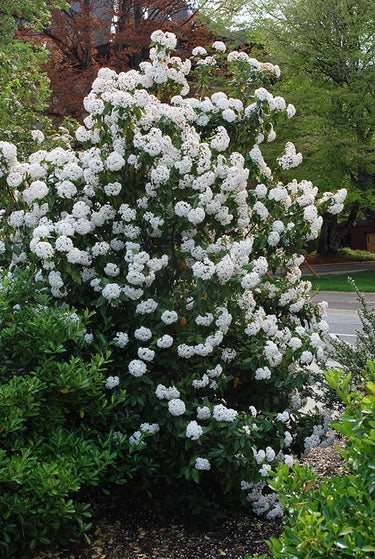
Laurustinus flowers when almost nothing else does. From late autumn the flat heads are already formed and waiting, tight clusters of deep pink buds sitting on the ends of the shoots, and through winter and into spring they open a few at a time into small fragrant white flowers, so the shrub carries pink and white together for months. The leaves are lustrous and leathery, dark above and noticeably paler beneath, held densely enough that the plant works as a screen the whole year. What follows the flowers is stranger and better: ovoid fruits of a hard metallic blue, almost enameled, ripening slowly to black.
Viburnum tinus comes from the Mediterranean basin, a standard shrub of the maquis from Portugal to Turkey and across North Africa, and has been in gardens for as long as anyone has kept records of gardens. Tinus was the plant's Latin name in classical times and Pliny wrote about the shrub under it; laurustinus simply welds that ancient name to laurel, for the look of the leaves. The genus sits in Adoxaceae now, having been moved out of the honeysuckle family, in the company of the elders. In Mediterranean folk medicine the leaves and fruit had a modest reputation, but that is history and not a use we recommend.
One practical note the old catalogs always flagged: laurustinus is reported to be poorly self-fertile, so a lone plant may flower beautifully for years and never set that metallic blue fruit. Two or more plants of different clonal origin, set within reach of the same bees, is the reliable way to get berries. The winter flowers are a genuine resource for whatever is flying on a mild January day, and the fruit feeds birds well into spring, which is also the source of one of the cautions below.
Grow laurustinus in full sun to part shade in ordinary well-drained soil, as a hedge, a screen, an informal evergreen backdrop, or clipped into something more formal, since the plant takes shearing without sulking. Reckon on six to twelve feet unless cut back. Hardy through USDA zones 8 to 10, and worth a sheltered wall at the cold edge. Two honest cautions. The berries are mildly toxic and best left to the birds rather than to children. And birds are efficient dispersers: Viburnum tinus has naturalized in parts of Oregon and California and is treated as invasive there, so gardeners on the West Coast should check locally before planting.
Photos courtesy of Oregon State University
- Hardiness
- USDA Zones 8–10
- Sun
- Full Sun, Part Shade
- Soil
- Well-drained
- Mature size
- Height 6–12 Feet · Spread 6–10 Feet
- Growth rate
- Medium
- Seasonality
- Evergreen
Flat clusters of small fragrant white flowers opening from deep pink buds through winter into spring
From rooting to shipping, our top priority is ensuring you receive healthy, thriving plants for your garden’s success.
Because most of our plants are grown from rooted cuttings — alongside seed, air layering, and grafting chosen for each variety — you receive a stronger, true-to-type plant that establishes quickly in your garden.
Raised on organic soil blends and eco-friendly pest management — never harsh chemicals — your plant arrives healthy for your garden, your family, and the pollinators they feed.
Every purchase gives back. We donate to the Aiken Arboretum and support local wildlife conservation, so growing your garden helps protect the wider ecosystem too.

All our plant material is carefully propagated, grown, and nurtured at our humble nursery in Aiken, South Carolina.

Your plant arrives carefully packed and ready to settle in. Unpack them promptly, give them a day or two to acclimate, then plant following the notes we include — that’s all it takes. Clear care guidance comes with every order, so success is the easy part.
What to expect upon delivery
All our plants are sold in 1-gallon sizes, though the height of each plant can vary depending on its growth rate and seasonality, typically ranging from 1/2 to 2.5 feet.
Each plant is carefully packaged with its roots enclosed in a secure plastic bag containing moist soil, forming a compact root ball. To ensure safe transport, the box is padded with recycled newspaper, providing both stability and eco-friendly protection from weather during shipping.
What is your return policy?
Review our full return policy information on our SHIPPING AND RETURNS POLICY page.
What payment methods can I use?
We offer 35 different payment methods including major providers like Mastercard, Visa, PayPal, American Express and Diners as well as many different local payment methods including Klarna, iDEAL, AliPay, Sofort, giropay, and many more.
Can I make changes to my order after it’s been placed?
At Woodlanders, we strive to fulfill orders as quickly as possible. Therefore, we can only accommodate changes to your order within the first 24 hours after it has been placed. These changes include adding or removing products and modifying the delivery address. If you need to make any changes or if there has been a mistake with your order information, please reach out to us promptly via our CONTACT page with your order number for the quickest resolution.
Your satisfaction is our priority, and we appreciate your understanding and cooperation.