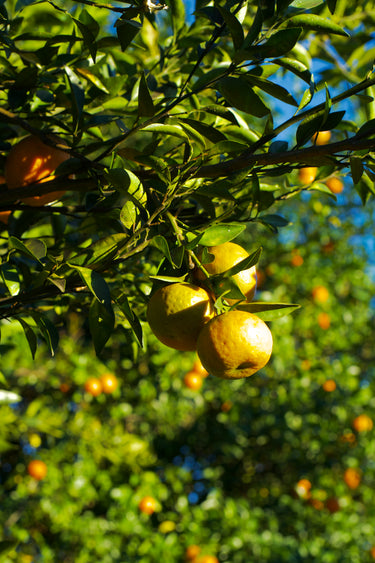


Field Guide · Trifoliate Orange and the Hybrids · Southeast
A thorny, deciduous, bitter little tree from northern China is the reason citrus grows north of Florida at all. Here are the tree and the hybrids the tree fathered: citranges, citrumelos and citrangequats.
In this guide
I.The bitter ancestor
Poncirus trifoliata, the trifoliate orange, is a citrus relative that behaves like a hawthorn. The tree comes from northern China and Korea, grows as a large shrub or small tree somewhere between thirteen and twenty-six feet, and drops all of the leaves every autumn, which is very nearly unheard of in a family built on evergreens. Each leaf carries three leaflets (hence trifoliata), and crushed ones smell of spice. The green stems bristle with thorns an inch or two long. In spring the white flowers open, larger than a true citrus blossom and, by most accounts, with much less scent. The fruit that follows is the size of a lime, covered in peach-like down, packed with seeds, and so bitter that most people call the fruit inedible fresh. Gardeners with a marmalade habit have dried and powdered the rind as a condiment, but nobody grows the plant for the table.
They grow the tree for the cold. The species is rated hardy to USDA zone 6, and published figures for a dormant, established plant run as low as minus twenty degrees Fahrenheit. That is a long way from a Valencia orange. Whether the tree belongs in Citrus at all is still argued: Walter Swingle moved the plant into a genus of their own, Poncirus, in 1943, and David Mabberley and Dianxiang Zhang folded the tree back into Citrus in 2008. Genome work has kept the question open. We use both names, depending on whom we are quoting.
One more trait matters for what follows. The trifoliate orange flowers at a different time from most true citrus, which in the wild keeps the two groups from crossing on their own. That is a barrier that breeders, with a paintbrush, are happy to step over.

II.A freeze, a breeding program, and a pun in Latin
Florida's citrus groves took a severe freeze in 1894, and the United States Department of Agriculture went looking for a tree that could survive the next one. Two USDA botanists, Herbert Webber and Walter Swingle, began crossing sweet orange with the trifoliate orange, hoping to keep the fruit of the first and the constitution of the second. The pairing is not an easy one. Plenty of seedlings kept the thorns and the bitterness along with the cold tolerance. A handful turned out well enough to name.
That work produced three families, and they are the plan of this guide. A citrange is sweet orange crossed with trifoliate orange. A citrumelo is grapefruit crossed with trifoliate orange (the "melo" borrowed from pomelo, grapefruit's relative). A citrangequat goes a step further, crossing a citrange with a kumquat, so that three genera meet in one tree. Each family trades some of the trifoliate's cold tolerance for fruit that looks more like citrus, and the table below shows how the bargain tends to work out.
| Group | Parentage | Typical published hardiness | Fruit |
|---|---|---|---|
| Trifoliate orange | Poncirus trifoliata | Zone 6; about -20°F dormant | Inedible fresh, very seedy |
| Citrange | Sweet orange × trifoliate | About 0°F | Sour; juice and ades |
| Citrumelo | Grapefruit × trifoliate | About 5°F | Tart, grapefruit-like; kitchen fruit |
| Citrangequat | Citrange × kumquat | About 5 to 10°F | Acid, kumquat-like; the most edible |
Field Note
Hardiness figures for hybrid citrus vary from source to source, sometimes by ten degrees, because the number depends on the freeze: how long, how windy, how well the plant was hardened off first, and how old the tree is. Read the figures in this guide as a ladder, not a guarantee. The order of the rungs is reliable; the exact degrees are not. For the full story of acclimation and freeze nights, see our Field Guide to Cold-Hardy Citrus, which this piece is meant to sit beside.
III.Citranges: sweet orange crossed with the thorn
The founding citrange appeared in a grove at Eustis, Florida, in the 1890s, in the care of a Colonel G. H. Norton, and was described by Webber and Swingle in 1905 as 'Rusk'. Sweet orange was the mother and trifoliate orange the father. The fruit is small, about two inches across, deep orange with a reddish flush, thin-skinned and very juicy, with a sprightly acid flavor and a trace of bitterness. In those years the fruit was eaten fresh with sugar, stirred into citrangeade, and made into pies, marmalades and jellies. The tree was also commended as an ornamental, which is fair: glossy leaves, fragrant spring flowers, orange fruit into winter.
Citranges have had a quiet second career underground, as rootstocks, and some of the best-known names in that world ('Troyer' and 'Carrizo', among them) are citranges. But a few are worth growing for their own sake, and the one we recommend is 'Morton'.
Citrus 'Morton' (Citrus sinensis × Poncirus trifoliata)
Morton citrange
- Fragrant spring bloom
- Large, smooth orange fruit
- Few seeds
- Ground in zones 7 to 10
- Container farther north
Big for a citrange, smooth-skinned and remarkably orange-like, with very few seeds. The fruit is too sharp to eat from the branch for most palates, but the juice, diluted and sweetened, makes a first-rate orange ade. A tree for the collector, and for anyone who wants a good-looking evergreen that fruits where tender citrus cannot.
A citrange is what you get when a sweet orange agrees to a thorn, and neither one gets quite what they wanted.
IV.Citrumelos: the grapefruit hybrids
Swingle made the grapefruit cross in 1907, using 'Duncan' grapefruit and the trifoliate orange. The seedling that became famous is the 'Swingle' citrumelo, and the cultivar's fame is entirely underground. The USDA's citrus collection records the tree as resistant to tristeza virus, Phytophthora foot rot, citrus nematode and cold, and the tree went on to become the most widely used rootstock in Florida. The rootstock is moderately salt tolerant, and unhappy in heavy clay or limy soil. Some trees on that rootstock declined on certain soils, and some scions are incompatible, so even the success story has footnotes.
For the garden, the better citrumelos are the ones that carry fruit worth cooking with. 'Dunstan' is the connoisseur's choice: growers have long ranked the plant as the best of the trifoliate hybrids, among the hardiest of all citrus, with golden fruit nearly four inches across and a flavor like a grapefruit picked a little shy of ripe. The glossy leaves fall in autumn, leaving a strong winter silhouette. 'Dallas', which came to us from the citrus enthusiast Tom McClendon, makes large, round, thick-rinded fruit with strikingly big seeds. Neither is a fruit bowl fruit. Both are marmalade fruit, syrup fruit, cocktail fruit, with sugar and a little patience.
Citrumelo 'Dallas' (Trifoliate × Grapefruit)
Dallas citrumelo
- Cold-hardy hybrid
- Large, thick-rinded fruit
- Full sun
- Sharp drainage
- Shelter from winter wind
Bold, tart, unmistakably citrus. Hardier than true grapefruit, and happy in a large container that can be rolled under cover for the hard freezes. A plant for the adventurous grower rather than the fruit bowl, and scarce on our bench this season.
Citrumelo 'Dunstan'
Dunstan citrumelo
- Among the hardiest citrus
- Fruit nearly 4 in across
- Leaves fall in autumn
- Full sun
A small, handsome tree with fragrant spring blossom and golden fruit that ripens by fall. Very hard to find, and worth the search; check the page for the next availability.
V.Citrangequats: three genera in one tree
In 1909, at the USDA station in Eustis, Swingle dusted the flowers of the Nagami kumquat with pollen from a citrange, and the seedlings were sent out across the South to prove themselves against the cold. By the custom of the day each took the name of the town where each first fruited. 'Thomasville' fruited in Thomasville, Georgia; 'Sinton' in Sinton, Texas; 'Telfair' in Telfair County, Georgia. 'Thomasville' and 'Sinton' were named and described in 1923. The citrangequats are often described as among the first three-genus hybrids ever made by hand from known parents, which is still a pleasure to say aloud. Of the three sisters, Thomasville thrived, Sinton hung on, and Telfair seems to have slipped out of cultivation.
Citrangequats are the most edible of the trifoliate hybrids. The fruit is egg-shaped, yellow to deep orange, sharply acid, and rewarding squeezed like a lime, sweetened into an ade or cooked into a marmalade with real bite. The fruit ripens in winter, from January into April, long after the other citrus fruit in the neighborhood has finished. Thomasville is the toughest of the group, rated about ten degrees Fahrenheit once established and suited to the ground in zones 8 to 10. The tree grows upright and vigorous, with thorny branches and three-parted leaves. Sinton leans toward the kumquat parent: simple leaves rather than trifoliate ones, a denser and more compact plant, and fruit so richly pigmented that chemists studying the rind found a carotenoid new to citrus and named it sintaxanthin after the tree.
Thomasville Citrangequat
Citrus × georgiana 'Thomasville'
- About 10°F once established
- Zones 8 to 10
- Fruit January to April
- Full sun to part shade
- Thorny
A piece of Southern horticultural history: first fruited in Thomasville, Georgia, raised by Swingle in 1909 and named in 1923. Fragrant white blossom in spring, then abundant egg-shaped fruit that mellows to a pleasantly acidic, kumquat-like flavor when fully ripe. Good in preserves, marmalades and citrus-forward cocktails.
Sinton Citrangequat
Nagami kumquat × Rusk citrange
- About 10°F once established
- Zones 8 to 10
- Compact and dense
- Simple leaves
- Good in a pot
The scarcer sister, with the kumquat's habit and a molecule named in the tree's honor. Sharply acid fruit for the kitchen, coloring a deep orange through winter. We have only a few.

VI.The root story, and two newer USDA oddities
It is worth saying plainly how much of the citrus world stands on trifoliate roots. A grafted citrus tree is two plants pretending to be one, and the plant underneath does the unglamorous work of roots, vigor and disease resistance. Citrus grafted onto trifoliate orange tends to be hardier than citrus on its own roots, which is why so many cold-hardy trees in this region are grafted onto some trifoliate selection. That is also why the hybrids in this guide matter beyond their own fruit: the same blood runs through much of what grows north of the citrus belt.
Two recent USDA releases show where the story is going. 'US-1516' is a rootstock from a cross the USDA made in 1975, African pummelo by 'Flying Dragon', the contorted, fiercely thorned dwarf form of the trifoliate orange. The seedlings were watched in Florida for forty years, and Kim Bowman's program released them in 2015, into the middle of the huanglongbing epidemic that has hollowed out Florida's groves. We sell them ungrafted, which is an unusual and honest thing to sell: a tree for the tinkerer who wants to practice budding or simply grow the trifoliate-blooded foundation and see how far north the plant will go.
'Weeping Dragon' is a different kind of gift. Bowman released the plant in 2016 from a cross of 'Flying Dragon' and 'Cipo', a sweet orange whose limbs arch toward the ground. The result is a citrus that weeps: branches spill over and cascade, so a plant in a tall pot reads less like a citrus and more like a small weeping tree. The fruit is small and sour, handsome and better for looking at than eating. Cold tolerance has not been formally rated, so treat the plant as reliable in the ground in zones 9 and 10, a gamble in a sheltered zone 8 spot, and a container plant farther north.
Citrus US-1516 (USDA Hardy Rootstock)
African pummelo × 'Flying Dragon'
- Sold ungrafted
- Nearly true from seed
- Vigorous, uniform
- For budding and tinkering
Released by the USDA in 2015. A plant for people who have plans for them.
Weeping Dragon Citrus
'Flying Dragon' × 'Cipo'
- Weeping habit
- Small sour fruit
- Zones 9 and 10 in the ground
- Tall pot
Citrus bred for the eye rather than the fruit bowl. Expect thorns and keep the plant back from a busy path.
VII.Growing them: a short field manual
All of these like full sun, sharp drainage and shelter from the worst of the winter wind. Most do well in a large container that can be moved under cover for a hard freeze, a habit that also lets a gardener farther north push the line. Plant in the ground where winters are mild, and site the tree where the spring fragrance and the winter fruit can both be enjoyed, with the thorns back from the path.
Which should I buy first?
For fruit you will eat, start with a citrangequat: 'Thomasville' is the safest choice and the most forgiving. For juice and drinks, choose the 'Morton' citrange. For cooking and marmalade, the citrumelos. For a conversation piece on the terrace, 'Weeping Dragon'.
Deciduous or evergreen?
The trifoliate orange is fully deciduous, and the blood shows: 'Dunstan' drops the glossy leaves in autumn and leaves a strong winter silhouette. Other hybrids hold more or less leaf depending on the winter. A bare, thorny tree in January is not a dead one; wait for spring before judging.
Are they really hardy in the ground?
In zone 8 and warmer, yes, with the ladder above in mind. In zone 7, plant 'Morton' or a citrumelo in the shelter of a south wall. Farther north, container culture with a cold garage for the hardest weeks is the dependable path. Our history of cold-hardy citrus tells the longer story of how people found these trees.
What do I do with the fruit?
Squeeze and sweeten for ades; simmer with sugar for marmalade; use the juice where you would use lime. Few are happy eaten out of hand. If a tidy yellow fruit with an old Southern pedigree is more your pace, our yuzu is the next stop.
From the Nursery
The citrus bench changes with the weeks. Browse our citrus for the current list of citranges, citrumelos and citrangequats, and watch the product pages above for the ones that have sold through.
References
- Cold-hardy citrus. Wikipedia, summarizing hardiness figures for trifoliate orange, citranges, citrumelos and citrangequats.
- Trifoliate orange (Citrus trifoliata). Wikipedia, on range, form, taxonomy and 'Flying Dragon'.
- Citrangequat (Citrus × georgiana). Wikipedia, on Swingle's 1909 crosses and cultivars.
- University of California Riverside, Citrus Variety Collection: Rusk citrange (CRC 301). citrusvariety.ucr.edu
- University of California Riverside, Citrus Variety Collection: Swingle citrumelo (CRC 3771). citrusvariety.ucr.edu
- University of California Riverside, Citrus Variety Collection: Sinton citrangequat (CRC 3642). citrusvariety.ucr.edu
- Woodlanders product records for 'Morton', 'Dallas', 'Dunstan', Thomasville, Sinton, US-1516 and Weeping Dragon, drawing on USDA release notes.