From the Nursery · Cold-Hardy Citrus
Yuzu Ichandrin: the cold-hardy citrus that grows where lemons can't
A mountain fruit from the high-elevation citrus regions of China and Japan — and one of the few citrus that zone 7 and 8 gardeners actually get to keep.

Woodlanders Resource
Growing citrus beyond zone 9? Our Cold-Hardy Citrus Guide covers what survives, what struggles, and what the zone maps don't tell you.
Most citrus is aspirational in the Southeast. You grow it in a pot, drag it inside every November, and spend the winter watching it shed leaves against a bright window and pretend that counts as gardening. Yuzu Ichandrin — a naturally occurring hybrid long cultivated in China and Japan, derived from Ichang papeda and Satsuma mandarin — is a different proposition entirely. It carries that mountain parentage deep in its constitution. Mature, established trees have come through temperatures in the single digits in zone 7b gardens with nothing worse than some tip dieback. A lemon would be a memory at those temperatures. A Meyer lemon, a fantasy.
The questions we get about yuzu at Woodlanders have only grown as the fruit has moved from a collector's curiosity into the broader conversation around serious cooking. It's no longer obscure — not to anyone who has tasted ponzu made from the real thing, or encountered yuzu kosho, or noticed it creeping into the dessert menus of restaurants that care where their ingredients come from. The fruit itself is not one you eat out of hand. It is too seedy, too aggressively sour, and frankly too valuable for anything as casual as snacking. What you want is what it gives: an aroma so particular, so floral and bright and faintly piney, that no combination of lemon and lime and grapefruit gets within shouting distance.
"The fruit is not one you eat out of hand. What you want is what it gives — an aroma so particular that no combination of lemon and lime and grapefruit gets within shouting distance."
Cold Hardiness
Hardier than most sources will tell you, with caveats worth understanding. Yuzu Ichandrin is rated reliably for USDA zone 8, but mature trees have come through 10°F and lower in documented gardens. The operative word is mature. A young tree in its first or second winter is a different creature — more vulnerable, less committed to survival — and it benefits from root mulch, wind protection, and deliberate placement. Zone 7 gardeners should treat those first two winters as an investment: pot the tree, give it a season to build its root system, then move it to its permanent home with confidence.
Rootstock selection shapes the cold hardiness story meaningfully. Trees on trifoliate rootstock (Poncirus trifoliata) push the thermal limits further than those on other understocks. Flying Dragon, a dwarfing trifoliate selection, produces an especially compact and precocious plant — useful if container growing is the plan, or if the garden runs out of room before the ambition does.
For zone 7 and marginal zone 8 sites, siting is not incidental. A south-facing wall accumulates thermal mass through the day that makes a real, measurable difference when a hard freeze rolls through at 2 a.m. The warmest, most sheltered microclimate in the garden is where this tree belongs.
Yuzu Ichandrin Cold-Hardy Citrus · Zones 7–9
A naturally occurring hybrid between Ichang papeda (Citrus ichangensis) and Satsuma mandarin, long cultivated across the high-elevation citrus regions of China and Japan. Upright and moderately vigorous, with glossy evergreen foliage and formidable thorns. Fragrant white flowers in spring; fruit ripens from green to deep gold in late autumn. Among the most cold-hardy citrus in cultivation — mature trees documented to 10°F and below.
Grafted onto trifoliate rootstock for maximum cold hardiness. Fruiting in two to three years from a grafted plant. Cannot be shipped to Alabama, Florida, Texas, Arizona, California, or Louisiana.
The Fruit
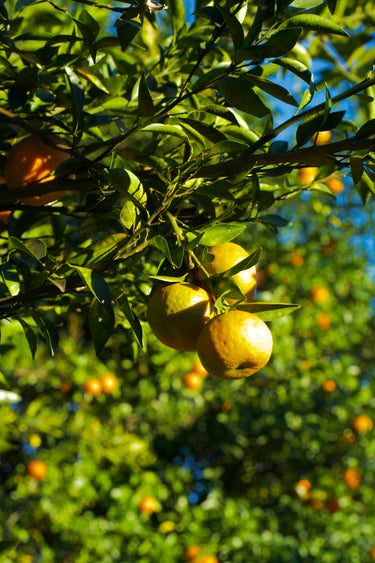
Bumpy, thick-skinned, roughly mandarin-sized, ripening from green to deep gold in late autumn. The seeds are large and numerous — this is emphatically not a fruit for eating fresh. But cut one open and press your nose to it, and the question of why serious kitchens pay what they pay for fresh yuzu juice becomes immediately, viscerally obvious. There is lemon in there, and grapefruit, and something floral that suggests white pepper and jasmine without resolving into either. It is a smell you want to follow around a kitchen.
The zest freezes beautifully, which is fortunate because the harvest window runs a compressed few weeks in late autumn and you will want to preserve every gram of it. Yuzu juice does anything lemon juice does in a vinaigrette or a marinade, and then does something lemon juice cannot. The zest folded into a curd or a pound cake brings a depth that stops conversation. The hollowed rind, used in traditional Japanese presentation as a vessel for food, is ornamental in ways that have no real equivalent on a Western table.
Growing It Well
Full sun — six hours at a minimum, more if you can manage it. Well-drained soil with a slightly acidic pH, somewhere in the 5.8 to 6.5 range. Yuzu Ichandrin establishes slowly, spending its first few years in what looks like deliberate idleness while the root system quietly does the real work, then maturing into a relatively self-sufficient tree that asks for less attention than its reputation implies. The thorns are serious; wear gloves when pruning. Fertilize three times a year with a balanced citrus formula — late winter, mid-spring, mid-summer — and resist the urge to feed in autumn, which pushes tender new growth directly into cold weather it is not equipped to handle.
In containers, the tree stays to a manageable four to six feet. Use a lightweight pot with genuine drainage, size up gradually as the tree matures, and move it to a bright interior when temperatures drop toward the mid-twenties. Container-grown trees on grafted rootstock often fruit within two to three years. Seed-grown trees can take a decade or more — a perfectly reasonable approach if you are a patient person with nowhere to be, and a poor one if you are not.
The graft union is visible as a diagonal scar low on the trunk. Keep it above the soil line and remove any growth that emerges below it without hesitation; sucker growth from the rootstock is vigorous and single-minded, and it will outcompete everything above it if ignored.
Available at Woodlanders Yuzu Ichandrin — the citrus for gardeners who assumed citrus was not for them.
Grafted onto trifoliate rootstock for maximum cold hardiness. Cannot be shipped to Alabama, Florida, Texas, Arizona, California, or Louisiana. For gardeners in zones 7–9, it turns out citrus was always an option. Just a question of which one.
Find Yuzu Ichandrin at Woodlanders →