


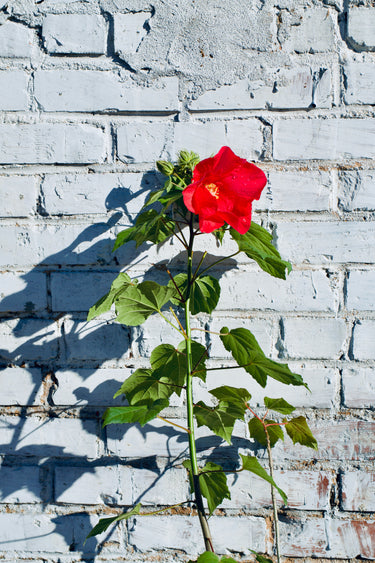


Single Red Confederate Rose
Hibiscus mutabilis 'Rubrum'
In propagation
Currently growing out 1 Gallon pots. Expected Fall 2026.
Add your name with the notify button below, and we will email you the moment this plant is ready to bring home.
Learn how we grow on The Prop House.
Pickup currently unavailable at Aiken Nursery
Hibiscus mutabilis has been grown in Southern gardens for so long that many people assume the shrub is a native, though the species traces to southern China, where gardeners prized the flowers centuries before the plant traveled west. The species name mutabilis, meaning changeable, describes the wild trick of the ordinary Confederate Rose, whose blooms open white in the morning and deepen to pink and then rose-red by evening. 'Rubrum' skips the performance and commits: the single flowers arrive already a saturated rose-red and hold that one deep tone through the day rather than shifting. For gardeners who love the late-season drama of the Confederate Rose but want a single, unwavering color, 'Rubrum' is the selection to plant.
The shrub belongs to the mallow family, Malvaceae, and shares that clan's signature: a prominent central column of fused stamens rising from the throat of a broad, five-petaled flower. Cotton, okra, and hollyhock are all cousins, and the kinship shows in the softly downy, maple-shaped leaves and the fuzzy seed capsules that earned the alternate common name, Cotton Rose. In the Deep South, 'Rubrum' builds into a large, multi-stemmed shrub of six to eight feet in a single season, flowering in the shortening days of late summer and fall when much of the garden has already gone quiet.
Beyond ornament, Hibiscus mutabilis carries a long medicinal history in China, where the plant is known as Mu Fu Rong. Traditional practitioners used the cooling leaves and flowers as poultices for burns, boils, and inflamed skin, and brewed them for coughs and respiratory complaints. Modern laboratory work has taken an interest in these old uses, isolating anti-inflammatory flavonoids from the flowers and an antiviral compound, tiliroside, from the plant, lending some scientific texture to a tradition many centuries old.
In the garden, give 'Rubrum' room and a backdrop. The tall, upright shrub reads best from a slight distance, at the back of a sunny border or as a freestanding specimen where the autumn flowers can carry the eye across the yard. Late-blooming salvias, ornamental grasses at mature height, and anything with a quiet green or silver leaf make good neighbors, since the rose-red flowers want a calm setting rather than competition. In the colder end of the range the shrub may die back to the ground in winter and return from the roots, so pair the plant with something that fills the early-season gap. If the common name Confederate Rose sits uneasily, Cotton Rose is the older, equally accurate alternative, and either name points to the same generous, late-flowering shrub.
- Hardiness
- USDA Zones 8–10
- Sun
- Full Sun, Part Shade
- Soil
- Well-drained, Moist
- Mature size
- Height 6–8 Feet · Spread 4–6 Feet
- Growth rate
- Moderate
- Seasonality
- Deciduous
These statements have not been evaluated by the Food and Drug Administration. This information is shared for traditional and educational interest only and is not intended to diagnose, treat, cure, or prevent any disease. Please consult a qualified healthcare professional before any medicinal use.
- Traditional use only; not a substitute for professional medical care.
- Consult a qualified practitioner before any medicinal use.
From rooting to shipping, our top priority is ensuring you receive healthy, thriving plants for your garden’s success.
Because most of our plants are grown from rooted cuttings — alongside seed, air layering, and grafting chosen for each variety — you receive a stronger, true-to-type plant that establishes quickly in your garden.
Raised on organic soil blends and eco-friendly pest management — never harsh chemicals — your plant arrives healthy for your garden, your family, and the pollinators they feed.
Every purchase gives back. We donate to the Aiken Arboretum and support local wildlife conservation, so growing your garden helps protect the wider ecosystem too.

All our plant material is carefully propagated, grown, and nurtured at our humble nursery in Aiken, South Carolina.

Your plant arrives carefully packed and ready to settle in. Unpack them promptly, give them a day or two to acclimate, then plant following the notes we include — that’s all it takes. Clear care guidance comes with every order, so success is the easy part.
What to expect upon delivery
All our plants are sold in 1-gallon sizes, though the height of each plant can vary depending on its growth rate and seasonality, typically ranging from 1/2 to 2.5 feet.
Each plant is carefully packaged with its roots enclosed in a secure plastic bag containing moist soil, forming a compact root ball. To ensure safe transport, the box is padded with recycled newspaper, providing both stability and eco-friendly protection from weather during shipping.
What is your return policy?
Review our full return policy information on our SHIPPING AND RETURNS POLICY page.
What payment methods can I use?
We offer 35 different payment methods including major providers like Mastercard, Visa, PayPal, American Express and Diners as well as many different local payment methods including Klarna, iDEAL, AliPay, Sofort, giropay, and many more.
Can I make changes to my order after it’s been placed?
At Woodlanders, we strive to fulfill orders as quickly as possible. Therefore, we can only accommodate changes to your order within the first 24 hours after it has been placed. These changes include adding or removing products and modifying the delivery address. If you need to make any changes or if there has been a mistake with your order information, please reach out to us promptly via our CONTACT page with your order number for the quickest resolution.
Your satisfaction is our priority, and we appreciate your understanding and cooperation.