


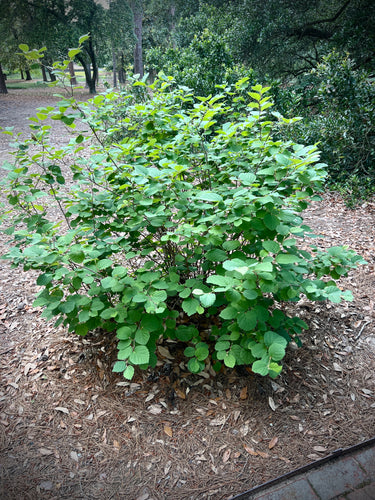


Sea Foam Fothergilla
Fothergilla × intermedia 'Sea Spray'
In propagation
Currently growing out 1 Gallon pots. Expected Fall 2026.
Add your name with the notify button below, and we will email you the moment this plant is ready to bring home.
Learn how we grow on The Prop House.
Pickup currently unavailable at Aiken Nursery
'Sea Spray' has long traveled under the name Fothergilla major, a tidy assumption the botanists have since complicated. Run through a flow cytometer, the plant turns out to be a hybrid, F. × intermedia, the meeting of mountain witch-alder (F. major) and the dwarf coastal F. gardenii, the little shrub Charleston's Alexander Garden sent across to England in the 1760s, in a genus already named for John Fothergill, the London physician who tried to grow half of America in a single garden. All of which makes the name, for once, honest. Most Sea Spray christenings are wishful; this one actually carries the coast in the blood.
What you notice first is the foliage: cool, glaucous, blue-green straight through summer, as though someone had breathed sea-fog across the leaves and it never quite lifted. In spring, before that color settles, the plant sends up white bottlebrush spikes, petal-less, all stamen, honey-scented, opening as the new leaves unfurl rather than ahead of them. Early pollinators find the flowers well before much else is awake. The habit stays modest and oval-rounded, more contained than a straight major, which is part of why collectors keep asking after a plant still genuinely scarce in the trade.
Fall is the honest part. On a good site 'Sea Spray' colors up; on others, as Michael Dirr noted from the lone specimen he had seen, at Bernheim in 1997, the plant settles for a quieter dark red-brown rather than the orange-and-scarlet riot the genus is known for. More sun, better color. We will not promise fireworks every November.
Our stock traces to a young plant at Hopelands Gardens, the Iselins' fourteen-acre estate here in Aiken, set there by Bob McCartney himself, beneath live oaks and the deodar cedars Hope Iselin planted a century before him. Cuttings off Bob's specimen, grown on at the nursery. Provenance you could drive to.
They ask for little in return: acidic soil that stays moist but drains, a spot in sun to part shade, a mulch over those shallow roots. Deer pass them by. This is the kind of shrub you set in among oakleaf hydrangea and native azaleas and then find yourself watching anyway, the blue of the leaves, the honey on the spring air, the slow pleasure of a thing that manages to be two places at once.
- Hardiness
- USDA Zones 5–8
- Sun
- Full Sun, Part Shade
- Soil
- Well-drained, Moist, Acid
- Mature size
- Height 4–8 Feet · Spread 3–5 Feet
- Growth rate
- Slow
- Seasonality
- Deciduous
1 to 2 inch bottlebrush inflorescences, white stamens, yellow anthers, honey-scented, April to May
From rooting to shipping, our top priority is ensuring you receive healthy, thriving plants for your garden’s success.
Because most of our plants are grown from rooted cuttings — alongside seed, air layering, and grafting chosen for each variety — you receive a stronger, true-to-type plant that establishes quickly in your garden.
Raised on organic soil blends and eco-friendly pest management — never harsh chemicals — your plant arrives healthy for your garden, your family, and the pollinators they feed.
Every purchase gives back. We donate to the Aiken Arboretum and support local wildlife conservation, so growing your garden helps protect the wider ecosystem too.

All our plant material is carefully propagated, grown, and nurtured at our humble nursery in Aiken, South Carolina.

Your plant arrives carefully packed and ready to settle in. Unpack them promptly, give them a day or two to acclimate, then plant following the notes we include — that’s all it takes. Clear care guidance comes with every order, so success is the easy part.
What to expect upon delivery
All our plants are sold in 1-gallon sizes, though the height of each plant can vary depending on its growth rate and seasonality, typically ranging from 1/2 to 2.5 feet.
Each plant is carefully packaged with its roots enclosed in a secure plastic bag containing moist soil, forming a compact root ball. To ensure safe transport, the box is padded with recycled newspaper, providing both stability and eco-friendly protection from weather during shipping.
What is your return policy?
Review our full return policy information on our SHIPPING AND RETURNS POLICY page.
What payment methods can I use?
We offer 35 different payment methods including major providers like Mastercard, Visa, PayPal, American Express and Diners as well as many different local payment methods including Klarna, iDEAL, AliPay, Sofort, giropay, and many more.
Can I make changes to my order after it’s been placed?
At Woodlanders, we strive to fulfill orders as quickly as possible. Therefore, we can only accommodate changes to your order within the first 24 hours after it has been placed. These changes include adding or removing products and modifying the delivery address. If you need to make any changes or if there has been a mistake with your order information, please reach out to us promptly via our CONTACT page with your order number for the quickest resolution.
Your satisfaction is our priority, and we appreciate your understanding and cooperation.