


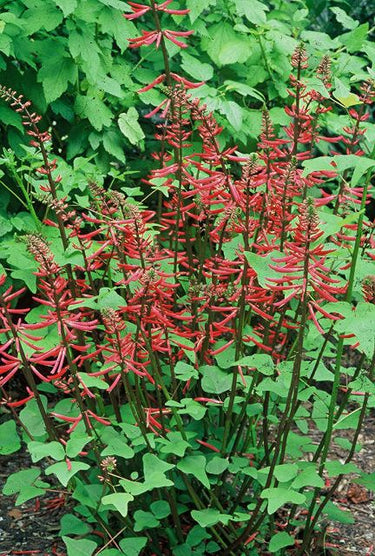

Coral Bean
Erythrina herbacea (Coral Bean)
In propagation
Currently growing out 1 Gallon pots. Expected Fall 2027.
Add your name with the notify button below, and we will email you the moment this plant is ready to bring home.
Learn how we grow on The Prop House.
Pickup currently unavailable at Aiken Nursery
A relic of the old Southern wilds, Erythrina herbacea, the coral bean, is a plant that commands attention, graceful yet defiant, wild yet refined. A legume native across the coastal Southeast, the coral bean shifts habit with the winter: in frost-free zones the plant grows as a woody shrub, branching boldly above the ground, while farther north the top dies down with the first hard freeze, only to rise again from a thick, gnarled rootstock when the heat returns, an emblem of Southern resilience.
Come spring, slender spires of scarlet, tubular flowers shoot skyward, brilliant beacons for ruby-throated hummingbirds returning north and a striking sight in any native or cottage garden. As summer deepens, the flowers give way to strings of glossy, bright red seeds cradled in split black pods, ornamental and eye-catching. Handsome as the seeds are, they are also distinctly poisonous, holding alkaloids that act on the nerves much as curare does, so the coral bean carries an old reputation as much for danger as for beauty.
For overwintering in colder climates, roughly zone 7 and below, cut the stems back after frost, heap coarse sand about ten inches over the base, and blanket the crown with pine straw. Come spring, peel back the layers and wait for those blood-red spires to return like old friends. Where winters are mild, no such fuss is needed, and the plant simply carries on as a shrub.
Coral bean thrives in rich, well-drained soil with generous summer water, reveling in full sun and heat, and asks little once established. Set the plant at the back of a sunny native border, in a pollinator or cottage garden, or anywhere the spring hummingbird show can be enjoyed, keeping the toxic seeds in mind around children and pets. Native to the southeastern United States and hardy in USDA zones 7 through 10, the coral bean is as much a part of the Southern landscape as the mockingbird and the longleaf pine.
- Hardiness
- USDA Zones 7–10
- Sun
- Full Sun, Part Shade
- Soil
- Well-drained
- Mature size
- Height 4–12 Feet · Spread 3–6 Feet
- Growth rate
- Moderate
- Seasonality
- Dies back, depends on zone
Showy tubular red flowers in spikes
From rooting to shipping, our top priority is ensuring you receive healthy, thriving plants for your garden’s success.
Because most of our plants are grown from rooted cuttings — alongside seed, air layering, and grafting chosen for each variety — you receive a stronger, true-to-type plant that establishes quickly in your garden.
Raised on organic soil blends and eco-friendly pest management — never harsh chemicals — your plant arrives healthy for your garden, your family, and the pollinators they feed.
Every purchase gives back. We donate to the Aiken Arboretum and support local wildlife conservation, so growing your garden helps protect the wider ecosystem too.

All our plant material is carefully propagated, grown, and nurtured at our humble nursery in Aiken, South Carolina.

Your plant arrives carefully packed and ready to settle in. Unpack them promptly, give them a day or two to acclimate, then plant following the notes we include — that’s all it takes. Clear care guidance comes with every order, so success is the easy part.
What to expect upon delivery
All our plants are sold in 1-gallon sizes, though the height of each plant can vary depending on its growth rate and seasonality, typically ranging from 1/2 to 2.5 feet.
Each plant is carefully packaged with its roots enclosed in a secure plastic bag containing moist soil, forming a compact root ball. To ensure safe transport, the box is padded with recycled newspaper, providing both stability and eco-friendly protection from weather during shipping.
What is your return policy?
Review our full return policy information on our SHIPPING AND RETURNS POLICY page.
What payment methods can I use?
We offer 35 different payment methods including major providers like Mastercard, Visa, PayPal, American Express and Diners as well as many different local payment methods including Klarna, iDEAL, AliPay, Sofort, giropay, and many more.
Can I make changes to my order after it’s been placed?
At Woodlanders, we strive to fulfill orders as quickly as possible. Therefore, we can only accommodate changes to your order within the first 24 hours after it has been placed. These changes include adding or removing products and modifying the delivery address. If you need to make any changes or if there has been a mistake with your order information, please reach out to us promptly via our CONTACT page with your order number for the quickest resolution.
Your satisfaction is our priority, and we appreciate your understanding and cooperation.