


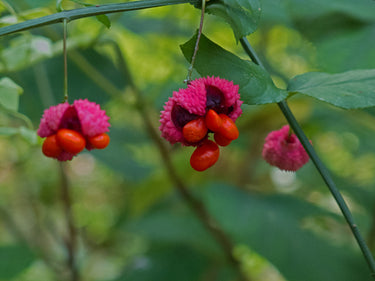


American Strawberry Bush
Euonymus americanus
Pickup currently unavailable at Aiken Nursery
In the quiet understory of the Eastern woodlands grows a shrub of subtle grace and striking autumn drama: Euonymus americanus, the American strawberry bush, known just as fondly by the folk name hearts-a-bustin'. This native, deciduous to semi-evergreen shrub sends up slender, distinctly green, angular stems clad in opposite, lance-shaped leaves to about three inches long. Through spring and summer the plant keeps to the shade of oak, hickory, and pine, quietly content in fertile, moist, well-drained soil.
Autumn is when this woodland native earns a place in memory and garden alike. The warty, scarlet seed capsules split open like little five-pointed stars, revealing bright orange-red seeds that dangle like jewels in the low October light. Those fiery bursts of scarlet and ember-orange give rise to the evocative country name hearts-a-bustin', a phrase that carries generations of Southern woodland lore. The small greenish, five-petaled spring flowers that precede them are easy to miss, but the fall fruit is unforgettable.
Beloved by naturalists and native-plant gardeners, the American strawberry bush is a true native of eastern North America and a quiet workhorse for wildlife. Birds, including wild turkeys and songbirds, take the seeds and scatter the plant to new corners of the woods, while deer browse the foliage and the loose thickets shelter small creatures. A note of caution for people: like others in the genus, the fruit and seeds are considered toxic if eaten, so the show is one for the eyes, not the table.
Plant this heirloom of the Southern woodland where a light touch of native character is wanted: in a shade or woodland garden, along a naturalized border, or in the dappled edge of taller trees. The understated summer foliage and green winter stems give way to that show-stopping autumn spectacle, a reminder that even the humblest forest shrub can carry real beauty and old tradition into the modern garden. Photos courtesy of Stephanie Brundage and Carolyn Fannon.
- Hardiness
- USDA Zones 5–9
- Sun
- Full Sun, Part Shade
- Soil
- Well-drained
- Mature size
- Height 6–8 Feet · Spread 3–5 Feet
- Growth rate
- Moderate
- Seasonality
- Semi-Evergreen
Small, greenish, five-petaled spring flowers, followed by warty scarlet capsules that split to reveal orange-red seeds in fall
From rooting to shipping, our top priority is ensuring you receive healthy, thriving plants for your garden’s success.
Because most of our plants are grown from rooted cuttings — alongside seed, air layering, and grafting chosen for each variety — you receive a stronger, true-to-type plant that establishes quickly in your garden.
Raised on organic soil blends and eco-friendly pest management — never harsh chemicals — your plant arrives healthy for your garden, your family, and the pollinators they feed.
Every purchase gives back. We donate to the Aiken Arboretum and support local wildlife conservation, so growing your garden helps protect the wider ecosystem too.

All our plant material is carefully propagated, grown, and nurtured at our humble nursery in Aiken, South Carolina.

Your plant arrives carefully packed and ready to settle in. Unpack them promptly, give them a day or two to acclimate, then plant following the notes we include — that’s all it takes. Clear care guidance comes with every order, so success is the easy part.
What to expect upon delivery
All our plants are sold in 1-gallon sizes, though the height of each plant can vary depending on its growth rate and seasonality, typically ranging from 1/2 to 2.5 feet.
Each plant is carefully packaged with its roots enclosed in a secure plastic bag containing moist soil, forming a compact root ball. To ensure safe transport, the box is padded with recycled newspaper, providing both stability and eco-friendly protection from weather during shipping.
What is your return policy?
Review our full return policy information on our SHIPPING AND RETURNS POLICY page.
What payment methods can I use?
We offer 35 different payment methods including major providers like Mastercard, Visa, PayPal, American Express and Diners as well as many different local payment methods including Klarna, iDEAL, AliPay, Sofort, giropay, and many more.
Can I make changes to my order after it’s been placed?
At Woodlanders, we strive to fulfill orders as quickly as possible. Therefore, we can only accommodate changes to your order within the first 24 hours after it has been placed. These changes include adding or removing products and modifying the delivery address. If you need to make any changes or if there has been a mistake with your order information, please reach out to us promptly via our CONTACT page with your order number for the quickest resolution.
Your satisfaction is our priority, and we appreciate your understanding and cooperation.