


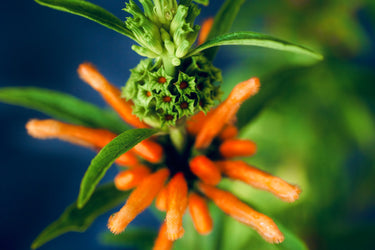


Lion's Ear
Leonotis leonurus
In propagation
Currently growing out 1 Gallon pots. Expected Fall 2026.
Add your name with the notify button below, and we will email you the moment this plant is ready to bring home.
Learn how we grow on The Prop House.
Pickup currently unavailable at Aiken Nursery
Few late-summer plants command a border like Leonotis leonurus, the lion's ear of the South African veld. Tall square stems, the signature of the mint family, Lamiaceae, rise five feet and more before breaking into tier upon tier of burnt-orange flowers, each whorl circling the stem like a ruff. The velvety, curved tubes are the source of both common names, lion's ear and lion's tail, and the botany agrees: Leonotis comes from the Greek for lion's ear, and leonurus for lion's tail.
In the homeland the plant is better known as wild dagga, a cornerstone of Khoikhoi and later Cape herbal tradition. Healers brewed decoctions and infusions of the leaves and flowers, and the dried aerial parts were smoked for a mild, calming effect that earned the shrub the nickname of wild cannabis, though the two plants are unrelated. Traditional practice reached for lion's ear against coughs, colds, and bronchitis, headaches and muscle cramps, snakebite and skin complaints, a breadth of use now drawing the interest of chemists studying the plant's labdane diterpenes and the compound leonurine.
The show builds through late summer and holds deep into autumn, sometimes into early winter where frost stays away, a season when tired gardens badly need the color. Hummingbirds treat the tubular flowers as built to order, and bees and butterflies work the whorls from dawn on. Between flushes the deep green, lance-shaped leaves give off a resinous scent when bruised, the sort of pungency that persuades deer and rabbits to browse elsewhere.
Give lion's ear the hottest, sunniest, sharpest-draining spot on the property and stand back. The bold vertical form earns a place at the back of a border, among ornamental grasses and late salvias, or in a gravel garden with agaves and other dry-country characters. In frost-free zones the shrub stays woody and evergreen; from about zone 8 the top dies down and the plant returns from the root, so cut the spent stems to the ground in late winter, mound coarse sand over the crown, and mulch well to carry the crown through. Overwatering is the one sure way to lose the plant; lean and dry is exactly how lion's ear likes to live.
- Hardiness
- USDA Zones 8–11
- Sun
- Full Sun
- Soil
- Well-drained
- Mature size
- Height 4–6 Feet · Spread 2–4 Feet
- Growth rate
- Moderate
- Seasonality
- Dies back, depends on zone
Burnt-orange tubular flowers in whorled tiers, late summer into fall
References & research
These statements have not been evaluated by the Food and Drug Administration. This information is shared for traditional and educational interest only and is not intended to diagnose, treat, cure, or prevent any disease. Please consult a qualified healthcare professional before any medicinal use.
- Leonotis leonurus is mildly psychoactive; smoking or strong preparations can cause dizziness, nausea, and light-headedness
- Avoid during pregnancy and breastfeeding
- Not a substitute for medical care for any condition
- Consult a physician or clinical herbalist before medicinal use
From rooting to shipping, our top priority is ensuring you receive healthy, thriving plants for your garden’s success.
Because most of our plants are grown from rooted cuttings — alongside seed, air layering, and grafting chosen for each variety — you receive a stronger, true-to-type plant that establishes quickly in your garden.
Raised on organic soil blends and eco-friendly pest management — never harsh chemicals — your plant arrives healthy for your garden, your family, and the pollinators they feed.
Every purchase gives back. We donate to the Aiken Arboretum and support local wildlife conservation, so growing your garden helps protect the wider ecosystem too.

All our plant material is carefully propagated, grown, and nurtured at our humble nursery in Aiken, South Carolina.

Your plant arrives carefully packed and ready to settle in. Unpack them promptly, give them a day or two to acclimate, then plant following the notes we include — that’s all it takes. Clear care guidance comes with every order, so success is the easy part.
What to expect upon delivery
All our plants are sold in 1-gallon sizes, though the height of each plant can vary depending on its growth rate and seasonality, typically ranging from 1/2 to 2.5 feet.
Each plant is carefully packaged with its roots enclosed in a secure plastic bag containing moist soil, forming a compact root ball. To ensure safe transport, the box is padded with recycled newspaper, providing both stability and eco-friendly protection from weather during shipping.
What is your return policy?
Review our full return policy information on our SHIPPING AND RETURNS POLICY page.
What payment methods can I use?
We offer 35 different payment methods including major providers like Mastercard, Visa, PayPal, American Express and Diners as well as many different local payment methods including Klarna, iDEAL, AliPay, Sofort, giropay, and many more.
Can I make changes to my order after it’s been placed?
At Woodlanders, we strive to fulfill orders as quickly as possible. Therefore, we can only accommodate changes to your order within the first 24 hours after it has been placed. These changes include adding or removing products and modifying the delivery address. If you need to make any changes or if there has been a mistake with your order information, please reach out to us promptly via our CONTACT page with your order number for the quickest resolution.
Your satisfaction is our priority, and we appreciate your understanding and cooperation.