


Simpson's Stopper (Myrcianthes)
1 plant in this collection
Filter and sort 1 product
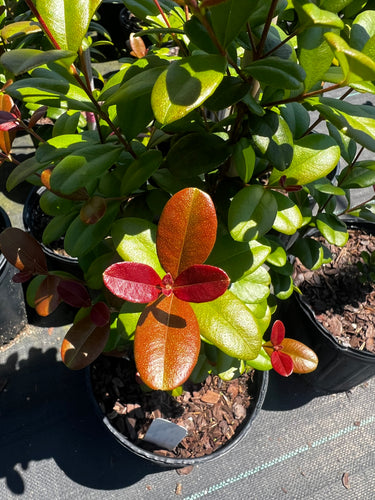

About the Simpson's Stopper (Myrcianthes) Collection
Three things recommend Myrcianthes fragrans, and the first is the bark. The outer layer flakes away in thin sheets to leave a smooth trunk in reddish-brown and tan, and on a plant limbed up into a small multi-trunked tree that alone will carry a courtyard. The second is the fruit, borne in small stalked clusters of three, often reduced to a conspicuous pair, which is where twinberry comes from. Green at first, then a bright reddish orange, and stripped in a hurry by mockingbirds, cardinals, blue jays and buntings. The third is the leaf, which releases a warm spicy scent when crushed that official Florida descriptions have long recorded as nutmeg, though anyone who reports citrus is not wrong either.
The name honors Charles Torrey Simpson, the naturalist of Biscayne Bay, who wrote Ornamental Gardening in Florida in 1916 and was still living in Miami when John Kunkel Small named a plant for him in 1917. Small published the shrub as Anamomis simpsonii; the species has since passed through Eugenia and through a Florida variety, var. simpsonii, that a 1992 revision of the genus quietly sank. Kew accepts Myrcianthes fragrans today, with sixty-one synonyms standing behind that one name, which tells you how long and how variously botanists have argued about this shrub. Stopper, incidentally, has nothing to do with Simpson: the name records an old use of the plant against dysentery.
The natural range runs from the Florida peninsula through the West Indies and down through Mexico and Central America into Brazil and Peru, and in Florida the northern limit is St. Johns County. The state lists the species as Threatened, on habitat loss rather than on any weakness in the plant, which makes a nursery-propagated specimen a quiet piece of conservation and a wild-collected one indefensible. In cultivation expect fifteen to twenty feet in time, growing about a foot a year, dense in full sun and looser in shade where the bark shows better. Give sun to part shade, tolerate alkaline and shelly soils happily, water through the first four summers, and shear as a hedge or lift the skirt into a tree; both work, though frequent shearing costs you the flowers and the fruit.
Now the honest caution, and it matters here in Aiken more than anywhere. This is a zone 8b to 11 plant. Foliage comes through to around 25 degrees intact, and below that you should expect damage; growers in zone 8b have watched established plants cut to near the ground by a hard freeze and return from the base the following season. In our own 8a that makes Simpson's stopper a plant to site in a warm microclimate against a wall, to treat as a cut-back shrub, or to keep in a large container and move under cover when a real freeze is forecast. Grown further south, none of that applies and you have one of the most useful small evergreens available to a Florida garden. Find more coastal and tender plants in our Sub-tropicals, further plants of conservation concern among our Endangered Species, and more evergreen structure in Small & Medium Shrubs.


