


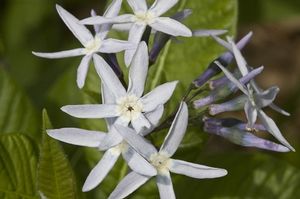

Louisiana Bluestar
Amsonia ludoviciana
In propagation
Currently growing out 1 Gallon pots. Expected season to be announced.
Add your name with the notify button below, and we will email you the moment this plant is ready to bring home.
Learn how we grow on The Prop House.
Pickup currently unavailable at Aiken Nursery
Most bluestars are smooth, cool customers; Amsonia ludoviciana is the outlier of the group. The Louisiana bluestar belongs to the dogbane family, Apocynaceae, and shares the clan's five-petaled, star-shaped flowers and milky sap, but the leaves set the species apart: narrow and willowy, and unusually clothed beneath with a grey-white felt, a woolly tomentum that catches the light and lends the whole plant a soft, silvered cast rare in the genus. In spring, clustered flowers of a clean sky-blue open at the tips of the upright stems, quiet and steely and worked over by the first butterflies of the season.
There is a real story behind these plants. Woodlanders obtained the Louisiana bluestar years ago from Brookgreen Gardens on the South Carolina coast, where the perennial had grown in cultivation since the celebrated botanist Dr. J. K. Small introduced the plant there in perhaps the 1920s. For a long stretch the species was feared lost, thought extinct in the wild, before being rediscovered in Louisiana; today botanists record scattered, uncommon populations from South Carolina west through Louisiana and Mississippi. Growing a nursery-raised plant of this rank keeps a rare Southeastern native in gardens and in circulation, a quiet piece of conservation.
The names carry their own small histories. The genus Amsonia honors Charles Amson, an eighteenth-century physician of colonial Virginia, while the epithet ludoviciana means simply of Louisiana, the state that sheltered the rediscovered plants. Like the milkweeds to which the bluestars are related, the stems run with a milky latex that browsing deer and rabbits leave strictly alone, so the plant reads as both delicate and durable: pollinators come for the spring nectar, and almost nothing comes to graze.
In the garden the Louisiana bluestar earns a place three seasons running. Site the plant in full sun to light shade and give lean, well-drained ground; despite wet-flatwoods origins the deep-rooted perennial shrugs off drought once settled, and only floppy, over-lush growth comes of rich soil. The spring flowers read against the silvered foliage, the fine-textured mound holds all summer, and in autumn the leaves turn a warm butter-gold that lights the border before the stems die back for winter. Set a plant among little bluestem, coneflower, and baptisia for a sunny native planting, or let a drift carry the cool blue through the edge of a meadow.
- Hardiness
- USDA Zones 6–9
- Sun
- Full Sun, Part Shade
- Soil
- Moist, Well-drained
- Mature size
- Height 3–4 Feet · Spread 2–3 Feet
- Growth rate
- Medium
- Seasonality
- Dies back, depends on zone
- Provenance
- Obtained years ago from Brookgreen Gardens in South Carolina, where the plant had grown since the botanist Dr. J. K. Small introduced it there in perhaps the 1920s.
Sky-blue star-shaped flowers in terminal clusters, spring; gold fall foliage
From rooting to shipping, our top priority is ensuring you receive healthy, thriving plants for your garden’s success.
Because most of our plants are grown from rooted cuttings — alongside seed, air layering, and grafting chosen for each variety — you receive a stronger, true-to-type plant that establishes quickly in your garden.
Raised on organic soil blends and eco-friendly pest management — never harsh chemicals — your plant arrives healthy for your garden, your family, and the pollinators they feed.
Every purchase gives back. We donate to the Aiken Arboretum and support local wildlife conservation, so growing your garden helps protect the wider ecosystem too.

All our plant material is carefully propagated, grown, and nurtured at our humble nursery in Aiken, South Carolina.

Your plant arrives carefully packed and ready to settle in. Unpack them promptly, give them a day or two to acclimate, then plant following the notes we include — that’s all it takes. Clear care guidance comes with every order, so success is the easy part.
What to expect upon delivery
All our plants are sold in 1-gallon sizes, though the height of each plant can vary depending on its growth rate and seasonality, typically ranging from 1/2 to 2.5 feet.
Each plant is carefully packaged with its roots enclosed in a secure plastic bag containing moist soil, forming a compact root ball. To ensure safe transport, the box is padded with recycled newspaper, providing both stability and eco-friendly protection from weather during shipping.
What is your return policy?
Review our full return policy information on our SHIPPING AND RETURNS POLICY page.
What payment methods can I use?
We offer 35 different payment methods including major providers like Mastercard, Visa, PayPal, American Express and Diners as well as many different local payment methods including Klarna, iDEAL, AliPay, Sofort, giropay, and many more.
Can I make changes to my order after it’s been placed?
At Woodlanders, we strive to fulfill orders as quickly as possible. Therefore, we can only accommodate changes to your order within the first 24 hours after it has been placed. These changes include adding or removing products and modifying the delivery address. If you need to make any changes or if there has been a mistake with your order information, please reach out to us promptly via our CONTACT page with your order number for the quickest resolution.
Your satisfaction is our priority, and we appreciate your understanding and cooperation.