




Chinese Fringetree
Chionanthus retusus
Pickup available at Aiken Nursery
Usually ready in 2-4 days
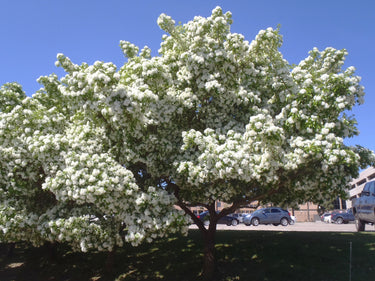
For a week or two in late spring, the Chinese fringetree vanishes under what looks like a fresh fall of snow. Chionanthus retusus is a deciduous small tree of eastern Asia, native across China, Korea, Japan, and Taiwan, and the whole performance turns on the flowering: dense, lacy panicles of narrow, strap-shaped petals, pure white and softly fragrant, break over the entire canopy until the leaves all but disappear beneath the froth. The genus name records the effect exactly, from the Greek chion, snow, and anthos, flower.
Few trees carry so much affection in their common names. In Korea the fringetree is known as the rice tree, 이팝나무, because the massed white bloom reads like heaped mounds of freshly steamed rice, and a generous flowering was long taken by farmers as a happy omen for the season's harvest. In Japan the same tree earned the delighted nickname nanja monja, roughly the what-on-earth-is-that tree, a name once handed to any striking specimen whose true identity had been forgotten. Old fringetrees are cherished across the region, several standing as protected natural monuments in Korea and Japan, among them a celebrated grove near Inuyama honored since 1923, and the species now ranks among the most planted street trees in Seoul.
The rest of the year the fringetree keeps quieter company with the seasons. Glossy, leathery, dark green leaves, finely toothed along the young margins, carry the summer and turn a clear gold in fall. On female trees the spent flowers give way to clusters of oval, blue-black fruits in late summer, a favorite of songbirds, for the species holds male and female flowers on separate plants and only the females set fruit. With age the bark grows handsomely ridged and furrowed and begins to peel in strips, so even the bare winter tree keeps something to show.
In the garden, Chionanthus retusus makes an exceptional small specimen or courtyard tree, slow and clean and thoroughly well-mannered, building a rounded, spreading head on a scale that suits a patio, a modest lawn, or a clearing beneath taller canopy. Site the tree where the late-spring bloom can be met at close range, near a path, a terrace, or a window, and set a dark evergreen behind to throw the white forward. Underplant with spring bulbs or low groundcovers that will not crowd the trunk, pair with dogwoods or other small flowering trees to lengthen the season, and, where fruit for the birds is wanted, plant a female within sight of a male.
- Hardiness
- USDA Zones 5–9
- Sun
- Full Sun, Part Shade
- Soil
- Well-drained, Moist
- Mature size
- Height 15–25 Feet · Spread 15–20 Feet
- Growth rate
- Slow
- Seasonality
- Deciduous
Lacy, fragrant, pure white panicles, late spring
From rooting to shipping, our top priority is ensuring you receive healthy, thriving plants for your garden’s success.
Because most of our plants are grown from rooted cuttings — alongside seed, air layering, and grafting chosen for each variety — you receive a stronger, true-to-type plant that establishes quickly in your garden.
Raised on organic soil blends and eco-friendly pest management — never harsh chemicals — your plant arrives healthy for your garden, your family, and the pollinators they feed.
Every purchase gives back. We donate to the Aiken Arboretum and support local wildlife conservation, so growing your garden helps protect the wider ecosystem too.

All our plant material is carefully propagated, grown, and nurtured at our humble nursery in Aiken, South Carolina.

Your plant arrives carefully packed and ready to settle in. Unpack them promptly, give them a day or two to acclimate, then plant following the notes we include — that’s all it takes. Clear care guidance comes with every order, so success is the easy part.
What to expect upon delivery
All our plants are sold in 1-gallon sizes, though the height of each plant can vary depending on its growth rate and seasonality, typically ranging from 1/2 to 2.5 feet.
Each plant is carefully packaged with its roots enclosed in a secure plastic bag containing moist soil, forming a compact root ball. To ensure safe transport, the box is padded with recycled newspaper, providing both stability and eco-friendly protection from weather during shipping.
What is your return policy?
Review our full return policy information on our SHIPPING AND RETURNS POLICY page.
What payment methods can I use?
We offer 35 different payment methods including major providers like Mastercard, Visa, PayPal, American Express and Diners as well as many different local payment methods including Klarna, iDEAL, AliPay, Sofort, giropay, and many more.
Can I make changes to my order after it’s been placed?
At Woodlanders, we strive to fulfill orders as quickly as possible. Therefore, we can only accommodate changes to your order within the first 24 hours after it has been placed. These changes include adding or removing products and modifying the delivery address. If you need to make any changes or if there has been a mistake with your order information, please reach out to us promptly via our CONTACT page with your order number for the quickest resolution.
Your satisfaction is our priority, and we appreciate your understanding and cooperation.