Plant Highlights · Chinese Fringetree · East Asia
For about two weeks in late spring, a small tree from Korea, Japan and China disappears under a fall of white so heavy that farmers once read the harvest in the bloom.
In this piece
I.Snow flower
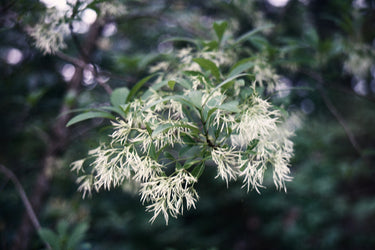
The genus name is a description, and an exact one. Chionanthus comes from the Greek chion, snow, and anthos, flower, and anyone who has stood under a Chinese fringetree in late May will tell you the botanists were not exaggerating. The flowers are pure white and faintly sweet, each one split into four narrow, strap-like lobes about half an inch to an inch long, and they come in loose panicles at the ends of the new shoots. On a tree in full flower the panicles are so numerous that the leaves all but vanish, and the whole crown reads as a single drift of white froth.
Chionanthus retusus is a small deciduous tree of eastern Asia, native to central and southern China, Taiwan, South Korea and Japan. In cultivation expect something between 10 and 30 feet tall and roughly as wide, a rounded, spreading head on a short trunk, though wild trees in their home range can reach well beyond that. The species epithet is a small joke for the leaf-minded: retusus means retuse, a rounded leaf tip with a shallow notch in the middle, as if someone had pressed a thumbnail into the end of each leaf.
The tree belongs to Oleaceae, the olive family, which puts the fringetree in company with lilacs, ashes, jasmines and the tea olives. That last kinship will make sense to anyone who has met both: the same clean, leathery, opposite leaves, the same habit of flowering in clouds. We wrote about the tea olives' own place in East Asian culture in Osmanthus and the Moon Palace, and the fringetree belongs to the same story.

II.The rice tree and the what-is-that tree
Few trees have been looked at so fondly, by so many people, for so long. In Korea the fringetree is ipap-namu, 이팝나무, and the most common explanation of the name runs back to ipap, an old word for a bowl of white rice: the massed flower heads look exactly like rice heaped high and steaming. A second theory ties the name to ipha, the solar term that marks the beginning of summer, which is roughly when the trees bloom. The two explanations are not rivals so much as neighbors, and both tie the tree to the farming year.
The connection went further than the name. In the south of the peninsula, a heavy flowering was taken as a sign of a good rice harvest to come. There is sense under the folklore: fringetrees bloom best where spring water is plentiful, and so are the paddies. Several old trees are protected as national natural monuments, mostly in the southwest of the country. One in Gimhae, Cheongok-ri, is put at around 500 years old and stands some 60 feet tall. Today the species is an increasingly popular street tree in Korean cities, common enough in places like Daegu that the bloom has become a civic event.
A heavy flowering was read as a full rice bowl in autumn. The tree was a calendar before the tree was an ornament.
Japan gave the tree a name with a wink in the middle. The proper name is hitotsubatago, but the nickname is nanja monja, roughly "what on earth is that," a label once handed out to any striking old tree whose identity people could no longer place. The best known Japanese stand grows wild near Inuyama in Aichi Prefecture, first recorded in 1822, rediscovered in 1922, and designated a national natural monument on 7 March 1923. Only a handful of trees remain there. Japan has a long habit of honoring individual trees as monuments, and we touched on that same reverence from the conifer side in The Cedar That Is Not a Cedar.
Field Note
Taiwan has the fringetree too, and the island's wild trees are now a rarity, confined to a small area of Taoyuan and once thought lost from the wild altogether. Plants from Taiwanese stock, with finer, more sharply toothed leaves, are often sold as var. serrulatus. Most botanists today fold that name back into the species, so treat the label as a description of a form rather than a firm division.
III.Reading the tree through the year
The bloom is the headline, but the tree keeps quieter company through the other fifty weeks, and those weeks are most of what you live with.
Spring. The leaves come first, and the flowers follow in late spring at the ends of the current season's shoots. In Aiken that usually means May. Expect a lighter show some years: the species has a tendency toward heavy bloom in alternate years, which is not a sign that anything is wrong.
Summer. The foliage is the summer story: opposite, leathery, glossy dark green and pale beneath. Leaves on young plants are often finely toothed, and the toothing tends to disappear as the tree matures, which confuses people who bought a sapling with serrated leaves and later find smooth ones.
Fall. Fruiting trees carry clusters of dark blue, olive-like drupes about half an inch long, ripening from late summer into autumn and taken by birds as soon as they color. Fall color is a clear yellow in a good year and an indifferent one in a poor year. Do not plant the tree for autumn alone.
Winter. Older trees develop grey-brown bark that ridges and peels in strips, so the bare frame has something to show. The architecture is low and broad and handsome against a dark evergreen.
Field Note
Fringetrees are often called dioecious, with male and female flowers on separate trees. The real arrangement in C. retusus is a little stranger. The species is androdioecious: some trees carry only male flowers, and the rest carry bisexual flowers that can set fruit on their own. Male trees put on the showier display. If you want the fruit for birds, you want one of the fruiting trees; if you want the most snow, a male tree like the columnar 'Tokyo Tower' delivers it.
IV.Two fringetrees, two calendars
The Southeast has a fringetree of its own, and the question we hear most is which one to plant. The honest answer is both, if you have the room, because they are not doing the same job.
Chionanthus retusus
Chinese fringetree, ipap-namu, nanja monja
- 10 to 30 ft
- Deciduous
- Full sun to part shade
- Zones 6 to 9
- Late spring bloom
A true small tree with a single trunk or a few, a broad head, glossy leaves and bark worth looking at in winter. Flowers on the new growth, after the leaves are out. Tolerant of a wide range of soils and of city conditions, and the more formal and tidy of the two.
Chionanthus virginicus
White fringetree, grancy graybeard, old man's beard
- 12 to 20 ft
- Deciduous
- Sun to part shade
- Zones 3 to 9
- Spring bloom
- Native
Native from New England to Florida and Texas, often a large multi-stemmed shrub rather than a tree. The flowers hang in longer, looser, more shaggy panicles on the previous year's wood, opening as the leaves emerge, roughly two weeks before the Chinese species. Fruiting plants carry blue-black fruit for birds from midsummer. The root bark has a long history of use in Southeastern Indigenous and Appalachian folk medicine.
| Trait | C. retusus | C. virginicus |
|---|---|---|
| Native range | China, Taiwan, Korea, Japan | Eastern and southeastern US |
| Size in gardens | 10 to 30 ft, about as wide | 12 to 20 ft, about as wide |
| USDA zones | 6 to 9 (5 with shelter) | 3 to 9 |
| Bloom | Late spring, after leaf-out | Mid spring, as leaves emerge |
| Flowers borne on | Current season's shoots | Previous year's wood |
| Leaves | Smaller, glossy, leathery | Larger, softer, matte |
| Habit | Small tree | Large shrub or small tree |
| Emerald ash borer | Resistant in trials | Documented host |
That last row deserves a sentence of its own. The emerald ash borer, which has gutted ash populations across eastern North America, has been documented attacking the native white fringetree, a relative of ash in the same family. In laboratory and field work the Chinese species proved resistant, with no field infestations found and no larvae surviving rearing trials. Nobody should take that as a reason to stop planting the native, which matters to our insects in ways an import cannot. The finding is a reason to plant the two side by side rather than putting every egg in one basket.
V.Siting and planting this fall
October is the right month for a fringetree here. The soil is still warm, the tree has stopped pushing new growth, and the roots have the whole cool half of the year to settle in before the first serious heat. We laid out the general argument in Plant It in the Cooling, and small flowering trees are among the plants that gain most from it.
Where to put the tree
Plant the fringetree where the bloom can be met at close range: beside a terrace, at the turn of a path, in view of a window you actually use in May. The scent is gentle and does not carry far, so give the tree a place where you will pass under the branches rather than look at them across a lawn. Set a dark evergreen behind (a holly, a tea olive, a podocarpus) and the white comes forward like a lamp. We made the broader case for siting by scent in Sited by the Nose.
Light, soil and water
Full sun gives the heaviest bloom; light afternoon shade is fine in the hottest gardens, at some cost to flower. The species is adaptable on soil, taking clay or loam and a range of pH, and tolerates urban conditions well enough to line streets in Korea. Sources disagree about drought tolerance, so we split the difference: water deeply through the first two summers, mulch the root zone, and expect an established tree to cope with ordinary dry spells without fuss.
Pruning and shaping
Because C. retusus flowers on the current season's growth, the timing is forgiving. Do any structural work in late winter while the tree is bare: choose a single trunk or a few, lift the lowest limbs if you want to walk under the canopy, and remove crossing branches. After that, leave the tree alone. The natural rounded head is the point.
Growing from seed
Fringetree seed is slow by design. Like the native species, the seed has a double dormancy: a warm, moist period of a couple of months followed by a cold period of similar length before anything happens. Sow fresh fruit outdoors in fall and expect germination the second spring, or buy a plant and save yourself a year and a half.
One honest caution comes with the tree: the fringetree is slow out of the gate. Expect a modest first year and a tree that starts to look like something in year three or four. After that, the tree will flower every spring for longer than most of us will be gardening.
A tree for the turn of the path
We grow Chionanthus retusus from good stock, and this fall's crop is ready to go into the ground now. Plant one where you walk in late May, put a dark evergreen behind the tree, and give the roots this winter to settle. If you have room for a second, the native Chionanthus virginicus blooms a fortnight earlier, and between the two you get nearly a month of snow.
References
- North Carolina Extension Gardener Plant Toolbox, Chionanthus retusus and Chionanthus virginicus. plants.ces.ncsu.edu
- Trees and Shrubs Online, Chionanthus retusus and Chionanthus virginicus. treesandshrubsonline.org
- Clemson Home & Garden Information Center, "Chinese Fringetree Puts on a Show in the Spring." hgic.clemson.edu
- Cultural Heritage Administration of Korea, natural monument records for Chionanthus retusus (ipap-namu). cha.go.kr and heritage.go.kr
- Inuyama City, Aichi Prefecture, record of the hitotsubatago wild stand, national natural monument designated 1923. city.inuyama.aichi.jp
- Seoul Metropolitan Government Media Hub, street tree species composition. mediahub.seoul.go.kr
- Studies of emerald ash borer host range in Chionanthus, including the resistance of C. retusus in field surveys and rearing trials. PubMed 26314014.
- Studies of the androdioecious breeding system of Chionanthus retusus. Flora, 2016.
- National Museum of Natural Science, Taiwan, Chionanthus retusus gallery notes. nmns.edu.tw