


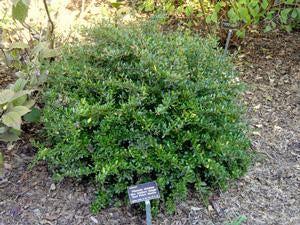

Viburnum, Dwarf Walter
Viburnum obovatum 'Mrs. Schiller's Delight'
In propagation
Currently growing out 1 Gallon pots. Expected Fall 2026.
Add your name with the notify button below, and we will email you the moment this plant is ready to bring home.
Learn how we grow on The Prop House.
Pickup currently unavailable at Aiken Nursery
'Mrs. Schiller's Delight' is an excellent dwarf clone of Viburnum obovatum, the fine small-leaved native evergreen known as Walter's viburnum. The clone was selected by our friend Steve Reifler in Florida, who thought the dense little shrub looked like 'Schillings', the widely grown dwarf yaupon holly, and named the plant for a friend whose name happened to sound almost the same. Woodlanders listed this shrub for years as 'Miss Schiller's Delight'; the trade name is 'Mrs.', and the spelling is corrected here.
Woodlanders was one of the first nurseries anywhere to offer the Reifler dwarf clones of Viburnum obovatum, which have since become staples of Southern landscaping and are now grown by the container-load in Florida. 'Mrs. Schiller's Delight' has stayed the most floriferous of the group, and remains the one we would plant ourselves.
Small, narrow, glossy leaves are held in opposite pairs on stiff twiggy branches, and that arrangement is what makes the shrub so remarkably dense. In the Deep South the foliage stays evergreen; toward the colder edge of zone 7 expect semi-evergreen behavior and some winter leaf drop. Then for two or three weeks in late February and early March the whole plant disappears under clusters of small white flowers, well ahead of almost anything else in the garden. Nurseries commonly quote three feet by four feet, and University of Georgia trial plants managed only fourteen inches by three feet in three years, but given enough time and decent soil the shrub can double the usual figure, so allow more room than the label suggests.
Walter's viburnum is a larval host for the spring azure butterfly, and those late-winter flowers are among the first substantial nectar sources of the year for bees and small pollinators, which matters more than the bloom count suggests. Plant in sun or part shade, with full sun producing the densest and most compact growth. Once established, 'Mrs. Schiller's Delight' has proven exceptionally drought tolerant, which makes the shrub useful as a low evergreen hedge, as a foundation planting that will never reach a window, as a clipped or unclipped mass, and as a native substitute wherever dwarf yaupon or boxwood would otherwise go.
- Hardiness
- USDA Zones 7–9
- Sun
- Full Sun, Part Shade
- Soil
- Well-drained, Average, Moist
- Mature size
- Height 2–3 Feet · Spread 2–3 Feet
- Growth rate
- Slow
- Seasonality
- Semi-Evergreen
Dense clusters of small white flowers, late February to mid March
From rooting to shipping, our top priority is ensuring you receive healthy, thriving plants for your garden’s success.
Because most of our plants are grown from rooted cuttings — alongside seed, air layering, and grafting chosen for each variety — you receive a stronger, true-to-type plant that establishes quickly in your garden.
Raised on organic soil blends and eco-friendly pest management — never harsh chemicals — your plant arrives healthy for your garden, your family, and the pollinators they feed.
Every purchase gives back. We donate to the Aiken Arboretum and support local wildlife conservation, so growing your garden helps protect the wider ecosystem too.

All our plant material is carefully propagated, grown, and nurtured at our humble nursery in Aiken, South Carolina.

Your plant arrives carefully packed and ready to settle in. Unpack them promptly, give them a day or two to acclimate, then plant following the notes we include — that’s all it takes. Clear care guidance comes with every order, so success is the easy part.
What to expect upon delivery
All our plants are sold in 1-gallon sizes, though the height of each plant can vary depending on its growth rate and seasonality, typically ranging from 1/2 to 2.5 feet.
Each plant is carefully packaged with its roots enclosed in a secure plastic bag containing moist soil, forming a compact root ball. To ensure safe transport, the box is padded with recycled newspaper, providing both stability and eco-friendly protection from weather during shipping.
What is your return policy?
Review our full return policy information on our SHIPPING AND RETURNS POLICY page.
What payment methods can I use?
We offer 35 different payment methods including major providers like Mastercard, Visa, PayPal, American Express and Diners as well as many different local payment methods including Klarna, iDEAL, AliPay, Sofort, giropay, and many more.
Can I make changes to my order after it’s been placed?
At Woodlanders, we strive to fulfill orders as quickly as possible. Therefore, we can only accommodate changes to your order within the first 24 hours after it has been placed. These changes include adding or removing products and modifying the delivery address. If you need to make any changes or if there has been a mistake with your order information, please reach out to us promptly via our CONTACT page with your order number for the quickest resolution.
Your satisfaction is our priority, and we appreciate your understanding and cooperation.