Landscape Design · Black Gum · The Southeast
Where the Black Gum Wants to Stand
The tupelo refuses to specialize, thriving in standing water and dry clay alike, which makes siting the tree less a matter of rules than of listening to the ground.
In this guide
I. A tree that will not be pinned down
II. Reading the ground before you dig
III. The autumn argument for placement
IV. Companions, birds, and the old bee gum
V. The tupelos for a particular corner
VI. Getting a young tree settled
Most trees tell you where they belong. A bald cypress wants the low wet ground, a longleaf pine wants the sand and the fire, and each will sulk when you put them anywhere else. Black gum, Nyssa sylvatica, keeps the gardener guessing. The same species grows in the standing water of a Carolina bay and on a dry upland ridge baked hard by August, and grows well in both. That range is the whole design problem and the whole design gift. A tree that adapts everywhere gives you the freedom to place the plant almost anywhere, which means the interesting question is not whether black gum will live, but where the tree will do the most work for a garden.
This is a companion to The Black Gum Chronicles, which told the long story of the species, the six-hundred-year lifespans, the folk medicine, the deep history. Here the concern is narrower and more practical: how to use black gum as a designer uses any strong vertical, and how to site the tree so the famous autumn color lands where a person will actually see the show.
I.A tree that will not be pinned down
Black gum belongs to a small genus of wetland-leaning trees, the tupelos, and by rights the species should be a swamp specialist like the relatives. Instead Nyssa sylvatica carries a rare tolerance in both directions. The roots take standing water in winter and spring, then take drought in high summer, and the tree treats neither as an emergency. For a Southern garden, where the same low spot can flood in February and crack open in September, that flexibility is worth more than almost any single ornamental trait.
The habit is the second gift. A young black gum grows with a straight central leader and neat horizontal branches, laddered out from the trunk in tiers, giving the tree a pyramidal, almost formal outline when young that loosens into an irregular, picturesque crown with age. The branching reads well in winter against a gray sky, and the tiered young form makes black gum one of the cleanest vertical accents a native palette offers.
A tree that adapts everywhere hands the decision back to you.
Worth saying plainly, because the flexibility can tempt a gardener into carelessness: adaptable is not the same as indifferent. Black gum resents having the roots disturbed and moves poorly once established, sending down a taproot early that does not care to be dug. The lesson for design is to decide well the first time and to plant young. A tree this long-lived is a fifty-year decision, not a five-year one.
II.Reading the ground before you dig
Because the species tolerates so much, the siting question turns on what you want from the tree rather than what the tree can survive. Three situations come up again and again in Southeastern gardens, and black gum answers each of them.
The wet spot that defeats everything else. Where a low corner holds water after every rain and rots the roots of ordinary shade trees, black gum settles in and thrives. The tree makes a natural anchor for a rain garden or the margin of a pond, and pairs there with the other plants that read water as an opportunity. For a fuller treatment of that kind of ground, our guide to working with a wet garden area maps the wider palette.
The dry upland where you still want reliable color. On a hot, well-drained slope, black gum trades some size for toughness and keeps the autumn display intact. The upland form, sometimes sold as the variety biflora in the swamp populations, carries smaller, more leathery leaves that shrug off heat. Here the tree earns a place as a specimen, sited for the fall show against evergreens.
The lawn tree that has to behave. Black gum casts a moderate, high shade rather than the dense dark of a live oak, so grass and groundcovers manage underneath, and the tree drops small fruit rather than large messy pods. As a single specimen in an open lawn, the tiered young habit and the clean trunk make a quiet, well-mannered focal point.
Field Note
Black gum is largely dioecious: male and female flowers usually sit on separate trees, though many individuals carry a few of each. Only the female-flowering trees set the blue-black fruit. If you are planting for the birds, plant more than one, and give the birds a few years, because seedling trees take time to reach flowering age.
III.The autumn argument for placement
If there is one reason to grow black gum, and one reason to fuss over placement, the reason is the fall color. The species is among the earliest hardwoods to turn, and among the most intense. The glossy summer leaves ignite into scarlet, orange, and deep wine-purple, often weeks before the surrounding woods have thought about changing, and frequently all three colors burn on the same tree at once. The leaves are thick and lustrous, so the color catches light and holds a shine that a dry oak leaf never manages.

Early color is a design tool, not just a pleasure. Because black gum colors ahead of the maples and the sweetgums, a single tree can open the autumn season in a garden, carrying the show for two or three weeks before anything else joins in. Site the tree where the low, slanting light of a September or October afternoon will pass through the crown rather than fall flat on the front of the tree, and the leaves light up from within. A black gum placed to the west or southwest of a favorite window, or across a lawn from where you sit in the evening, pays that placement back every fall.
The tree opens the season while the rest of the garden is still green.
One honest caution comes with the beauty. That early turn also means an early drop; black gum sheds ahead of the pack, so the tree is not the plant to lean on for late-November color. Think of black gum as the overture and let a later species, an oak or a Japanese maple, carry the closing weeks. This is the same layered thinking behind our essay on why woody plants are the foundation of a climate-resilient garden, where the point is to build a sequence rather than a single moment.
IV.Companions, birds, and the old bee gum
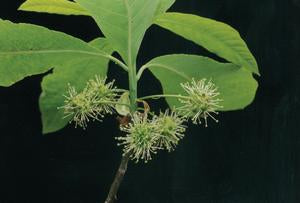
Black gum earns a place in an ecological planting well before the leaves turn. The small greenish spring flowers are inconspicuous to a person and a feast to a bee; a flowering black gum hums audibly, and honeybees make a prized, light honey from the nectar. Later, the female trees hang small blue-black drupes, sour to us and rich in fat to a bird, and the fruit is stripped fast by thrushes, woodpeckers, cedar waxwings, bluebirds, and even wild turkeys, right as the migration moves through.
For companions, lean into the layered woodland edge the tree naturally belongs to. Underplant with the acid-loving shrubs that share the same ground: blueberries and their kin, mountain laurel, a drift of native azalea. In the wet situations, the plant reads beautifully beside buttonbush and swamp hibiscus. In the drier upland version, black gum stands well over a matrix of little bluestem and a scatter of aromatic asters, the horizontal branching drawing a line above the grasses.
Field Note
The common name gum has nothing to do with sap. Old black gum trees hollow out cleanly with age, and mountain beekeepers once cut the hollow logs into sections and stood them on end as hives. Those log hives were called bee gums, and the word gum became a synonym for a beehive across Appalachia. A hollow black gum in the woods is still a hive in waiting, and a shelter for owls, bats, and tree frogs besides.
V.The tupelos for a particular corner
Black gum is the tupelo for most gardens, but the genus holds a few relatives worth knowing when a site is unusual. Each solves a problem the common species does not, and all share the family gift for wet ground and clean autumn color.
Black Gum
Nyssa sylvatica
Wet to dry
Zones 4 to 9
Early scarlet fall
Bee and bird tree
The all-purpose choice: the widest tolerance, the longest life, and the most reliable color. If you are planting one tupelo, plant this one. See black gum in the shop.
Ogeechee Tupelo
Nyssa ogeche
Coastal plain
Wet ground
Edible fruit
Tupelo honey
A medium tree of the southeastern Coastal Plain, and the true source of tupelo honey. The tart red fruit, the Ogeechee lime, was once made into a drink and a preserve. For a wet, warm, low-country site with a taste for story. See Ogeechee tupelo in the shop.
Water Tupelo
Nyssa aquatica
True swamp tree
Swollen base
Large leaves
Golden fall
The swamp specialist, a large tree that develops a buttressed, swollen base in frequently flooded ground and turns clear yellow in fall. For genuine standing water, where even black gum reaches the limit. Offered when available.
VI.Getting a young tree settled
Everything easy about black gum in maturity depends on care in the first two years, because the trait that makes the species long-lived, that early diving taproot, also makes the tree resent transplanting. Plant young, from a container, and disturb the root ball as little as possible. Set the tree at the depth the plant grew and no deeper, water deeply through the first two summers, and then, in most Southeastern gardens, step back and let the tree take over. Below, the practical spine of the plant, for the record.
Light and form
Full sun to part shade. Full sun gives the densest crown and the strongest fall color; the tree will take high shade but grows looser and colors less intensely. Expect a straight-leadered young tree that broadens with age to a rounded, irregular crown, ultimately a large tree of forty to seventy feet in good ground, smaller and tougher on a dry site.
Soil and water
Prefers a moist, acid, well-drained loam but tolerates a remarkable range, from seasonally flooded clay to dry upland sand. Neutral to acid pH suits the tree best. Once established, black gum handles both drought and periodic standing water without complaint.
Planting and aftercare
Plant young, from a container, in fall or early spring. Handle the root ball gently and avoid heavy root disturbance. Water through the first two summers to establish, mulch to hold moisture and keep mowers away from the trunk, and prune only lightly when young to set a single leader if the tree has forked.
| Trait | Black gum in the garden |
|---|---|
| Mature size | 40 to 70 ft tall, 20 to 35 ft wide in good ground; smaller on dry sites |
| Hardiness | USDA zones 4 to 9 |
| Light | Full sun to part shade (best color in sun) |
| Soil and moisture | Wet to dry, acid to neutral; exceptionally adaptable |
| Fall color | Early scarlet, orange, and wine-purple, often all at once |
| Wildlife | Spring nectar for bees; fatty fruit for songbirds and turkeys |
| Design role | Specimen, rain-garden anchor, well-mannered lawn shade tree |
Choose the ground once, choose it well, and black gum will hold that corner longer than you will hold the house. Few native trees give a garden so much, for so long, in exchange for a single good decision made early.
References
North Carolina Extension Gardener Plant Toolbox, Nyssa sylvatica. · Virginia Native Plant Society, Black Gum, Nyssa sylvatica. · Lady Bird Johnson Wildflower Center, Nyssa sylvatica. · United States Department of Agriculture, plant hardiness and range data for Nyssa sylvatica and Nyssa ogeche.