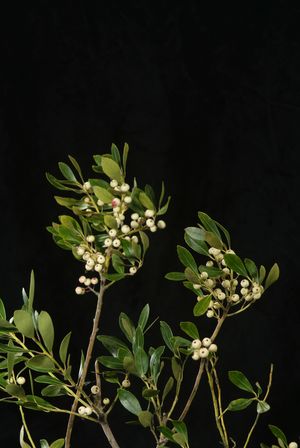

Plant Highlight · Ilex verticillata · Eastern Wetlands
A Matched Pair: 'Winter Red' and 'Southern Gentleman'
Most plant introductions are a single name on a single label. Robert Simpson released two at once, a female winterberry and the male he had picked out to pollinate her. Half a century later they still do their best work side by side, and the branches still carry a holiday table better than anything wired.
IAn Indiana nursery and a good idea
Most plant introductions are a single name on a single label. Robert Simpson released two at once, a female and the male he had picked out for her, as if he already knew how many gardeners would plant the first and forget the second.
Simpson Nursery in Vincennes, Indiana, had been growing fruit trees since the middle of the nineteenth century. After Robert Simpson took over in 1968, he turned the place toward ornamentals and made winterberry one of his specialties. 'Winter Red' came out of that work: a seedling selected around 1960, watched for years, patented, and introduced in 1977. She is a large, rounded female, six to ten feet high and wide, and her berries color early, hold their red clean and bright through the coldest months, and are packed along the stems so thickly that the bare shrub reads as red from across a field.
Alongside her Simpson selected a male, listed at first under the plain working name 'Late Male', and better known since as 'Southern Gentleman'. He was chosen for one thing above all: to bloom when she does.
He was chosen for one thing above all: to bloom when she does.
IIWhy late needs late
Winterberry, Ilex verticillata, grows wild from eastern Canada to the Gulf, and over that great range the plants have drifted into early-flowering and late-flowering types that can miss one another by weeks. Hollies are pollinated by bees and other insects, not by wind, so a male is useful only if his flowers are open while hers are. 'Winter Red' is a late bloomer. The common early male 'Jim Dandy' will have shed his pollen and finished before she opens, and she will stand there berryless however close he is planted.
'Southern Gentleman' flowers late, in step with 'Winter Red' and the rest of the late crowd: 'Winter Gold', 'Sparkleberry', 'Cacapon', 'Shaver' and 'Sunset'. One plant keeps six to ten females in fruit within bee range, so a single gentleman will serve a whole hedge. The forty to fifty feet usually quoted is a planning figure rather than a fence. Our pairing guide goes into the details.
IIIThe holly that drops her leaves
Winterberry surprises people. The finely toothed leaves give no hint of holly through the summer, and in fall they drop, which most people do not expect a holly to do. That is the trick. With the leaves gone, nothing stands between you and the fruit, and a mature 'Winter Red' in December is simply a shrub-shaped cloud of red against gray bark, snow or a plain fence.
'Southern Gentleman' is no hardship to look at either. He makes a vigorous, upright, rounded shrub of glossy dark green that turns soft yellow-green and bronze in fall, and his small spring flowers hum with native bees doing the work he is there for. Plant him for what he does rather than for what he shows, and the red will follow.
IVSiting the pair
Winterberry is a wetland plant: swamp edges, pond margins, wet woods. In the garden the pair want moist to wet, acid soil in full sun to part shade, and they take clay and standing water that would drown most shrubs. A rain garden, a pond edge, a wet swale or the back of a mixed border all suit them. Plant several females together for a solid wall of berries, set the male in among them or at one end, and be patient: expect meaningful fruit about three years after planting. Both are hardy from the far north down into the heat of the Deep South.
'Winter Red' and 'Southern Gentleman'
Winterberry, Ilex verticillata, female and male
- 'Winter Red' between crops
- 'Southern Gentleman' in stock
- Deciduous
- Native
- 6 to 10 ft
- Wet ground
- Late blooming
Sold separately and planted together. One 'Southern Gentleman' for every six to ten 'Winter Red'.
For a smaller garden. 'Red Sprite' is winterberry at three to five feet, heavy with large, glossy scarlet berries on a compact frame. She blooms early, so her partner is the early male 'Jim Dandy' rather than 'Southern Gentleman'. 'Red Sprite' is in stock now; 'Jim Dandy' returns with his next crop, and a neighbor's early winterberry may well do the job in the meantime.
VBranches for the house
Florists have prized cut winterberry for generations, and 'Winter Red' is one of the best for the purpose. Cut stems in December once the berries are fully colored, strip any last leaves, split or recut the stem ends, and stand them in water or dry in a vase. The berries hold indoors for weeks, long past the point where most holiday greens have given up. Our guide to harvesting and conditioning woody stems covers the technique.
Cut with restraint, though. Leave plenty of fruit on the shrub for the robins, waxwings and mockingbirds, who come for the berries late in winter once better food has run out. We tell that story in The Pantry at the End of Winter.
One honest caution: winterberry fruit carries enough saponin to upset people and dogs. Keep cut branches where small hands and curious noses cannot reach the fallen berries.
From the Nursery
'Red Sprite' is in stock now, the winterberry to plant this season. 'Southern Gentleman' is in stock for gardens that already grow 'Winter Red' or another late female, and 'Winter Red' herself returns with her next crop. Orders over $200 ship free.
References
- US Plant Patent PP4146, Ilex verticillata 'Winter Red', R. C. Simpson, Vincennes, Indiana.
- Bernheim Arboretum and Research Forest. Ilex verticillata 'Winter Red' and 'Southern Gentleman' (formerly 'Late Male'). bcarboretum.org
- Oregon State University Landscape Plants. Ilex verticillata 'Winter Red'. landscapeplants.oregonstate.edu
- Dirr, M. A. Manual of Woody Landscape Plants, 6th ed. Stipes Publishing, 2009.