
Plant Highlight · Ilex cassine · Southern Wetlands
The Holly Named for the Wrong Drink
Dahoon has spent more than two and a half centuries answering to a name meant for somebody else. A smooth-leaved evergreen holly of Southern swamps, generous with scarlet fruit, happy with wet feet, and quietly the grandmother of some of the most planted hollies in America.
IA misheard word
Dahoon has spent more than two and a half centuries answering to a name meant for somebody else. Not through any fault of her own. A Spanish colonist misheard a word, Linnaeus wrote the word down on the wrong page, and the holly that actually brewed the famous drink had to wait thirty-six years for a name of her own.
Here is how it went. Spanish settlers in sixteenth century Florida drank the caffeinated holly tea of the Timucua and wrote the Timucua name for the drink as something like cacina. When Linnaeus came to name the North American hollies in 1753, he attached that drink-word to this plant, the smooth-leaved holly of the swamps, as Ilex cassine. The holly the drink was actually brewed from was yaupon, and yaupon was not formally named until William Aiton called her Ilex vomitoria in 1789. So dahoon carries the name of a drink she never made, and yaupon carries an insult she never earned. We tell the drink's side of the story in The Black Drink.
For good measure, the chemistry agrees with history. A 2019 survey of caffeine and its relatives across the genus found them in yaupon, yerba mate and guayusa, and specifically could not corroborate older reports of caffeine in Ilex cassine. The common name is no clearer. Thomas Walter published Ilex dahoon in 1788, and where he got the word dahoon nobody has ever established.
So dahoon carries the name of a drink she never made, and yaupon carries an insult she never earned.
IIThe plant herself
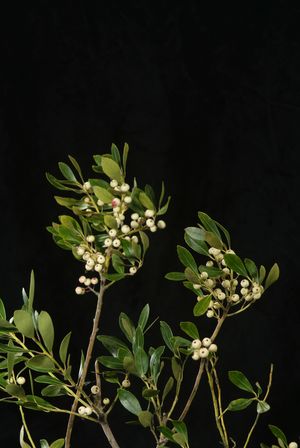
Set the naming muddle aside and what remains is one of the most useful evergreen hollies for the South. Dahoon is a large shrub or small tree with narrow, smooth-edged, bright green leaves, a world away from the fierce spines of American holly, so the plant is a pleasure to brush past on a path or plant beside a bench. In spring small greenish-white flowers feed the bees. In fall the females string their branches with small, glossy scarlet berries that hold into winter and feed the birds when other food runs short.
In the wild dahoon grows in swamps, pond margins and wet flatwoods along the coastal plain from the Carolinas around to Texas, and takes standing water and heavy rain where many evergreens sulk. In the garden the plant is more forgiving still, thriving on ordinary moist, acid soil in full sun or part shade and asking mainly that the roots not bake dry. Growth is steady rather than fast, building over years into a dense, glossy mass.
Dahoon
Ilex cassine, female
- In stock
- Evergreen
- Native
- Wet ground
- Red berries
Smooth leaves, scarlet winter fruit, and a tolerance for wet ground that few evergreens share. Her male match is growing on at the nursery and will follow in a later restock.
IIIA family tree worth knowing
Where dahoon and American holly, Ilex opaca, grow near each other in the wild, they cross. The natural hybrid is Ilex × attenuata, and selections of that cross gave Southern gardens 'East Palatka' and the Foster hollies, which between them line a remarkable share of the parking lots, bank branches and courthouse lawns of the South. Most people who know a Foster holly have no idea a swamp holly is half of the story. We grow another selection of the cross, 'Alagold', when we have her.
IVWhere dahoon belongs in a garden
Put dahoon where the ground stays damp and you want an evergreen that will not draw blood. A pond margin, the low end of a rain garden, the wet corner of a property line, a row along a drainage swale. Use her as an evergreen screen or hedge, a berrying specimen, or a small tree limbed up beside a seating area. The smooth foliage reads lighter and brighter than American holly, a good foil for darker evergreens, and the winter fruit brings robins, mockingbirds and waxwings through the cold months.
One honest caution comes with the crop: holly berries are mildly toxic to people, dogs and cats, so the fruit is for admiring and for the birds.
VA note on pairing
Dahoon, like every holly, is male or female, and our plants this winter are female. She will set berries only when a male dahoon, or another holly blooming at the same time, grows within reach of the bees. Her male match is growing on at the nursery now and will follow in a later restock; plant her this season and he can join her when he is ready. Our pairing guide explains how close he needs to be.
Further reading on The Node
For the whole genus, read A North American Guide to Hollies. For more wet-ground natives, see Working With Water.
From the Nursery
Female dahoon is in stock now, with yaupons and inkberry in the same restock. Orders over $200 ship free.
References
- Linnaeus, C. Species Plantarum, 1753. Ilex cassine.
- Walter, T. Flora Caroliniana, 1788. Ilex dahoon.
- Aiton, W. Hortus Kewensis, 1789. Ilex vomitoria.
- Hudson, C. M., ed. Black Drink: A Native American Tea. University of Georgia Press, 1979.
- Dirr, M. A. Manual of Woody Landscape Plants, 6th ed. Stipes Publishing, 2009. Ilex cassine and Ilex × attenuata.