
Field Guide · Ilex · Pairing
One Male, Six Females: Why Your Holly Has No Berries
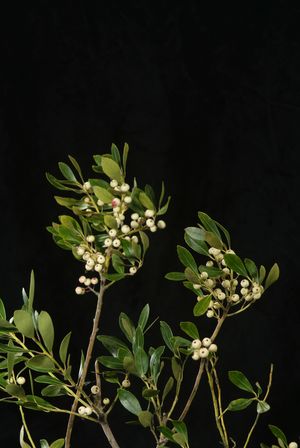
The most common holly question we get, answered once and properly. What dioecious means in a real garden, why distance matters less than timing, and which male goes with which female in our beds this winter.
IA healthy holly with nothing to show
Somewhere in the South, right now, a perfectly healthy holly is standing in a perfectly good bed, not setting a single berry, and her owner is reading the plant tag again for clues. The tag will not help. The problem is not soil or sun or a bad batch from the nursery. The problem is that she is a she, and there is no he within reach of the bees.
We get this letter every winter, usually in December, usually with a photograph of a handsome green shrub and a sentence that ends in a question mark. Almost always the plant is fine. She is simply on her own. The good news is that the fix is cheap, permanent, and easy to plant in an afternoon. The better news is that a well-chosen male earns his place in the garden for reasons that have nothing to do with fruit.
IITwo plants, one crop
Hollies are dioecious, an ugly word for a simple arrangement. Every plant is either male or female. The males carry flowers full of pollen and never fruit. The females carry flowers with a small green ovary at the center, and only those flowers, once pollinated, swell into berries. A female with no pollen reaching her will flower faithfully every spring and drop the spent blossoms a few weeks later, and that is the end of the story.
You cannot tell a young holly's sex by looking at the leaves. The flowers give the game away: in spring, a female flower shows that little green ovary like a bead in the middle, while a male flower is all stamens, four of them, dusted yellow. Seedling hollies come up roughly half and half, which is why we sell named clones and labelled seedlings by sex, and why a plant sold as simply "holly" at a big-box store is a gamble with a coin.
She is not sick. She is lonely.
IIIThe bees decide, not the wind
Holly pollen does not drift. The flowers are small, greenish white and easy to walk past, but bees find them, along with wasps, flies and even ants, and those insects do the carrying. What matters, then, is not a measured distance but whether an insect can make the trip from a male in flower to a female in flower while both are open.
The usual planning figure is forty to fifty feet between male and female. Treat that as a suggestion, not a fence. Isolated hollies have been recorded fruiting well with no male in sight, which almost always means a male in somebody else's yard, or a wild one in the woods behind the fence, doing quiet work for the whole street. If you garden in holly country, you may already have a pollinator you have never noticed. If your female has been barren for three springs, you do not.
IVTiming is the part people miss
Here is where good gardeners come unstuck. A male only helps if he is shedding pollen in the same weeks the female is receptive, and in some hollies that is far from guaranteed.
Winterberry, Ilex verticillata, is the classic trap. The species spans a huge range, from Canada to the Gulf, and the named clones fall into early-flowering and late-flowering groups that can miss each other by weeks. 'Winter Red' is a late bloomer. Plant her beside the early male 'Jim Dandy' and he will have finished his business before she opens, which is a bit like arriving at a party after everyone has gone home. She needs a late male, and the one bred for the job is 'Southern Gentleman', selected by Robert Simpson of Vincennes, Indiana, to pollinate the late clones he was introducing. He serves 'Winter Gold', 'Sparkleberry', 'Cacapon', 'Shaver' and 'Sunset' just as well.
Yaupon, Ilex vomitoria, is kinder. Yaupon blooms from March into May and has no documented early and late races, so any male yaupon flowering in the same spring should serve any female. Inkberry, Ilex glabra, flowers in May and June and pairs within the species just as simply.
Field Note
Can a different holly stand in? Sometimes. Hollies of different species that bloom at the same time can cross, which is exactly how the wild hybrids arose: dahoon and American holly met in Florida and gave us Ilex × attenuata, the parent of the Foster hollies. But a stand-in is a hope, not a plan. The surest match is a male of the same species, and for winterberry, a male of the same flowering group.
VHow many females one male can keep
Fewer males than you would think. One male yaupon will look after six to eight females. One 'Southern Gentleman' will keep six to ten winterberries in fruit within bee range. For a hedge of females, one male tucked into the middle or at one end is usually enough, and two is generous.
Then there is patience, which no plant tag mentions. A young winterberry takes about three years in the ground before fruiting in earnest. Evergreen hollies vary, but the first winter after planting is rarely the showy one. Plant the pair, give them time to root, and judge them in year three.
VIThe pairs we grow
Here is who goes with whom in our beds right now, and a few pairings for plants we grow at other times of year.
| Female | Male to plant with her | Notes |
|---|---|---|
| Yaupon 'Hoskins Shadow' | Male yaupon or 'Will Fleming' | Any male yaupon blooming the same spring will do |
| Yaupon 'Lowrey's Big Leaf' (if female; we are confirming) | Male yaupon or 'Will Fleming' | 'Will Fleming' where there is no room for a second broad shrub |
| Yaupon 'Yawkey', 'Gold Top', 'Virginia Dare', 'Folsom's Weeping' | Any male yaupon, including 'Dewerth' | One male serves six to eight females |
| Winterberry 'Winter Red' | 'Southern Gentleman' | Late with late; 'Jim Dandy' blooms too early for her |
| Winterberry 'Red Sprite' | 'Jim Dandy' | Early with early; 'Jim Dandy' returns with his next crop |
| White-berried inkberry, Ilex glabra f. leucocarpa | Male inkberry | Ivory berries from fall to spring |
| Dahoon, Ilex cassine | Male dahoon | Her male match is growing on at the nursery and follows in a later restock |
Our guide to choosing a yaupon sets every yaupon we grow side by side, and the winterberry pair get a page of their own.
VIIMales worth planting for themselves
It is easy to think of the male as a chore, the plant you buy so the other one can perform. That undersells him. 'Will Fleming' grows twelve to fifteen feet tall on a base two or three feet wide, a green exclamation point beside a door or at the corner of a bed, and he happens to pollinate every female yaupon in range while standing there. The straight male yaupon shears as cleanly as boxwood into a hedge, a screen or a topiary. 'Southern Gentleman' makes an upright, rounded shrub of glossy dark green that turns soft yellow and bronze in fall, and his spring flowers hum with native bees. Male inkberry is a neat, spineless evergreen in his own right, and his flowers feed the bees that make gallberry honey.
So plant the male where you would want a good shrub anyway. The berries next door are a bonus he delivers quietly.
VIIIQuestions we get asked
My holly flowered but still has no berries. Why?
Either she is a male, there is no male in bee range, or the male in range blooms at a different time. Look closely at the flowers next spring: a green bead in the center means female. If she is female, add a male of the same species, matched for bloom time if she is a winterberry.
Can I plant the male and female in the same hole?
Gardeners do, and the two grow up as one shrub with berries on half of the branches. We prefer a little space between them so each can make a full plant, but in a small garden the shared hole is an honest compromise.
Does a male holly ever turn into a female?
No. A clone keeps the sex of the plant the cuttings came from. Every named clone we sell is propagated from cuttings, so the label is the plant.
Are the berries safe for children and pets?
No. Holly berries are mildly toxic to people, dogs and cats, and are for looking at and for the birds. Site fruiting plants with that in mind where small children play.
Further reading on The Node
For the whole genus, start with A North American Guide to Hollies. For what the birds do with all those berries, read The Pantry at the End of Winter.
From the Nursery
Restocked this winter: 'Hoskins Shadow' and 'Lowrey's Big Leaf' yaupons with two males to match them, the straight male yaupon and the columnar 'Will Fleming'; white-berried inkberry with the male inkberry; and dahoon, whose male follows in a later restock. Compact 'Red Sprite' winterberry is in stock too. Orders over $200 ship free.
References
- Dirr, M. A. Manual of Woody Landscape Plants, 6th ed. Stipes Publishing, 2009. Ilex entries.
- Bernheim Arboretum and Research Forest. Ilex verticillata cultivar records, including 'Southern Gentleman' (formerly 'Late Male') and 'Winter Red'. bcarboretum.org
- US Plant Patent PP4146, Ilex verticillata 'Winter Red', R. C. Simpson, Vincennes, Indiana.