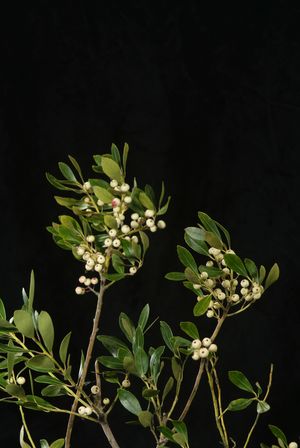

Essay · Ilex vomitoria · The Southeastern Coast
The Black Drink
For centuries the peoples of the Southeast brewed a dark, bitter tea from a holly and drank the stuff in council, in ceremony and at breakfast. Europeans watched, misunderstood, and wrote their mistake into the plant's Latin name. The story of yaupon, North America's own caffeine.
IA name that tells on the namer
Europeans arriving on the Southeastern coast watched men drink a dark, bitter tea brewed from a holly, watched some of them purge afterward, and drew the obvious and wrong conclusion. The plant has carried their mistake in her Latin name for more than two centuries. Ilex vomitoria, the botanist William Aiton called her in 1789, as if she were the cause.
She was not. The purging belonged to particular rites of purification, and the people who practiced them knew how to bring it on: by drinking very large quantities very fast, often after fasting. The anthropologist Charles Hudson, who spent a career on the peoples of the Southeast and edited the standard book on the subject, put the emetic effect down as the exception rather than the rule. Councils could sit and drink for hours with no such result. Modern analysis of the leaves finds nothing in them that would explain it. The name is a record of what Europeans saw, not of what the plant does.
The common name is kinder and older. Yaupon comes to us from the Catawba ya'pa, a small word that means, more or less, little tree.
The name is a record of what Europeans saw, not of what the plant does.
IIThe white drink
What the colonists called black drink, for the color in the cup, many of the peoples who brewed the tea called by names meaning white: white for purity, for peace, for things set right. The leaves and twigs were parched over a fire, which deepens the color and the flavor, then boiled and strained, and the drink was served in shell cups, often whelk or conch from the coast.
Hudson describes three broad uses. Black drink was a social drink, poured for guests and taken through the day much as we take coffee. Black drink opened councils, where the cups went round in a set order before any business was done, and the drink carried meaning about clarity of mind and honest speech. And black drink belonged to purification, before war, before the ball game, at the great renewal festivals, when the large quantities and the purging came in. The Creek, Cherokee, Choctaw, Chickasaw, Natchez, Timucua and a score of other nations all drank the tea. A Timucua council taking black drink appears in a sixteenth century engraving after the French artist Jacques le Moyne, one of the earliest European pictures of life on this coast.
The tea also traveled far beyond the plant. Yaupon grows on the coastal plain, yet archaeologists working at Cahokia, the great Mississippian city near present-day St. Louis, have found the chemical signature of holly tea, caffeine, theobromine and ursolic acid in the right proportions, absorbed into eight ceremonial beakers made between about 1050 and 1250, far north of where the plant grows wild. Leaves were traded inland, and there is evidence that some communities planted and tended yaupon outside the species' natural range.
Field Note
On respect. Black drink was and in some communities still is a sacred practice, not a historical curiosity. We tell the story because the plant cannot be understood without it, and we have tried to tell it from the published work of historians and anthropologists rather than from guesswork. The references below are a good place to read further.
IIICarolina tea
Colonists took to yaupon quickly, and for a long while the drink was simply part of coastal life. A Spanish priest in Florida wrote in 1615 that neither Spaniard nor Indian went without the tea morning or evening. English settlers called the drink Carolina tea or South Sea tea, the Spanish and South Carolinians cassina, and in the eighteenth century the cured leaves were shipped to Europe, where for a time the tea was sold in London and served in Paris as appalachine. Traveling through Cherokee country in the 1770s, William Bartram heard yaupon called the beloved tree. Along the Outer Banks and the Carolina coast, families kept on brewing yaupon into the twentieth century, when real tea was dear or the boats did not come.
The historian Christine Folch, writing in 2021, pulled together five centuries of yaupon's record in English, French and Spanish and noticed a gap: the tea's place in the lives of enslaved and free Black Southerners, many of whom came from West African communities with deep caffeine traditions of their own, is almost absent from the written record despite yaupon growing on the plantations themselves. Her question is why a native stimulant, so close to hand, never became what yerba mate became in South America. Part of the answer seems to be the name, and part of it the steady, colonial habit of treating anything Indigenous as second best.
Yaupon is having a quiet revival now. Small growers on the Gulf and Atlantic coasts roast and sell the leaves as tea again, and the plant's cousin yerba mate, Ilex paraguariensis, is in every supermarket. We wrote about mate in The Holly You Can Drink.
IVWhat is actually in the leaf
Yaupon is the only plant native to North America known to carry caffeine in useful amounts. A 2009 study by Palumbo, Talcott and Putz at the University of Florida measured caffeine in the leaves at levels comparable to tea, alongside theobromine, the gentler stimulant of chocolate, and a good deal of antioxidant polyphenols. Yaupon belongs to the same small family of caffeinated hollies as yerba mate and the Amazonian guayusa, and nothing else in the genus does what those three do.
That is the end of what we will say about the chemistry. This is a history, not health advice, and nothing here is a suggestion to brew, drink or dose anything. Talk to your doctor before trying a new caffeinated drink, particularly if you are pregnant or take medication. And note that the leaves and the berries are different matters entirely: yaupon berries are mildly toxic to people and pets, and are for the birds.
VThe holly that got the wrong name, and the one that got the drink's
There is one more twist. The plant that should have carried the drink's name in Latin is yaupon. The plant that actually does is her cousin, the dahoon. Spanish colonists in Florida heard a Timucua word for the drink and wrote down something like cacina, and when Linnaeus came to name the hollies in 1753, he attached that word to the wrong one. Ilex cassine, the dahoon of Southern swamps, has carried the name of a drink she never made ever since, and yaupon waited thirty-six more years for Aiton and an insult. We tell the dahoon's side in The Holly Named for the Wrong Drink.
VIGrowing the story
Every yaupon we grow descends from this history, whether she is clipped into a hedge in Charleston or standing as a weeping specimen by a gate. The species is salt tolerant, drought tolerant and indifferent to hard pruning, at home in zones 7 to 9, and the named forms run from columnar to weeping to big-leaved. Our guide to choosing a yaupon sets them side by side. If you garden in the Southeast, you may well have yaupon already, planted by a bird along a fence line. Look at the plant again with this story in mind. She has been keeping it all along.
Further reading on The Node
For the medicinal history of woody plants more broadly, read The Apothecary That Stands. For the rest of the genus, start with A North American Guide to Hollies.
From the Nursery
'Hoskins Shadow', 'Lowrey's Big Leaf', 'Will Fleming' and the straight male yaupon are in stock now. Orders over $200 ship free.
References
- Hudson, C. M., ed. Black Drink: A Native American Tea. University of Georgia Press, 1979.
- Hudson, C. M. The Southeastern Indians. University of Tennessee Press, 1976.
- Folch, C. Ceremony, medicine, caffeinated tea: unearthing the forgotten faces of the North American stimulant yaupon (Ilex vomitoria). Comparative Studies in Society and History 63(2), 2021: 464 to 498.
- Crown, P. L., T. E. Emerson, J. Gu, W. J. Hurst, T. R. Pauketat and T. Ward. Ritual Black Drink consumption at Cahokia. Proceedings of the National Academy of Sciences 109(35), 2012: 13944 to 13949.
- NCpedia. Yaupon. ncpedia.org
- Palumbo, M. J., S. T. Talcott and F. E. Putz. Ilex vomitoria Ait. (yaupon): a native North American source of a caffeinated and antioxidant-rich tea. Economic Botany 63(2), 2009: 130 to 137.