Field Notes · Cullowhee Native Plant Conference · Western North Carolina
Four Days in the Cove
Jonas and Megan drove north with coordinates and a great deal of coffee, chasing rhododendron on the rock and endemics on the barren. A field dispatch from the mountains, and the plants we carried home in our heads.
In this dispatch
There is a particular kind of quiet that settles over the truck once you cross into the mountains and the radio gives up. Megan and I left Aiken on a Wednesday morning, armed with coordinates and enough coffee to see us up the escarpment, bound for the Cullowhee Native Plant Conference at Western Carolina University. For nearly forty summers this gathering has pulled botanists, nursery folk, landscape architects, and garden-club stalwarts into the same cove to argue happily about native plants, and this year carried a particular weight, being the last the conference will call Western Carolina University home before it moves to a new site yet to be chosen. Woodlanders has old friendships in that room. We wanted to renew them, and we wanted to see the flora that these people spend their lives defending.

IThe Road Up
We could not resist a detour. Tallulah Gorge opened beneath us like a wound in the Blue Ridge, one of Georgia's great chasms, and clinging to the rock above it in real numbers was Rhododendron minus, the Piedmont rhododendron, rooted into seams where no soil has any business being. There is no better argument for the toughness of the Ericaceae than a rhododendron making a living on a cliff face.

Our last stop before check-in was a slow bend of the Little Tennessee River in Macon County. We spent a couple of hours there, ate lunch, swam, and read the banks from the water, which is the honest way to meet a river's plants. In that time we counted a full congregation of native heaths and their neighbors: Rhododendron maximum leaning over the current, Oxydendrum arboreum (the sourwood, whose midsummer bloom the bees turn into that famous mountain honey), Rhododendron viscosum throwing a clove-sweet scent across the shallows, Vaccinium in fruit, Kalmia latifolia, and the arching sprays of Leucothoe fontanesiana. It was our first real look at the richness we would spend the week inside.
Read a river's plants from the water. The bank tells you one story; the current tells you the truer one.
We made check-in with just enough daylight to wash the river off before dinner and the opening assembly. The room was full of the institutions Woodlanders has kept company with for decades: friends from Lockerly Arboretum, the Georgia Native Plant Society, the North Carolina Botanical Garden, and a dozen others. The conference had not formally begun and already the best part had: people who love the same difficult plants, standing in one place.
IIHigh Ground
Day two began the only responsible way, with breakfast, and then a climb to Waterrock Knob on the Haywood and Jackson county line, up where the air thins and the flora changes character entirely. The notable company there included Rhododendron vaseyi (the pinkshell azalea, a Southern Appalachian endemic and one of the loveliest things in these mountains), Vaccinium erythrocarpum with translucent red fruit, Chelone appalachiana, Angelica triquinata, more Kalmia latifolia, and the delicate Micranthes petiolaris tucked into the seeps.

We came down in time for the enigmatic Joey Santore, who spoke on a theme he called "Native Plants as Infrastructure." The idea is not as radical as it first sounds, and it is getting less radical every summer: as the need for urban cooling climbs, native plantings stop being decoration and start being public works. To a room that has already devoted their lives to putting natives into public spaces, it landed like a new tool set gently on the bench.
After lunch we split our attention between two smaller sessions. The first followed the Triangle Connectivity Collaborative and their work stitching conservation corridors around the growing Triangle region of North Carolina. The second was pointed straight at work coming up at our own nursery: Nate Miller on "Creating Native and Edible Landscapes with Curb Appeal," a talk that made a persuasive case for weaving natives together with the tried garden treasures that Southern gardens and pantries have leaned on for generations.

Field Note · Botanizing after dark
Megan took the evening plenary; I could not sit still and slipped off with a friend to a stretch of the Blue Ridge Parkway near Cullowhee that is famous for its floral oddities. The list from that golden hour ran long: Hypericum graveolens, Hypericum buckleyi, Triantha racemosa, Crataegus oreophila, Allium allegheniense, Helianthus glaucophyllus, Rhododendron calendulaceum (the flame azalea, still smoldering orange), Lilium superbum, and Rubacer odoratum. Back at the dorm there was live music, a moth survey drawing its own winged congregation to the sheet, and the particular hum of botanists refusing to go to bed.

IIIThe Serpentine
The third day was the long one, and the best. We drove out with our Georgia friends to the Buck Creek Serpentine Barren in Clay County, a place underlain by a strange, metal-rich geology that has spent millions of years filtering the flora down to plants that can tolerate it. Ground like this breeds specialists, and Buck Creek keeps a few the rest of the world does not have.
Field Note · Why a barren is not barren
Serpentine soils are high in magnesium and heavy metals and stingy with calcium, a chemistry most plants read as poison. The species that adapt often adapt only here, which is how a single rocky opening ends up holding endemics found nowhere else on earth. "Barren" describes the soil's generosity, never the botany.
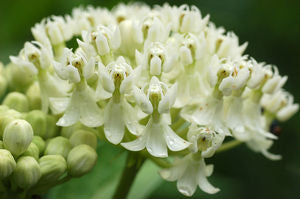
The single-site endemics were the pilgrimage: Symphyotrichum rhiannon, the Buck Creek heartleaf (Hexastylis species 1), and Packera serpenticola, whose very name wears the rock underfoot. Around them stood a supporting cast worth the drive on their own: Rhododendron viscosum var. montanum, Asclepias verticillata, Stenanthium aff. gramineum, Spiraea latifolia, Platanthera ciliaris (the orange fringed orchid), Castilleja coccinea, Silene regia, Epigaea repens, and Phlox ovata. We saw a salamander. We found Megan reading her book by a creek, which is its own kind of endemic sighting.


The full species list, day by day
Day 1, Tallulah Gorge & the Little Tennessee: Rhododendron minus, Rhododendron maximum, Oxydendrum arboreum, Rhododendron viscosum, Vaccinium spp., Kalmia latifolia, Leucothoe fontanesiana.
Day 2, Waterrock Knob: Rhododendron vaseyi, Vaccinium erythrocarpum, Chelone appalachiana, Angelica triquinata, Kalmia latifolia, Micranthes petiolaris.
Day 2, Blue Ridge Parkway (evening): Hypericum graveolens, Hypericum buckleyi, Triantha racemosa, Crataegus oreophila, Allium allegheniense, Helianthus glaucophyllus, Rhododendron calendulaceum, Lilium superbum, Rubacer odoratum.
Day 3, Buck Creek Serpentine Barren: Symphyotrichum rhiannon, Hexastylis sp. 1 (Buck Creek heartleaf), Packera serpenticola, Rhododendron viscosum var. montanum, Asclepias verticillata, Stenanthium aff. gramineum, Spiraea latifolia, Platanthera ciliaris, Castilleja coccinea, Silene regia, Epigaea repens, Phlox ovata.
Day 3, riverbank (afternoon): Viburnum cassinoides, Lindernia monticola, Adiantum pedatum.
By late morning the barren had turned into a griddle, so we voted with our feet and took our friends back to the river. Botanizing the banks a second time turned up what the first pass had missed: Viburnum cassinoides, the tiny Lindernia monticola, and Adiantum pedatum, the northern maidenhair fern, fanning green over the wet stone. We made it back for Preston Montague's afternoon plenary on echoing wild landscapes in the ones we build on purpose, a fitting sermon after a day spent standing in the original. The famous talent show closed the evening and was, in the kindest possible reading, something to behold. Later there was more music at the dorm, including a sing-along set to the tune of "Wild Mountain Thyme," the old air The Chieftains made famous, rewritten for the occasion to mark the final gathering at Cullowhee. There was reason for the elegiac key: this is the last year the conference will gather at Western Carolina University, with the next home still to be decided, and the whole room seemed to carry that farewell on a single melody.
IVPea-Vines and Parting
Our last morning belonged to Bryan England and the pea-vines of North Carolina, a talk on the historical range and quiet vanishing of a plant most people have never thought about. It was heavy hearing how much ground has been lost. It was lighter hearing what his team is doing to hold the line and, where they can, to return the pea-vine to lands that once knew it well. Then we gathered our purchases from the holding booth, the traditional tithe every plant person pays at Cullowhee, and pointed the truck south, leaving the cove for the last time.
We came home with a truck full of plants and a head full of them, which is the correct ratio.
VWhat We Carried Home
You do not have to drive to a serpentine barren to grow the mountains. A surprising number of the plants that made the trip memorable are Southeastern natives we grow and ship from Aiken, and they behave beautifully in a home garden given shade, moisture, and acidic soil. If the dispatch above left you wanting the real thing, here is where to start.
| Plant | Light | Habit | Hardiness | Note |
|---|---|---|---|---|
| Kalmia latifolia (mountain laurel) | Part shade | Evergreen shrub, 5–10 ft | Zones 5–9 | Late-spring bloom, spring-loaded pollen release |
| Oxydendrum arboreum (sourwood) | Sun to part shade | Small tree, 20–30 ft | Zones 5–9 | Summer bloom, scarlet fall color, honey tree |
| Leucothoe racemosa (fetterbush) | Part to full shade | Arching shrub, 4–8 ft | Zones 5–9 | Fragrant spring racemes, streamside native |


From the Nursery
We propagate and ship Southeastern mountain natives from our fields in Aiken, mountain laurel and sourwood and the shade-loving heaths among them. Growing a nursery-raised native at home is a quiet way to keep these plants in the world, and to bring a little of the cove back with you.
Browse Southeastern NativesReferences & further reading
- Western Carolina University, The Cullowhee Native Plant Conference. wcu.edu
- North Carolina Native Plant Society, species and habitat accounts. ncwildflower.org
- Flora of the Southeastern United States (FSUS), UNC Chapel Hill Herbarium. fsus.ncbg.unc.edu
- North Carolina Extension Gardener Plant Toolbox. plants.ces.ncsu.edu