

Plant Highlight · Gelsemium sempervirens · Southeast
The Gold That Comes Before the Thaw
Carolina jessamine is South Carolina’s state flower, a scented evergreen vine, and a plant that deserves both your admiration and a careful hand.
I.A name borrowed from the jasmines
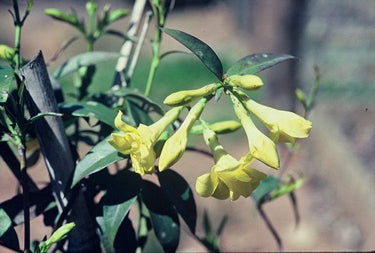
Every February the roadside ditches of the Carolinas do something faintly unreasonable. Before the redbuds, before the last hard frost has been properly dealt with, a dark evergreen vine hauls up a pine trunk or over a fence wire and hangs out a few hundred small yellow trumpets. The scent arrives first, sweet and a little heavy, and you smell Gelsemium sempervirens well before you work out where the gold is coming from.
The genus name is a gift from Italian. Gelsomino is the word for jasmine, and early botanists latinized the word into Gelsemium because the flowers looked and smelled the part. They are not jasmines, though. True jasmines (Jasminum) belong to the olive family; Carolina jessamine sits alone in a small family, Gelsemiaceae, which holds just three species: this one, the swamp-dwelling Gelsemium rankinii, and a very toxic Asian cousin, Gelsemium elegans. The common names ("yellow jessamine," "Carolina jasmine") keep the old confusion alive, and we have stopped fighting the habit. If you want the real jasmines sorted out, we wrote a whole field guide for that.

The scent arrives first, and you smell the vine well before you work out where the gold is coming from.
II.The state flower, and the honest caution
South Carolina made Carolina jessamine the state flower in 1924, which means that in Aiken the plant is less a novelty than a municipal institution. The native range runs across the Southeast and, by the NC State Extension account, on down through Mexico to Guatemala and Honduras. Hardiness is listed from zone 6 through 10, and the glossy evergreen leaves often bronze in cold weather, a small winter courtesy most vines do not extend.
Now the caution, which belongs in the first third of any honest piece about this plant. Every part of Gelsemium sempervirens is poisonous: flowers, leaves, roots, sap, seeds. The toxic principle is a group of alkaloids, and the symptoms of ingestion are serious. NC State also notes that the pollen is toxic to honeybees, which is worth knowing if you keep hives. None of this is a reason to skip the plant; it is a reason to site the vine thoughtfully. Grow the vine up a trellis or arbor away from children's play areas, wash your hands after pruning, and do not let anyone steep a tea from the garden because a website said something about folk remedies. The plant has a long history in traditional medicine and, later, in homeopathy, and this is a field where we say plainly: this is not medical advice, and the margin between a dose and a poisoning is narrow.
Field NoteCarolina jessamine is also rated highly flammable by NC State, and the plant can turn weedy in disturbed ground and along roadsides. Keep the vine off the house wall and out of the defensible space around the foundation, and give the vine a fence or arbor to call home instead.
III.Siting and growing
The plant is far more adaptable than the vine's refined reputation suggests. Full sun gives the heaviest bloom, but partial shade (two to six hours of direct light) is tolerated, with fewer flowers and a leggier habit. Soil should be moist, organically rich and well drained, yet Carolina jessamine puts up with wet feet, occasional flooding, wind, moderate salt, and short droughts. NC State lists acid, neutral and alkaline soils as acceptable, which in practice means you can plant the vine almost anywhere in the Southeast that is not a parking lot.
Twining vines need something to twine on. Give the plant a trellis, an arbor, a wire fence, or a porch post with strings run up the post, and expect 10 to 20 feet in height over a few seasons, with a considerably wider spread if you let the stems wander. Left without support, the vine settles into a bushy, tumbling ground cover, which is a legitimate use on a bank. Prune soon after flowering finishes, so the vine has the whole growing season to make flowering wood for next year. A late-winter haircut, by contrast, takes the bloom with it.
Quick planting notes
Plant in fall or early spring so roots establish before summer heat. Water through the first summer. Mulch lightly, and do not fertilize heavily; a vine pushed into lush green growth flowers less, not more.
Why is my jessamine not flowering?
Usually one of three things: too much shade, a late-winter pruning that took the buds, or a young plant that is still putting energy into stems. Move the support toward the sun, prune only after bloom, and give young vines two or three seasons.
IV.Selections worth knowing
Gelsemium sempervirens 'Margarita'
FragrantHeavy bloomZones 6 to 10
A freely flowering selection with a reputation for strong scent and deer resistance. If the question is "which one do I buy," the answer is usually this one. See the Woodlanders listing.
Gelsemium sempervirens 'Pride of Augusta'
Double flowersEvergreen
A double-flowered form, the sort of plant that makes visitors stop and ask whether the flowers are real. Details here.
Gelsemium sempervirens 'Pale Yellow'
Soft primroseFragrant
Quieter than the species, a primrose-cream that reads gently against dark brick or a weathered gray fence. Listing.

V.The swamp cousin that skips the perfume
Gelsemium rankinii, the swamp jessamine, is the cousin gardeners meet second and mix up first. The plant grows wild in swamp forests from the Carolinas around the Gulf coast states, including the Black and Waccamaw river swamps, and is hardy in zones 7 to 9. The flowers look much like Carolina jessamine's, but there is no fragrance to speak of, and the bloom comes twice: once in spring and again in fall. For a wet corner where the scent matters less than the second flush, the swamp jessamine is the sensible choice. Woodlanders grows both.

| Trait | G. sempervirens | G. rankinii |
|---|---|---|
| Common name | Carolina jessamine | Swamp jessamine |
| Hardiness | Zones 6 to 10 | Zones 7 to 9 |
| Fragrance | Sweet, strong | Not aromatic |
| Bloom | Late winter to early spring, sometimes fall | Spring and fall |
| Habitat | Woods, roadsides, thickets | Swamp forests |
For planting partners, consider the fall-blooming company in Sited by the Nose, and note that our piece on native wisteria covers another well-behaved twiner for the same arbor. Timing for planting is in Plant It in the Cooling.
§References
- NC State Extension, Gelsemium sempervirens (Carolina Jessamine)
- NC State Extension, Gelsemium rankinii (Swamp Jasmine)
- JC Raulston Arboretum, Gelsemium rankinii plant profile
From the Nursery
We propagate Carolina jessamine and the swamp jessamine here in Aiken. Availability moves quickly on the named selections, so browse the Gelsemium collection and see what is ready to ship. If you are building a trellis wall, the broader vine collection is worth a wander.