Plant Highlight · Salvia leucantha · The Southern Garden
The Sage That Saves the Best for Last
When the summer border has said everything and the year begins to lean toward frost, Salvia leucantha finally speaks, in a low velvet purple that the bees and the hummingbirds have been waiting all season to hear.
In this piece I. A latecomer worth the wait II. Where the plant comes from III. The velvet trick IV. Growing Mexican bush sage in the South V. Siting and good company VI. The plant at a glance
I.A latecomer worth the wait
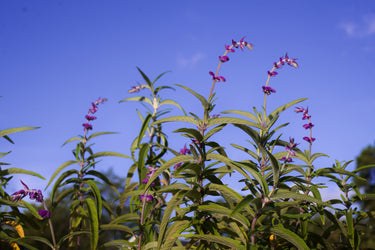
Every garden has a rhythm, and by the middle of a Southern August the rhythm has gone quiet. The spring perennials are long finished, the summer annuals are tired and leggy, and the gardener is mostly watering and waiting. This is the exact moment Salvia leucantha chooses to begin. The Mexican bush sage spends the warm months building a broad, gray-green mound of narrow leaves, patient and unshowy, and then, as the nights lengthen and the light turns amber, the plant throws up dozens of long, arching wands covered in flower.
Those wands are the whole point. Each spike is packed with small tubular blooms wrapped in a calyx so densely furred that the entire flower head looks spun from felt or plush velvet. The color reads as a saturated royal purple from across a garden, and up close the trick reveals itself: the fuzzy purple part is the calyx, and a small white (or in some forms purple) corolla pushes out from within, like a tongue from a velvet glove. The effect is quietly theatrical, and the timing is everything. Mexican bush sage carries a Southern garden from the exhaustion of late summer straight through to the first hard freeze.
Some plants open the season. This one closes it, and does so with more grace than anything that bloomed in May.

Salvia leucantha
Mexican bush sage, velvet sage. A tender woody perennial grown for a late-season flood of purple, felted flower spikes that feed hummingbirds and bees when little else is left in bloom.
- Late summer to frost
- Zones 8 to 10
- Full sun
- Drought tolerant
- Hummingbirds & bees
II.Where the plant comes from
Mexican bush sage is native to the subtropical conifer and oak forests of central and eastern Mexico, a landscape of warm days, cool nights, and a distinct dry season. Understanding that home country explains almost everything about how the plant behaves in cultivation. A creature of a place where autumn is the reward for a long dry summer, Salvia leucantha is wired to flower on shortening days, which is why the show arrives so late and why no amount of coaxing brings the spikes any earlier.
The species name is a small poem in itself. Leucantha comes from the Greek leukos, white, and anthos, flower, a nod to those pale corollas that emerge from the purple calyces. The genus name Salvia traces to the Latin salvere, to heal or to be well, the same root that gives us common garden sage and the word 'salvation.' The Mexican bush sage carries no great medicinal tradition of the kind that clings to culinary sage, but the plant sits squarely in one of the largest and most generous genera in the whole plant kingdom, with close to a thousand species worldwide.
Field Note Mexican bush sage flowers in response to shorter days, not to heat or to feeding. If a young plant looks all leaf and no bloom through July and August, the plant is not sulking. The spikes are simply waiting for the calendar. Resist the urge to fertilize a reluctant plant into more foliage; patience is the only fertilizer that works here.
III.The velvet trick
Most gardeners meet a flower as a single object: a petal, a color, a shape. Mexican bush sage rewards a closer look because the plant separates the job of 'being colorful' from the job of 'being a flower,' and hands the two tasks to different parts. The dense, felted purple is the calyx, the protective cup that in most plants is a modest green afterthought. Here the calyx does the advertising, and does so for weeks, because a calyx does not wilt and drop the way a petal does. The actual corolla, the true flower, is the smaller white or purple tube that slips out to offer nectar, gets pollinated, and falls away. The calyx stays, holding the color long after the corolla has done the work.
This division of labor is why a Mexican bush sage in full flower looks so improbably lasting. The plant is not holding a single bloom for a month; the plant is holding a scaffold of long-lived purple cups while a rolling succession of small corollas comes and goes within them. Hummingbirds read the arrangement perfectly, working spike after spike in the cool of the morning, and the late bees and butterflies come for the same reason: nectar-rich, tube-shaped flowers at a season when the meadow has mostly closed for business.

IV.Growing Mexican bush sage in the South
In the Aiken garden and across most of the middle and lower South, Mexican bush sage is grown as a woody-based perennial that dies back to the crown in winter and returns from the root. Reliable root hardiness runs through USDA zones 8 to 10, and gardeners in the warmer parts of zone 7 can hold the plant over with sharp drainage and a winter mulch, keeping the crown on the dry side through the cold months. Farther north, many gardeners grow the sage as a fast, free-flowering annual, since a single season is enough to build a mounding shrub three to four feet across and bring the plant into flower.
The care is refreshingly undemanding, and most failures come from kindness rather than neglect. The plant wants full sun, lean-to-average soil, and, above all, drainage. Wet winter feet are the surest way to lose a crown that the cold alone would have spared. Give the sage room, because a happy plant fills a generous circle, and resist heavy feeding, which trades flowers for floppy green growth.
Field Note Leave the old stems standing over winter rather than cutting the plant to the ground in November. The dead top growth shelters the crown, and the hollow stems give overwintering native bees a place to sleep. Cut back hard in early spring, once new shoots show at the base, and the plant will rebuild the whole mound by the time the days shorten again.
Care, spelled out
Light, soil, and water
Full sun is not negotiable; the spikes lean and thin in shade. Average to lean soil suits the plant better than a rich border, and the single most important condition is drainage that carries winter water away from the crown. Water a new plant through the first summer to settle the roots, then step back. Established Mexican bush sage is genuinely drought tolerant and prefers to run a little dry.
Pruning and overwintering
Leave the frost-killed stems in place as winter cover for the crown and for solitary bees. In late winter or early spring, once fresh basal shoots appear, cut the whole plant back to a few inches. A midsummer pinch of the growing tips, no later than early July, encourages a bushier, better-branched plant without delaying the fall flowering, which is set by day length rather than by pruning.
Making more plants
Mexican bush sage roots readily from soft cuttings taken in late spring and early summer, which is the surest way to carry a favorite selection over in a cold-winter garden. A rooted cutting overwintered under lights or on a bright sill will be a flowering plant by the following autumn. For the fuller method, our piece on summer cuttings from the nursery bench walks through the craft step by step.
V.Siting and good company
Site Mexican bush sage where the low autumn light can come through the spikes from behind, because backlighting turns the felted purple almost luminous and catches the fine hairs along every wand. A position against a dark evergreen, or with the late sun beyond the plant rather than on the near side, earns the most from those few golden weeks. Give the mound space to round out, and set the sage toward the middle of a border where the bare lower stems of high summer can hide behind something shorter.
For company, reach for the other plants that save themselves for the end of the year. The tall yellow spikes of the forsythia sage, Salvia madrensis, make a regal contrast, and the airy sky-blue of bog sage, Salvia uliginosa, lightens the heavier purple. Ornamental grasses in seed, asters, and the warm russets of turning foliage all belong in the same late composition. Woodlanders grows a deep bench of these autumn sages, gathered in the Salvias collection, and the genus rewards a gardener who plants for succession rather than for a single midsummer peak. If the whole tribe interests you, our field guide to the salvias is the place to wander next, and gardeners planting for a drying climate will find kin in our xeriscape field guide.
VI.The plant at a glance
| Botanical name | Salvia leucantha |
|---|---|
| Common names | Mexican bush sage, velvet sage |
| Family | Lamiaceae, the mint family |
| Origin | Central and eastern Mexico, subtropical conifer and oak forest |
| Habit | Woody-based perennial, mounding 3 to 4 feet tall and wide |
| Bloom | Late summer to frost; felted purple calyces with white or purple corollas |
| Light | Full sun |
| Soil | Average to lean, sharp winter drainage essential |
| Water | Drought tolerant once established |
| Hardiness | Root hardy USDA zones 8 to 10; holds in warm zone 7 with dry, well-drained winter soil; grown as an annual farther north |
| Wildlife | Hummingbirds, bees, late butterflies |
From the Nursery
Woodlanders grows Mexican bush sage and a long list of the late-blooming sages that carry a Southern garden into fall. If a felted purple close to the season sounds like the note your garden is missing, you can find the plant and the rest of the late-blooming tribe in the Salvias collection.
References
- Missouri Botanical Garden, Plant Finder: Salvia leucantha. missouribotanicalgarden.org
- North Carolina Extension Gardener Plant Toolbox: Salvia leucantha (Mexican Bush Sage, Velvet Sage). plants.ces.ncsu.edu
- Texas A&M AgriLife Extension, Master Gardener Plant Library: Mexican Bush Sage. txmg.org
- University of Florida IFAS Gardening Solutions: Salvia leucantha. ask.ifas.ufl.edu