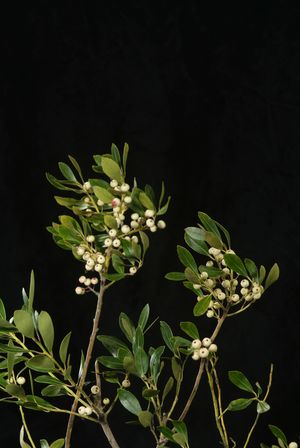
Plant Highlight · Ilex paraguariensis · Ethnobotany
A Holly You Can Drink
The story of Ilex paraguariensis: South America's caffeinated holly, the gourd-and-straw ritual built around it, its unlikely kinship to a tree already growing wild in the Southern woods, and how to raise and cure your own.

Here is a fact that rearranges how you look at a holly hedge: one of the most widely consumed caffeinated beverages on earth comes from a plant in the same genus as the prickly evergreen by your front steps. Yerba mate, the drink that fuels Argentina, Paraguay, Uruguay, and southern Brazil, that travels in a thermos under the arm of nearly everyone in the region, is not a tea, not a coffee, not an herb in any loose sense. It is the dried, cured leaf of Ilex paraguariensis, a South American holly. A holly you can drink.
For a nursery in the American Southeast, this is more than a curiosity. The South has its own caffeinated holly growing wild in its woods, and the two plants are close cousins. To grow Ilex paraguariensis in a Carolina garden, then, is not quite the exotic stretch it sounds. It is closer to inviting a distant relative home. But first, the plant itself, and the remarkable culture that grew up around it.
In this piece
IA Holly That Wakes You Up
Botanically, Ilex paraguariensis is exactly what it appears to be: a broadleaf evergreen holly, upright in habit, growing as a large shrub or small tree, with leathery, glossy, finely toothed leaves and the small white flowers and red drupes that mark the genus. In its native range, the subtropical highlands where Argentina, Paraguay, and Brazil meet, it reaches the scale of a real tree in the forest understory. In cultivation it behaves as a handsome, dense, well-mannered evergreen that would pass unremarked in any holly planting.
What sets it apart is chemistry. The leaves carry caffeine, along with theobromine (the gentler stimulant of the cacao bean) and a battery of polyphenols and saponins that give brewed mate its particular character: alert without the jangle of strong coffee, bitter and grassy and faintly sweet, a flavor that drinkers describe as closer to a green vegetable than to tea. The combination is the whole point. It is why a leaf that looks like landscaping became, for tens of millions of people, a daily ritual.
It is not a tea, not a coffee, not an herb in any loose sense. It is the dried leaf of a holly, and half a continent drinks it before noon.
IIThe Gourd, the Straw, the Ritual
You do not, traditionally, make a cup of mate. You make a gourd of it. The vessel, a hollowed and cured calabash called a mate or cuia (which lent its name to the drink itself), is packed most of the way with dried, ground leaf. Hot (never boiling) water is added in stages, and the infusion is drawn up through a bombilla, a metal straw with a filtered, flattened end that strains the leaf as you sip.
The ritual is social to its core. One person, the cebador, keeps the gourd, refilling it with water and passing it around the circle, with each drinker finishing the gourd before handing it back to be refilled and passed on. A single set of leaves is steeped many times over; the flavor shifts and softens across a long, unhurried session. To share mate is to share the same gourd and the same straw, and the gesture carries a weight of hospitality and belonging that no individual cup of coffee quite matches. The drink is a verb as much as a noun. People do not just drink mate; they take mate, together, for an hour.

IIIFrom the Guaraní to the Jesuits
Mate is old. Long before Europeans arrived, the Guaraní peoples of the Paraná basin gathered and brewed the leaves of caá, using it as a stimulant, a medicine, and a centerpiece of social and ceremonial life. They carried the leaves on journeys and traded them across a wide network; the plant was valued enough to function as something close to currency.
When Spanish Jesuit missionaries established their reductions in what is now Paraguay and northeastern Argentina in the seventeenth century, they encountered a culture organized partly around a beverage they at first regarded with suspicion and eventually embraced wholeheartedly. The Jesuits accomplished something the indigenous harvesters never had: they learned to germinate and cultivate the notoriously difficult seed, establishing the first true plantations of the plant. For a time, mate moved through colonial commerce as yerba de los Jesuitas, or Jesuit tea. When the order was expelled, the cultivation secret was largely lost again, and the trade reverted for generations to the wild harvest of native stands. Ilex paraguariensis holds the distinction of being essentially the only species in a vast genus of ornamental hollies to have been domesticated as a crop.
Field Note · A lost Woodlanders specimen
The plant has quiet history in the South, too. A book published in the 1930s recorded a Woodlanders-grown yerba mate growing in the garden of a Mrs. Phelps, a specimen long since lost to the years. We mention it because it is the kind of thread the nursery has always pulled on: a plant carried from one continent to another, set in a Southern garden, written down once, and nearly forgotten. Growing it again is, in a small way, picking that thread back up.
IVThe Cousin in Our Own Woods
For a Southeastern gardener, the most interesting thing about yerba mate may be how little of a stranger it actually is. The genus Ilex, the hollies, is enormous and global, and the South is rich in it. Two native hollies sit close enough to I. paraguariensis to matter.
The first is Ilex cassine, the dahoon holly, a wetland evergreen of the coastal Southeast that Ilex paraguariensis closely resembles, so much so that the two can read as regional variations on a single theme. The second is the more remarkable: Ilex vomitoria, the yaupon, the only plant native to North America that produces caffeine. Long before yerba mate had a name in English, the indigenous peoples of the Southeast were roasting and brewing yaupon leaves into a stimulant tea, the so-called “black drink” central to ceremonial life across the region. The caffeinated-holly tradition, in other words, did not have to be imported. It already existed here, in parallel, an ocean away from the Guaraní, drawn from a different branch of the same genus.
Set a yerba mate beside a yaupon in the same Southern garden and you are growing two ends of one of botany's quiet coincidences: two continents, two peoples, two hollies, the same idea about how to start the morning. Our guide to the North American hollies traces the wider genus; here, it is enough to say that Ilex paraguariensis arrives in a Southern garden among relatives.
VGrowing Ilex paraguariensis in the Southeast
Yerba mate is a subtropical plant with a surprising streak of toughness once it matures, which makes it a genuine, if marginal, in-ground possibility in the warmer Southeast, and a rewarding container plant anywhere. The key, as with so much, is the difference between an established plant and a young one.
Ilex paraguariensis — At a Glance
Hardiness
Mature plants to roughly 15°F (zone 8b); young plants vulnerable below 30°F. Site warm in zone 8, container-grow colder than that.
Light
Full sun for best growth, with afternoon shade welcome in the worst of Southern summer heat to prevent leaf scorch.
Soil
Fertile, well-drained, slightly acidic. Consistently moist through the growing season; never waterlogged.
Habit
Evergreen large shrub to small tree; upright; slow to establish, then steady.
Uses
Edible/medicinal landscape, cultural & collector's gardens, evergreen structure, and a homegrown harvest in suitable climates.
In the ground, treat it the way you would any marginal broadleaf evergreen: give it the warmest, most sheltered pocket of the garden, mulch the roots well, and protect young plants through their first winters until the root system is established and the plant has earned its hardiness. Below zone 8b, grow it in a container you can move. It makes an excellent patio plant that comes indoors or into a bright, cool, frost-free space for the winter, the same strategy that keeps tender citrus alive up north.
Like all hollies, yerba mate is dioecious: male and female flowers grow on separate plants, and you need both for the female to set its red berries. Here is the convenient part: you are growing this plant for its leaves, not its fruit, so a single plant of either sex is entirely sufficient for a harvest. The berries are a bonus for the patient collector with room for a pair, not a requirement.

VIHarvest & Cure Your Own
This is where growing yerba mate stops being ornamental and becomes genuinely useful. Fresh holly leaf is not mate; the green leaf must be processed to develop the flavor and shut down the enzymes that would otherwise turn it dark and flat. The traditional sequence has been refined over centuries, and a home gardener can approximate every step of it.
- Harvest mature leaves and fine twigs, ideally from established growth. As with tea, the youngest flushes are the most prized, but a home harvest can be more forgiving.
- Sapecado, the flash of heat. The leaves are briefly passed over or near an open flame, scorching them just enough to halt oxidation almost instantly. This is the step that fixes the green, grassy character and gives traditional mate its faint smokiness. At home, a very brief exposure to high dry heat stands in for the fire.
- Dry thoroughly. The flash-heated leaves are then dried completely, slowly and with gentle warmth, until they are crisp and snap cleanly.
- Age, if you have the patience. Commercial mate is often stationed (aged for months to a year) to round off harshness and deepen flavor. A home batch can be used young or rested in a sealed container to mellow.
- Grind to a coarse meal, leaf and a little stem together, and you have yerba: the green, fragrant material that goes into the gourd.
The result will not be identical to a commercial Argentine yerba. It never is, the same way garden tomatoes are not supermarket tomatoes, and that is rather the point. A gourd of mate from leaves you grew, cured over your own heat, and shared from your own porch is a different category of pleasure entirely. It is, in the most literal sense, the drink of the Guaraní, grown in a Carolina garden.
VIIQuick Answers
How cold-hardy is yerba mate, really?
Established plants have taken roughly 15°F (zone 8b), but young plants are tender and want protection below about 30°F. In zone 8 give it the warmest, most sheltered site you have and protect it young; colder than that, grow it in a movable container.
How does the caffeine compare to coffee?
A gourd of mate carries less caffeine per serving than a strong coffee, but it is paired with theobromine and a slow, repeated-steeping delivery, so the lift tends to feel steadier and more sustained, with less of the spike-and-crash. Drinkers often describe it as “awake but calm.”
Do I need two plants?
No. Hollies are male and female on separate plants, but you harvest yerba mate for its leaves, not its berries, so a single plant of either sex gives you everything you need to make a gourd of mate.
Can't I just use our native yaupon instead?
You can, and people increasingly do. Ilex vomitoria is North America's caffeinated holly and makes a fine tea. But it is a different plant with a different flavor. Growing yerba mate gives you the genuine article, and growing both lets you taste the two ends of the caffeinated-holly story side by side.
How long before I can harvest?
Give the plant time to establish and build a framework you can harvest from without setting it back, generally a few seasons in the ground or a well-grown container plant. Harvest as you would prune: take mature growth, leave the plant enough to recover.
From the Nursery
Ilex paraguariensis at Woodlanders
An evergreen holly with a global ethnobotanical résumé, and one of the more unusual things you can plant in a Southern garden. Glossy, upright, well-mannered, and genuinely useful to the gardener who likes a plant with a story and a harvest.
Find Yerba Mate at Woodlanders →References & Further Reading
- Oregon State University. Landscape Plants: Ilex paraguariensis. Botanical description and cultivation notes.
- Woodlanders. Ilex paraguariensis (Yerba Mate). Nursery cultivation notes and provenance history.
- Woodlanders. A North American Guide to Hollies. The wider Ilex genus, including I. vomitoria (yaupon) and I. cassine (dahoon).
- On the ethnobotany of mate: Guaraní use of caá, Jesuit-era cultivation, and the gourd-and-bombilla tradition of the Río de la Plata.